- Nikola Tesla.[ref]
The Resonant Universe: How Octaves May Hold the Key to Everything
Abstract
This essay explores the pervasive role of octaves in both the physical and conceptual structures of nature. Beginning with an analysis of musical octaves as a framework for understanding harmonic resonance, the discussion expands to illustrate how octave-based scaling manifests in fields as diverse as acoustics, electromagnetism, and quantum physics. The principle of frequency doubling—central to the concept of octaves—extends beyond sound into the electromagnetic spectrum, biological rhythms, and even potential models of consciousness. By drawing parallels between scientific principles and natural order, the essay underscores the fundamental nature of harmonic scaling in the fabric of the universe. Through this lens, the octave emerges not merely as a musical construct but as a universal organizational principle that governs phenomena across multiple domains.
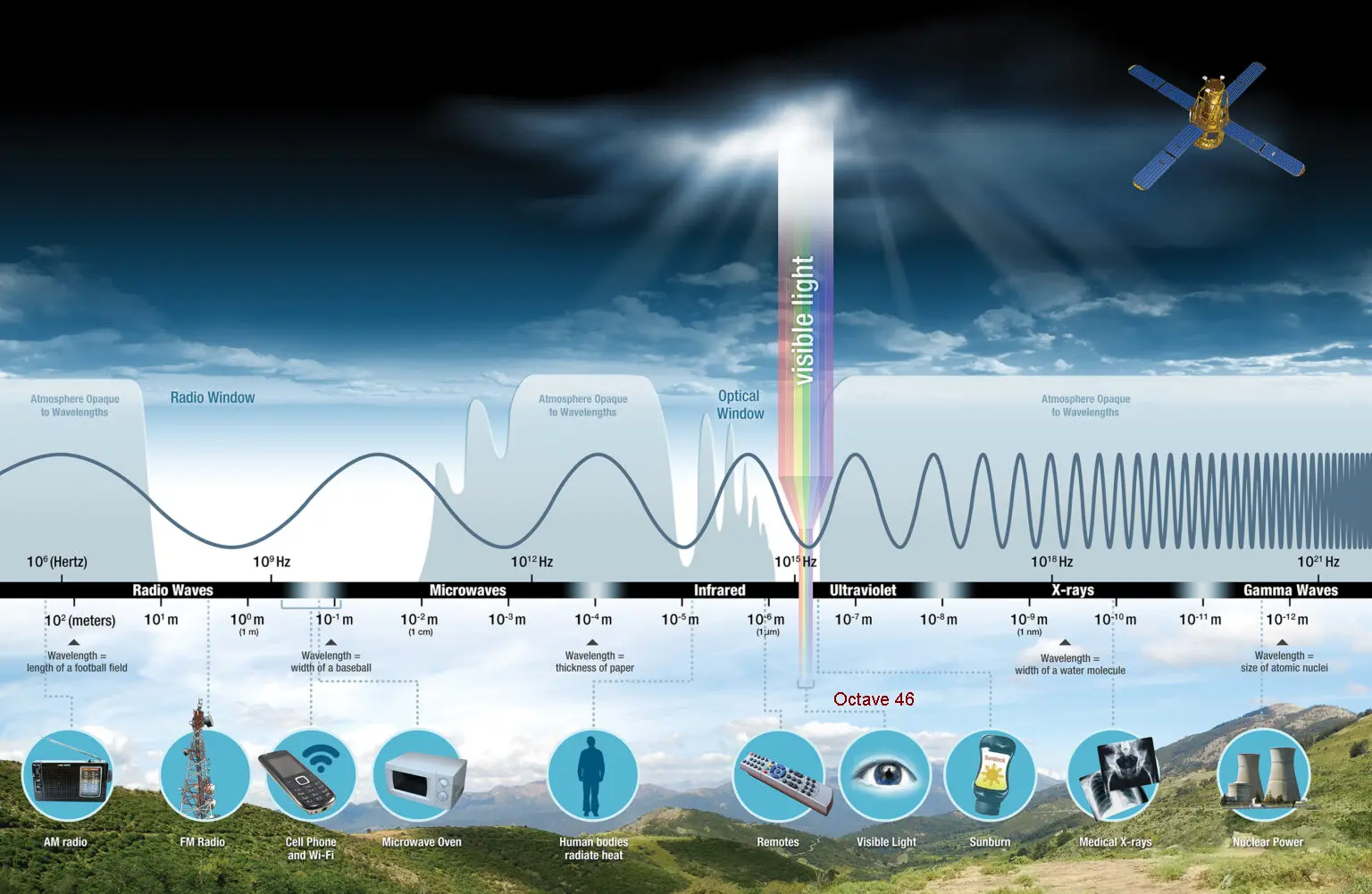
In the superuniverse of Orvonton there are one hundred octaves of wave energy. Of these one hundred groups of energy manifestations, sixty-four are wholly or partially recognized on Urantia. The sun’s rays constitute four octaves in the superuniverse scale, the visible rays embracing a single octave, number forty-six in this series. The ultraviolet group comes next, while ten octaves up are the X rays, followed by the gamma rays of radium. Thirty-two octaves above the visible light of the sun are the outer-space energy rays so frequently commingled with their associated highly energized minute particles of matter. Next downward from visible sunlight appear the infrared rays, and thirty octaves below are the radio transmission group. [ref]
This particular passage seemed relatively innocous at first blush. When I initially ran across it, it was probably in study group and I don't think we dwelled upon it. From what I remember so long ago, is that it didn't seem terribly important, especially since I knew from Physics days in both High School and College that visible light was a small piece of the electromagnetic spectrum and from playing the trombone that octaves were related to music scales. But it was nice to know that since Urantia is in the local universe of Nebadon that resides in the superuniverse of Orvonton, and we were learning how the revelation was informing us how God's universe of universes was constructed (mostly top-down), there was at least a subliminal connection to the apparent fact that the revelation was concerned with informing us of octaves and in fact, Urantia was apparently limited to 100 of them. It nagged at me for some time that maybe they were telling us in their own unique revelatory-constrained way that bottom up was important too. Owing to the enormity of the expanded cosmology I was synthesizing along the way, I remember hoping to squirrel-away this fact for a rainy day of reflection. Well, that day has come roughly 45 years later!
At this stage of my understanding of the sweep of the revelation, in reflecting upon this brief passage (there are only two paragraphs where octaves are mentioned) it appears that octaves are ubiquitous. The structure of octaves is potentially one of those fundamental universal archetypes that the revelation has inserted - almost clinically - to open doors providing a GPS orientation to a much deeper augury of how God might (or might not) have instructed the Architects of the Master Universe to put their "spin" on effecting His purposes. Sometimes I wish the revelatory rules of disclosure didn't have the constraints of premature knowledge; nonetheless, the aditional scaffolding the revelation provides does push one's insight envelope to imagine how some of the disclosures (revelations) are connected - if you allow cosmic mind to respond.
That said, I write this short essay to exapnd upon what I have unearthed about the concept of octaves and where and how I see some of its potential connections to not only what science knows today at the end of the first quarter of the 21st century, but also what connections and associations it might have to other aspect of the revelation. For example, If morontia "substance" exists on Urantia (viz. the soul and Jesus' resurrection), then might morontia matter have a relevancy to the higher end of the spectrum? Where exactly does matter begin to show up? What about spirit and mind? The revelation talks of mind energy. While it doesn't seem like mind is electromagnetic energy as matter, we are revealed mind "... is not inherent in energy; energy is receptive and responsive to mind; mind can be superimposed upon energy, but consciousness is not inherent in the purely material level."[ref]
In reflecting on what I have unearthed about the concept of octaves, it is becoming increasingly clear that their presence extends far beyond the realm of musical intervals or even the electromagnetic spectrum as currently understood. The very structure of reality—across classical, relativistic, and quantum domains—appears to be shaped by recurring patterns of harmonic doubling, resonance, and frequency scaling. A harmonic is a wave that vibrates at a whole-number multiple of a fundamental frequency. It’s like adding extra layers of motion that fit perfectly with the original wave.

To visualize harmonic doubling imagine you’re holding a jump rope with a friend. If you shake it up and down once per second, you’ll see a simple wave moving back and forth. That’s like the fundamental frequency—the most basic vibration. Now, if you shake the rope twice as fast, something interesting happens: you see two waves instead of one. You’ve just created a harmonic—a vibration that is a frequency multiple of the original one!
Wth respect to resonance, in simple terms resonance happens when something vibrates at just the right frequency to make another object start vibrating in sympathy, too—often with an outcome of vastly increased power. When frequencies match up, things vibrate together in harmony—whether it’s sound waves, swings, buildings in an earthquake or even minds during a groupthink or prayer exercise. When frequencies match up, things vibrate together in harmony; outcomes can be destructive or constructive. Thus resonance occurs when vibrations align so perfectly that they amplify each other, creating an effect greater than just adding them together. A single guitar string makes only a faint sound, but when resonance occurs between the strings and the guitar’s body, the whole instrument produces a deep, full sound far louder and richer than the sum of individual vibrations. If soldiers march in step on a bridge, their synchronized footsteps can match the natural frequency of the bridge, causing it to resonate. Over time, small vibrations build up into huge movements, which can lead to structural failure—this is why soldiers break step when crossing bridges. Just like mechanical waves amplifying each other, resonance between minds can create breakthroughs that transcend what each person could achieve alone. The Urantia Book hints at mindal uplift—the idea that higher consciousness is strengthened through unity and attunement with divine truth. A Melchizedek makes this interesting statement:
110:1.6 (1204.4) Today you are passing through the period of the courtship of your Adjuster; and if you only prove faithful to the trust reposed in you by the divine spirit who seeks your mind and soul in eternal union, there will eventually ensue that morontia oneness, that supernal harmony, that cosmic co-ordination, that divine attunement, that celestial fusion, that never-ending blending of identity, that oneness of being which is so perfect and final that even the most experienced personalities can never segregate or recognize as separate identities the fusion partners—mortal man and divine Adjuster.
To round out this triad, frequency scaling is the process of increasing or decreasing the frequency of something while keeping its overall pattern the same. When you change the speed of a song, the whole tune shifts up or down in pitch. While radio waves, microwaves, and X-rays are all electromagnetic energy, just at different frequencies, scientists can "scale" frequencies up or down to create different technologies like Wi-Fi, cell signals, or medical imaging. It's like adjusting the speed of a bike—you’re still pedaling, but at a different pace!
This leads to an intriguing thought: Does the concept of octaves offer a key to unifying physics? Classical mechanics, relativity, and quantum physics each describe different domains of reality, yet they remain largely disconnected in contemporary theory. The revelation that the superuniverse of Orvonton contains one hundred octaves of wave energy—of which only sixty-four were currently recognized on Urantia in 1935—suggests that our scientific models may still be missing a substantial part of the cosmic equation. If the structure of energy follows harmonic scaling laws extending beyond what is currently measurable, then octaves may represent a bridge between these seemingly disparate fields of physics, a stepping stone toward the long-sought Theory of Everything.
And yet, as I continue to explore these ideas, I must acknowledge a necessary correction regarding a widely circulated Tesla quotation I included earlier under the main image. Nikola Tesla, as far as historical records indicate, never explicitly stated that the key to understanding the universe is "energy, frequency, and vibration" in those exact words. However, the spirit of the quote remains profoundly relevant to this discussion. Tesla’s work was deeply enmeshed in the exploration of resonance, harmonics, and the interaction of waves at different scales. He understood that frequencies govern physical interactions in ways that extend beyond simple electrical engineering and into the grand architecture of nature itself. Perhaps, in a way, the misattribution serves as an accidental revelation—highlighting a truth that Tesla himself might have embraced had he the full breadth of today’s knowledge at his disposal.
This brings us to the true subject of our inquiry: the nature of octaves, not merely as they relate to sound or electromagnetism, but as a cosmic principle underlying resonance, harmonics, and the transmission of energy at all levels of reality. Before we can grasp their implications in science and revelation, we must first establish what an octave truly is—not only in music but in physics, cosmology, and beyond.
Singers reach higher (or lower) pitches when their larynx and vocal cords produce sound waves at double (or half) the frequency of a given note. For example, the note A on a piano vibrates at 440 Hz, and one octave higher, it vibrates at 880 Hz—doubling the frequency. When we say 440 Hz, we mean the sound wave is oscillating 440 times per second. The faster the vibration, the higher the pitch; the slower the vibration, the lower the pitch. This mathematical doubling is not just a feature of sound—it appears throughout nature. In fact, this doubling (or halving) pattern may be a fundamental organizing principle of the universe. Perhaps that’s why the revelators drew our attention to the significance of octaves.
Figure 1 below shows what one cycle of a sound wave looks like when plotted on an X-Y graph and illustrated as a shaded gradient to the right. The top panel shows a single sound wave of the most simple form, a sine wave. There is one compression (high pressure) and one rarefaction (low pressure) in each “cycle.”3 The lower panel shows a sound at double the freqency of the upper. Note that there are two compressions and two rarefactions in the lower panel in the same period of time. The gradient graph is provided to see the compacting or compression of the molecules as the energy wave passes through the medium; the matter in the medium is not moving forward but rather oscillating locally. The compression of the local particles of matter (medium) is depicted as the darker column of the gradient. Again, the energy wave during a mechanical wave event somehow is passing through the medium. During an earthquake event, the earth itself is compacting and expanding as the energy passes through as a wave. You can see this in a slinky; the coils remain intact, but the energy created by a pushing/pulling on the end of the slinky can be seen as moving linearly through the coils; the coils are responding essentially in place to the energy wave. Waves moving to a beach function the same way; it's not the water moving, but the energy as a wave. The particles don’t travel with the wave; they merely oscillate locally in response to energy passing through.
To reiterate, at any fixed position along a slinky, a sound wave, or ocean wave, a continuous oscillation of compression and rarefaction (or peaks and troughs) occurs over time as the wave passes through that location. If a surfer stays in one spot, she will move up and down as waves pass by, experiencing a continuous cycle of crests and troughs. If you hold a slinky and create an energy wave by pushing the slinky creating a longitudinal wave, every coil oscillates back and forth in place, but the wave moves along the length of the slinky. It almost looks like an optical illusion.
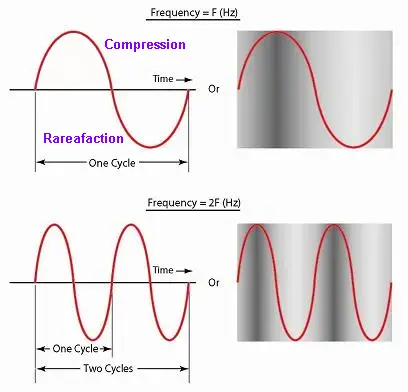
What is sometimes difficult to visualize is why the peak and trough (compression and rarefaction respectively) can express both the compaction and expansion of particles (air molecules) in what seems to be congruent areas, since the curve at the top and bottom loops are the same size. Figure 2 displays how the sound wave (think of the slinky again) leaves a speaker and travels to the ear. Energy always travels forward linearly as a wave. When it emanates from the speaker it is the energy that moves, not the medium, the matter.
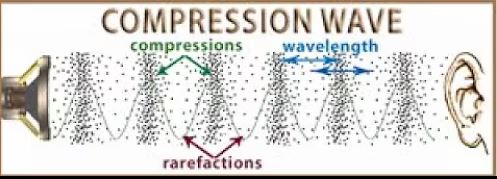
This concept of compression and rarefaction in mechanical waves provides a glimpse into the broader, underlying patterns that govern not only acoustics but also a wide range of natural phenomena. The way energy propagates through a medium—whether as sound waves in air, seismic waves in the earth, or even water waves moving toward the shore—follows a rhythmic, structured behavior. Yet, these mechanical waveforms represent only one layer of a much deeper principle at work in the universe: the systematic doubling of frequency, a mathematical progression that appears far beyond the realm of sound alone.
It turns out that the same kind of structured frequency relationships seen in sound waves—specifically, the harmonic doubling that creates musical octaves—can be observed in domains as diverse as atomic structures, electromagnetic radiation, and even genetic coding. This essay now turns toward exploring how octaves, once considered purely a musical phenomenon, might in fact be a fundamental organizing principle woven into the very fabric of reality.
Thus, with respect to sound waves the sequence of frequencies between the note A and the next one that pitches at double the frequency is called an octave. A standard piano has 88 keys, which covers 7 full octaves plus a minor third (from A0 to C8). Some extended pianos, like those made by Bösendorfer, can have more than 88 keys, adding extra bass notes and slightly extending the range. Most musical instruments do not have the capability of playing 7 octaves however. For example, a violin can reach 4 octaves and a Tuba can extend to 3 octaves.
Let's explore briefly how this came about by taking at a snapshot into the history of how mankind discovered this phenomena.
It took until the early 17th century that Marin Mersenne (1588–1648), a French mathematician and music theorist calculated the frequency of musical notes based on string length, tension, and mass. Mersenne estimated that the note A (modern A4) vibrated at about 270 Hz. This was not exactly 440 Hz (modern tuning), because tuning standards varied across Europe. Later, Joseph Sauveur (1653–1716) refined these calculations, and the standard for A4 = 440 Hz was only officially adopted in the 20th century (1936, International Standardization).
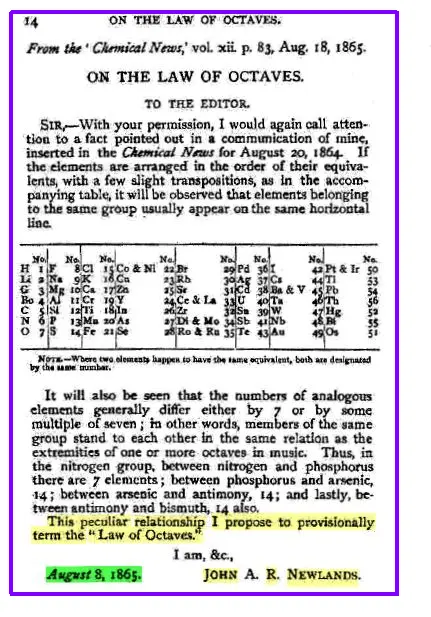
The big leap came in the mid-19th century when chemist John Newlands noticed that when elements were arranged in increasing atomic weight, every eighth element had similar chemical properties, just like an octave in music. When Newlands proposed his "Law of Octaves" in 1865, there were only 56 known elements (see Figures 3&4). His periodic table was based on arranging elements in order of increasing atomic weight, and he noticed that every eighth element seemed to have similar chemical properties, much like musical octaves. At the time, the periodic table was incomplete, as several elements had yet to be discovered. Noble gases (He, Ne, Ar, etc.) were unknown, and many transition metals and rare earth elements had not yet been isolated. He observed that the eighth element in each sequence had properties similar to the first, similar to notes in a musical scale. This early observation laid the groundwork for Dmitri Mendeleev’s Periodic Table, where elements repeat in groups due to electron configuration. Bottom line, The periodic table is a balance of sequential atomic structures (left to right) and repeating chemical behavior (top to bottom), with some octave-like patterns embedded within. So, in reflecting on just this non-sound complex set of patterns one should reasonably reflect that there is something very interesting in beginning to speculate at octaves as potentialy fundamental to the universe.
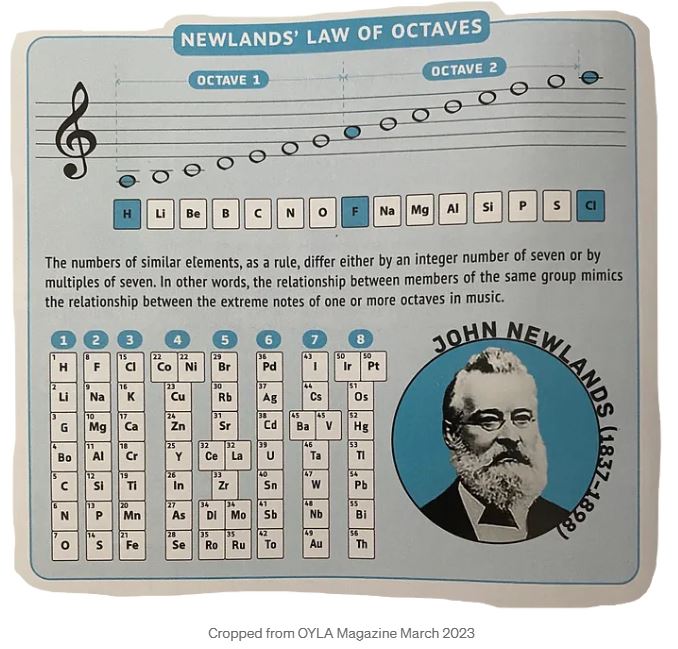
Today octave relationships show up in biology, chemistry, and even cosmology. The way atoms absorb and emit energy follows patterns of frequency that mimic octaves. The arrangement of elements in the periodic table is also influenced by repeating patterns of electron configurations; the periodic table may just have octaves within octaves.
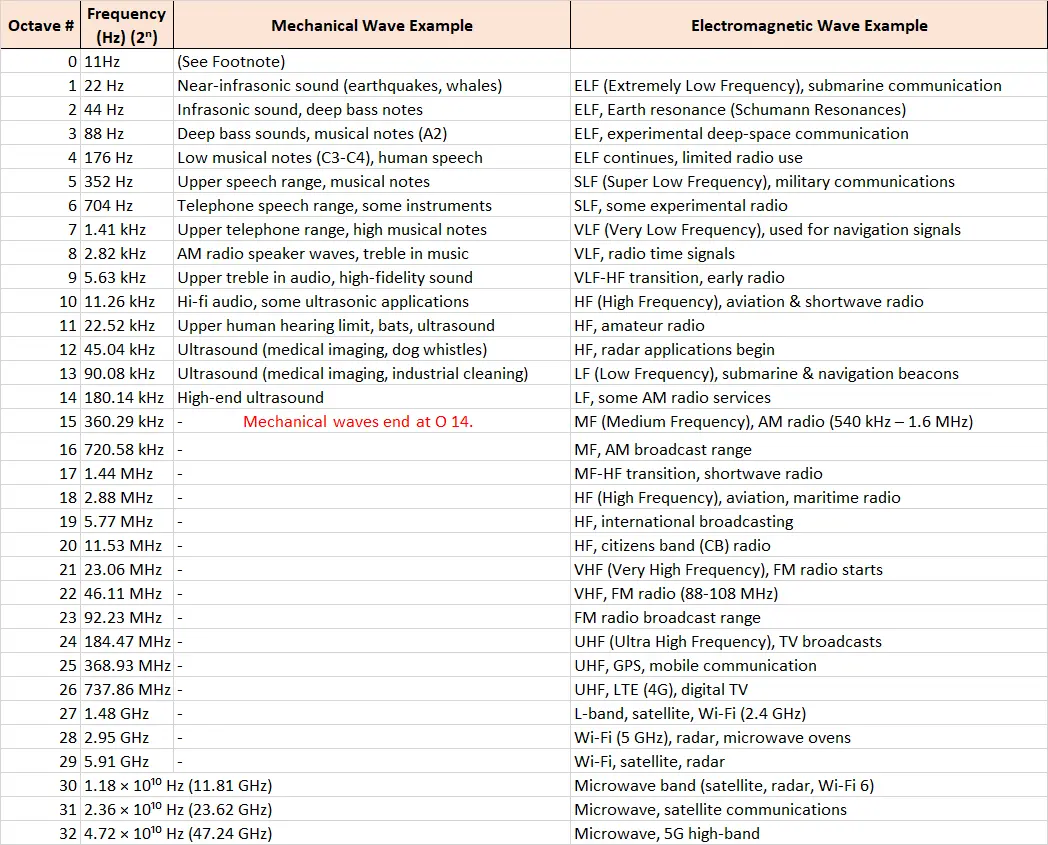
The entire electromagnetic spectrum, which includes everything from radio waves to visible light and X-rays, is also structured in octaves. Different categories of electromagnetic waves—like radio waves, infrared, visible light, and gamma rays—exist in bands where each successive section represents a doubling of frequency. Scientists use this understanding to study the universe, from identifying the elements in distant stars to designing technologies like Wi-Fi, medical imaging, and even cell phones. Here's a short table that provides the first 32 octaves. Notice that mechanical waves only exist up to Octave 14. This should lead to at least few questions: Why do mechanical waves end at octave 14? Are mechanical and electromagnetic waves differnt in degree or kind?
For example, when light from distant stars passes through a prism or spectrograph, it splits into a spectrum of colors. When light from distant stars passes through a prism or spectrograph, it splits into a spectrum of colors. Each element absorbs and emits light at specific frequencies, forming unique spectral lines—like a "barcode" for each element. Scientists compare these spectral lines with known elements on Earth to determine the chemical composition of stars and galaxies.
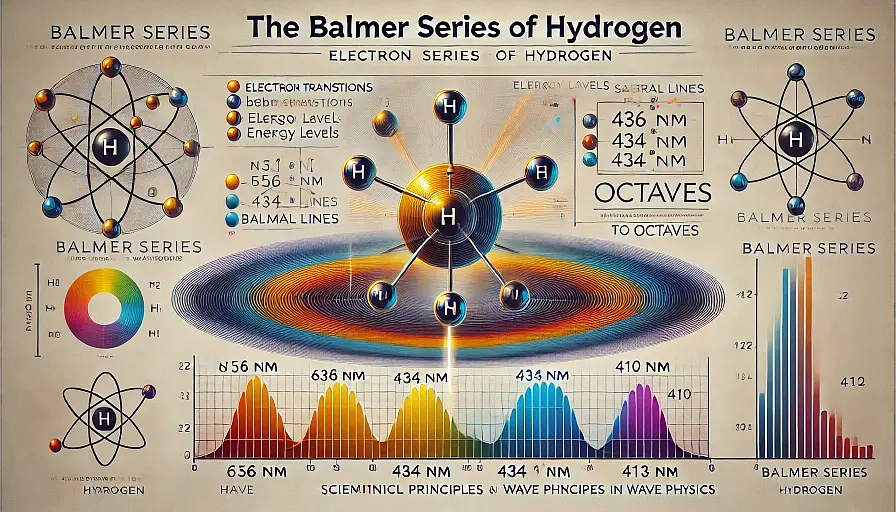
Just as octaves organize musical notes, the universe organizes light waves into predictable energy patterns. By applying this concept in spectroscopy, science decodes the elements of distant stars, galaxies, and even the origins of the universe. Electrons in an atom jump between energy levels by absorbing or emitting light at specific frequencies. These frequencies are related mathematically, often forming patterns of octaves. For example, the Balmer Series of hydrogen shows a harmonic-like pattern in the visible spectrum (red, blue-green, violet lines). Just as a piano has fixed keys producing specific notes, atoms have fixed energy transitions that correspond to precise wavelengths of light. This creates a "fingerprint" of spectral lines, which scientists compare to known elements to identify materials in stars. Some elements emit harmonically related spectral lines—meaning they follow a frequency-doubling rule.
Let's examine the Balmer series a bit deeper. The Balmer series of hydrogen shows a sequence of spectral lines that follow a harmonic pattern.
Johann Jakob Balmer (1825–1898) was a Swiss mathematician and schoolteacher who made a groundbreaking discovery about the harmonics in the hydrogen atom—even before quantum mechanics existed! Balmer spent most of his career teaching mathematics at a secondary school in Basel, Switzerland. He was known for his love of numbers and patterns, often encouraging students to look for mathematical relationships in nature. Though he was not a professional physicist, he was fascinated by wave phenomena and harmonics. By analyzing data from spectroscopy experiments, he found a simple harmonic-like formula that predicted the wavelengths of visible hydrogen emission lines. His formula accurately described the spectral lines of hydrogen in the visible range, much like how harmonics describe overtones in sound waves. Balmer’s formula suggested that hydrogen’s spectral lines followed a harmonic structure, much like musical octaves and overtones. Later, Niels Bohr (1913) used Balmer’s insights to develop quantum mechanics, proving that electrons move in quantized orbits that follow harmonic principles. The Balmer series was the first hint that atoms had a structured, harmonic energy system—just like music! Johann Balmer was a humble teacher who saw the music of the universe before anyone else did.
Balmer’s discovery of the harmonic series in the hydrogen atom was not just a triumph of mathematics; it was a testament to the power of personal insight. He did not rely on an epochal revelation—no grand cosmic event dictated his findings. Instead, through persistent inquiry and a disciplined mind, he uncovered a fundamental truth about the universe. His work reminds us that knowledge is not always granted in dramatic flashes of divine revelation; sometimes, it emerges from the quiet, courageous process of independent thinking, the same kind that Jesus sought to cultivate in his apostles. When Jesus asked, “But who do you say that I am?” there was a moment of hesitation before Simon Peter, moved by personal revelation, boldly declared, “You are the Deliverer, the Son of the living God.” Jesus affirmed that this insight was not learned from human teaching but revealed by the Father—a truth unveiled to the soul ready to receive it. Peter’s response was not merely an acknowledgment of faith; it was a reflection of his openness to cosmic reality, a willingness to think beyond the conventional wisdom of his time.
As the Universal Censor warns in 16:6.9 (192.5), “It is sad to record that so few persons on Urantia take delight in cultivating these qualities of courageous and independent cosmic thinking.” Epochal revelation serves to seed the mind with enhanced concepts of cosmic consciousness, much like Jesus’ probing question to the apostles stirred their awareness of a greater truth. Such revelation does not hand knowledge to passive minds—it beckons those willing to think deeply, to inquire boldly, and to entertain the profound harmonics of the universe. Balmer, though he lacked any divine revelation of atomic structure, had the presence of mind to ask deeper questions, to search for hidden patterns, and in doing so, he glimpsed the fundamental harmonics of reality. His example affirms that while epochal revelation shapes the destiny of civilizations, it is personal revelation—the courage to ask, to seek, and to trust in the process of discovery—that brings the grand truths of the cosmos within reach.
This mathematical doubling is a fundamental principle in how we perceive sound, and it’s not just a coincidence—it’s a law of nature; and that may be an understatement! What should be interesting to all of us, is that until the late 19th century, all that was known about the "octave" concept, was how mechanical waves operate. A mechanical wave is a wave that requires a medium (such as air, water, or solid matter) to travel through. These waves transfer energy by causing oscillations or vibrations of particles within the medium. So, guitar strings move molecules of air and earthquakes produce seismic waves that move Urantia's solid materials (rock, soil, crust, mantle). Yet, this doubling concept extends way beyond what is commonly thought of as solid matter. What is interesting when one develops a table of energy frequencies, is there exist equivalent electromagnetic frequencies from octave #1 to octave #14. Physicists in the late 19th and early 20th century discovered that light, radio waves, and X-rays also follow patterns of frequency doubling. This is identified and designated the elecromagnetic spectrum. Electromagnetic waves (like radio waves, light, and X-rays) do not need a medium and travel through space. Electromagnetic waves exist at all frequencies but have different applications across the spectrum.
From the double helix of DNA, to electron shells in atoms, to cosmic waves rippling through the early universe, octave-like relationships are now becoming increasingly recognized as ubiquitous in nature. Whether in biology, chemistry, or cosmology, these repeating, harmonic structures[ref] suggest that octave principles—once thought to be exclusive to music—may be a universal organizing principle in the cosmos. So, To put a capstone on why understanding octaves is important to using the revelation to gain insights for progressive growth and development of society, take DNA as an example.
Recent research has unveiled intriguing patterns even within DNA sequences that echo the concept of octaves found in music and other natural phenomena. In 2013, Jean-Claude Perez[ref] analyzed the human genome's single-stranded DNA sequence and discovered a notable partitioning among the 64 codons—the triplet sequences of nucleotides that code for amino acids. He observed a sharp distinction between the first 56 codons and the last 8, suggesting a hierarchical organization into eight groups, or "octaves," each containing eight codons. This finding implies that the genetic code is structured in a manner reminiscent of musical or electronic octaves, reflecting a deep numerical harmony within our DNA.
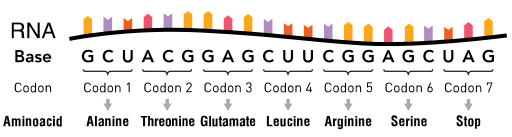
Further studies have gone so far as to have found some interesting associations and deeper nature-aspects of this intersection between genetics and music. For instance, researchers have converted amino acid sequences into musical notes to reveal auditory patterns, making genomic sequences more approachable and highlighting the inherent musicality within genetic coding. Scientists have converted genome-encoded protein sequences into musical note analogues to reveal auditory patter. Seyed Hossein Khatami[ref] derived a reduced range of 13 base notes by pairing similar amino acids and distinguishing them using variations of three-note chords and codon distributions to dictate rhythm. In an amazing leap of insight, this conversion, or mapping if you will, will help make genomic coding sequences more approachable for the general public, young children, and vision-impaired scientists.
These insights suggest that the principle of octaves—a pattern of doubling and repetition—extends beyond acoustics and chemistry, permeating even the very essence of biological life. Such recurring patterns underscore the possibility that octaves are a fundamental organizational principle in the universe, manifesting across diverse domains from sound waves to the sequences that define living organisms.
Conclusion: Resonance and the Supreme Pathway
If Tesla was right—if resonance is the key to understanding the universe—then it follows that resonance may also be the key to understanding God's will. Across all known domains of existence, from mechanical waves in a simple slinky to the structured harmonics of the electromagnetic spectrum, we see that when frequencies align, energy transfers effortlessly. Resonance amplifies power, reduces resistance, and unites disparate elements into a greater, harmonic whole. If this principle holds in the physical world, might it not also be true in the spiritual? Could it be that spiritual progression is, at its core, a process of achieving resonance with the divine?
The Urantia revelation hints at exactly this. Jesus, in his human life on Urantia, achieved such complete harmony with his Thought Adjuster that it personalized—one of the most extraordinary revelations about the relationship between God and man. He lived not just in obedience to God's will, but in resonance with it, allowing divine energy to move through him as effortlessly as a tuning fork set to vibrate at its fundamental frequency. In him, cosmic truth was no longer something to be grasped—it simply was. He became the living example of how a mortal mind can ascend through the psychic circles, transcend the constraints of evolutionary mind, and become one with the flow of divine purpose.
If resonance is fundamental to physical reality, it is equally fundamental to mind and spirit. The adjutant mind spirits, the cosmic mind, and the evolving Supreme all point toward a grand symphony of being, where every advancing personality is learning to vibrate in accordance with a deeper, universal truth. It may be that the path of spiritual growth—traversing the cosmic circles, discovering divine values, aligning with truth, beauty, and goodness—is a gradual attunement process. The Supreme Being itself, we are told, is growing as a result of the experiences of all evolving personalities. Could it be that, as individuals, we are learning to resonate not only with God but also with the Supreme? That our progression is not just an individual ascent, but a collective harmonization with the totality of evolving reality?
This is the frontier of revelation that remains largely unexplored. If truth has a frequency, if the universe sings at the level of energy and at the level of mind, then perhaps spiritual enlightenment is simply the process of learning to hear that song—to match its wavelength and let its currents carry us ever closer to the Divine Source. It is no wonder that when we encounter a deep and profound reality, we often say that it “rings true.” Perhaps this is more than a metaphor. Perhaps when we encounter cosmic truth, something within us—our soul, our higher mind, our indwelling Adjuster—begins to vibrate in sympathy.
This is why, as I write these essays, I hope readers might resonate with what I call "truth bells." These are not just intellectual recognitions or philosophical musings, but moments when the soul knows—beyond logic, beyond analysis—that it has touched something real. That the frequencies of spirit and mind have, even for a moment, aligned with the great harmonic of truth itself.
If octaves, resonance, and harmonics are more than just mathematical abstractions, if they are a universal law that extends beyond the material into the spiritual, then the implications are staggering. It suggests that, just as a violin string plucked in one room can cause another to vibrate at a distance, our spiritual actions may reverberate across space and time—affecting not just ourselves, but the very fabric of the Supreme.
If that is the case, then perhaps the next great step for humanity is not merely the conquest of physical forces, nor the mastery of intellect alone, but the pursuit of a harmonic alignment with divine purpose itself. And if so, the journey ahead will not just be one of knowledge—but of resonance.
// Bob Debold 1st draft March 6, 2025