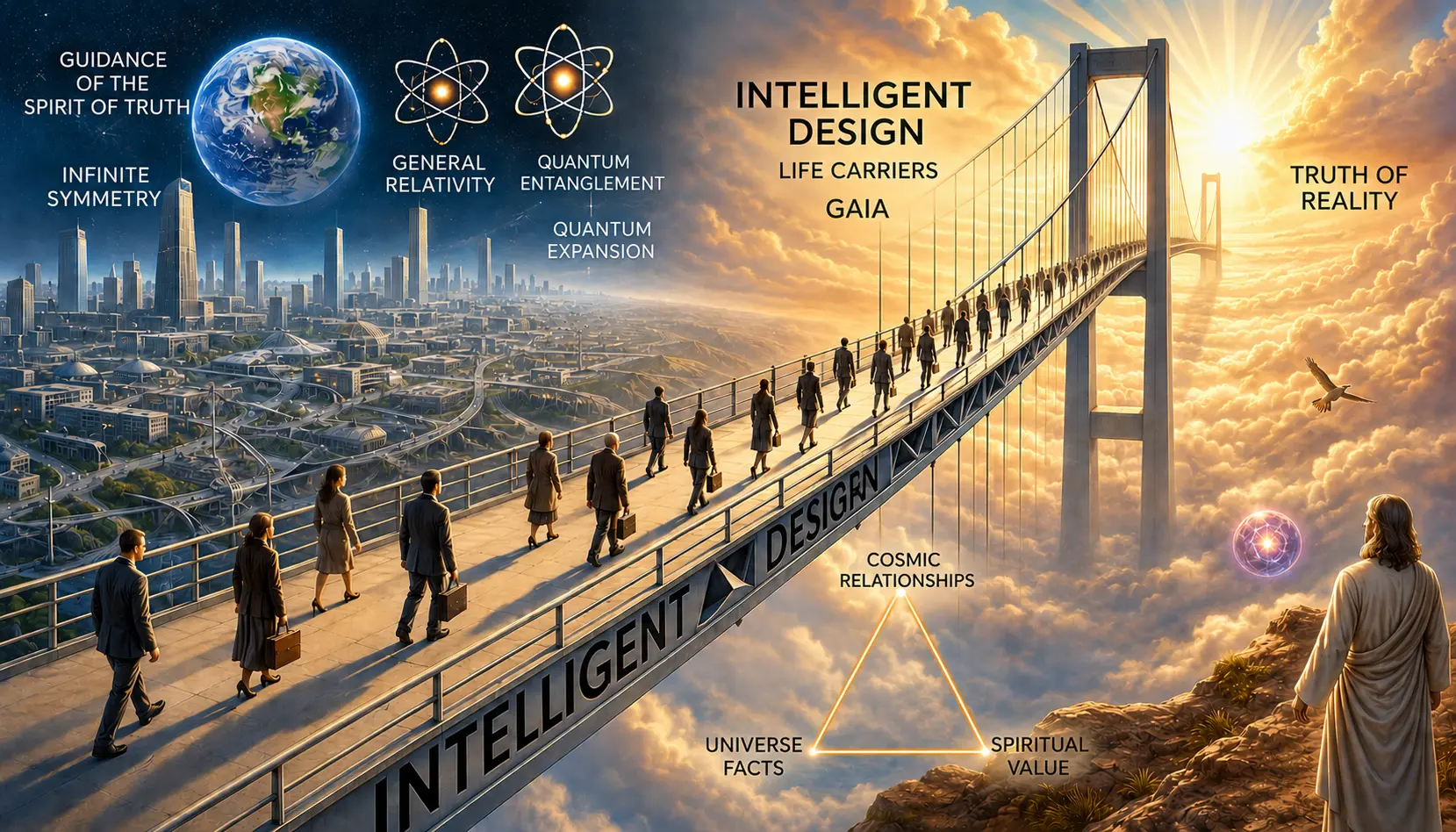
The COSAR Concept as The Truth of Reality
With that as a backdrop, I believe JJ’s development of a concept he calls COSAR (the coordination of science and religion) is based upon this powerful statement made by a Melchizedek of Nebadon in paper 103 of the Urantia Book:
The truth—an understanding of cosmic relationships, universe facts, and spiritual values—can best be had through the ministry of the Spirit of Truth and can best be criticized by revelation. But revelation originates neither a science nor a religion; its function is to co-ordinate both science and religion with the truth of reality. Always, in the absence of revelation or in the failure to accept or grasp it, has mortal man resorted to his futile gesture of metaphysics, that being the only human substitute for the revelation of truth or for the mota of morontia personality. 103:7.8 (1138.6).
In other words, the best way to understand the truth of reality—how everything in the universe is connected, what’s really real, and what’s truly valuable in life—is through the guidance of the Spirit of Truth, which helps us see things as they truly are. Revelation (like spiritual insights given to humanity) is the best way to evaluate or criticize truth, but it doesn’t create science or religion. Instead, its job is to coordinate science and religion so they both work together to reveal a deeper and truer understanding of reality. Without revelation—or if people don’t accept or understand it—humans tend to turn to metaphysics (deep philosophical thinking about life and existence) as their only substitute. But this human approach falls short compared to the higher truths revealed by spiritual insight or the advanced understanding of reality that comes with "mota"—a kind of wisdom tied to the next level of existence.
Let me summarize two examples of metaphysical philosophies that have historically created deep divisions or misunderstandings among groups of individuals:
Dualism vs. Monism - Dualism (such as that proposed by René Descartes) asserts a fundamental division between mind and matter (or soul and body). This has led to debates about whether consciousness exists independently of the physical brain. Many religious groups align with dualistic views because they support the idea of a soul separate from the body. Monism, on the other hand, argues that everything is derived from a single substance, whether it's material (Materialism), mindal (panpsychism), or spiritual (Idealism). For instance, materialistic monism claims consciousness is just a product of physical processes, leading to tension with spiritual or religious perspectives that view consciousness as transcendent. These debates have contributed to divisions between scientific materialists and religious thinkers.
The Urantia Book integrates truth elements of both dualism and monism, offering a more nuanced and unified explanation of reality that can help one to transcend the apparent contradictions between these philosophical positions. Instead of fully siding with one or the other, the Urantia revelation reveals a cosmic framework that acknowledges the validity of both perspectives while placing them in a larger, integrated spiritual and material reality. Dualism as a singular perception of reality is conceived crudely because human experience generally observes a tension between the physical and spiritual aspects of existence.
With respect to Dualism, the book clearly recognizes the existence of both physical and spiritual realities, asserting that these realms are distinct but interconnected. Matter represents the finite, observable universe, while spirit represents the eternal and transcendent aspects of reality. Mind serves as the bridge between spirit and matter; it ministers to both spirit and matter. The mind enables mortal beings to grasp spiritual truths while functioning within a material body. This superficial dualistic relationship is central to human experience, as we mortals are spiritually connected beings inhabiting physical forms. The Urantia Book acknowledges dualistic thinking as a developmental stage in human philosophy, but it does not suggest that dualism exists as a permanent or ultimate reality. Instead, the book promotes an evolutionary understanding in which all perceived divisions are ultimately reconciled in unity.
In fact, This perspective renders dualism irrelevant because everything, from the physical to the spiritual, exists as an integrated whole, progressing toward cosmic unity.
The human mind does not create real values; human experience does not yield universe insight. Concerning insight, the recognition of moral values and the discernment of spiritual meanings, all that the human mind can do is to discover, recognize, interpret, and choose. 196:3.10 (2094.9)
While the revelators acknowledges dualism, they describe a monistic perspective by affirming the unity of all reality under God. And they go even further by defining Deity as various levels of unification. For example, we learn that with primitive man, even polytheism is a relative unification of the evolving concept of Deity; polytheism is monotheism in the making. Sooner or later, God is destined to be comprehended as the reality of values, the substance of meanings, and the life of truth. That said, God is presented as the ultimate source and center of all things—spiritual, material, and intellectual. All distinctions in reality (matter, mind, and spirit) ultimately originate from and are unified within God’s infinite nature. The revelation teaches that the entire universe is part of a divine, evolutionary process aimed at achieving unity under the Supreme Being. This suggests that all things—material and spiritual—are part of one interconnected, purposeful reality.
GOD is unity. Deity is universally co-ordinated. The universe of universes is one vast integrated mechanism which is absolutely controlled by one infinite mind. The physical, intellectual, and spiritual domains of universal creation are divinely correlated. The perfect and imperfect are truly interrelated, and therefore may the finite evolutionary creature ascend to Paradise in obedience to the Universal Father’s mandate: “Be you perfect, even as I am perfect.” 56:0.1 (637.1)
All religious philosophy, sooner or later, arrives at the concept of unified universe rule, of one God. Universe causes cannot be lower than universe effects. The source of the streams of universe life and of the cosmic mind must be above the levels of their manifestation. The human mind cannot be consistently explained in terms of the lower orders of existence. Man’s mind can be truly comprehended only by recognizing the reality of higher orders of thought and purposive will. Man as a moral being is inexplicable unless the reality of the Universal Father is acknowledged. 3:6.3 (53.1)
The second is Materialism vs. Idealism. As with Dualism and Monism, the Urantia Book integrates materialism and idealism by offering a combined and expanded explanation of reality. Rather than promoting one as the sole truth, it presents a multi-faceted view in which both material and spiritual dimensions are essential, interdependent aspects of a unified cosmic reality.
Both these divisions—mind-body dualism and materialism vs. idealism—have fueled misunderstandings between scientists, philosophers, and theologians, creating intellectual and cultural rifts that persist to this day.
The Urantia Book acknowledges the material world as real, important, and governed by natural laws. It emphasizes that science, rooted in materialism, provides humanity with essential knowledge about the physical universe and its workings. The material cosmos is described as the "arena" in which life evolves and in which spiritual growth occurs. Materialism is not dismissed but seen as incomplete when it excludes or denies the spiritual dimension.
Science is the source of facts, and mind cannot operate without facts. They are the building blocks in the construction of wisdom which are cemented together by life experience. Man can find the love of God without facts, and man can discover the laws of God without love, but man can never begin to appreciate the infinite symmetry, the supernal harmony, the exquisite repleteness of the all-inclusive nature of the First Source and Center until he has found divine law and divine love and has experientially unified these in his own evolving cosmic philosophy. 111:6.6 (1222.5)
The expansion of material knowledge permits a greater intellectual appreciation of the meanings of ideas and the values of ideals. A human being can find truth in his inner experience, but he needs a clear knowledge of facts to apply his personal discovery of truth to the ruthlessly practical demands of everyday life. 111:6.7 (1222.6)
The Urantia Book simultaneously upholds idealism, asserting that ultimate reality is spiritual. Spiritual values, meanings, and purposes are the foundation of the universe, with material reality existing as an expression of spiritual origin and governance. Idealism, or the focus on mind and spirit as central to reality, is validated as a higher perspective that encompasses the material world without discarding it.
Mankind is slow to perceive that, in all that is personal, matter is the skeleton of morontia, and that both are the reflected shadow of enduring spirit reality. How long before you will regard time as the moving image of eternity and space as the fleeting shadow of Paradise realities? 189:1.3 (2021.2)
The Urantia Book presents reality as a hierarchy of levels—material, intellectual, and spiritual—unified under the will of the Universal Father. Each level contributes to the whole, with materialism and idealism representing complementary perspectives. Matter and spirit are not separate or opposing forces but different manifestations of the same ultimate reality. Material things are described as "shadows" or reflections of higher spiritual realities. This view transcends materialism (which sees only matter) and idealism (which prioritizes mind/spirit) by affirming both as essential components of the universe.
In cosmic evolution matter becomes a philosophic shadow cast by mind in the presence of spirit luminosity of divine enlightenment, but this does not invalidate the reality of matter-energy. Mind, matter, and spirit are equally real, but they are not of equal value to personality in the attainment of divinity. Consciousness of divinity is a progressive spiritual experience 12:8.15 (140.11)
The mind plays a critical role in integrating material and spiritual realities. We humans are beings endowed with a derivative of cosmic mind that enables us to interpret material experiences in the light of spiritual insight, thereby achieving a fuller understanding of reality.
"Mind transmutes the values of spirit into the meanings of intellect; volition has power to bring the meanings of mind to fruitfulness in both the material and spiritual realms." (130:4.5)
The Urantia Book does not choose between materialism and idealism but integrates them into a cohesive cosmic worldview. It affirms the reality and importance of the material world while elevating the spiritual dimension as the ultimate foundation and purpose of existence. This synthesis invites reader-students to embrace a holistic approach to understanding reality—one that balances the discoveries of science with the revelations of spirit, leading to a more complete comprehension of the cosmos and humanity’s place within it.
This is the essence of COSAR as a truth of reality.At the end of the day, JJ Johnson’s concept of COSAR provides an inspiring and practical lens for exploring the harmonization of science and religion, a hallmark of the Urantia Book. This essay presented two examples that demonstrate how metaphysical confusions are harmonized by revelation. By integrating dualistic and monistic perspectives, as well as materialism and idealism under a spiritually oriented cosmic picture, the book offers a framework that transcends historical divisions and unites seemingly opposing philosophies. COSAR highlights how revelation coordinates these domains, offering deeper insights into truth, meaning, and value while providing pathways to spiritual growth. This synthesis not only bridges intellectual gaps but also nurtures the human spirit, enabling individuals to align their material experiences with transcendent spiritual realities. As humanity progresses, the principles of COSAR remain a guiding light for those seeking a unified understanding of the universe and their place within it. JJ’s dedication to this profound concept underscores the transformative potential of harmonizing science and religion in the pursuit of eternal truths.
I am grateful for my good friend and kindred spirit brother to have inspired me to reflect and consider the impact of how this simplified concept has significant value.
Bob Debold
Fairfax Virginia, January 2025