
MMT—Not Just a Theory, But the Reality Few Recognize
Author’s Note: Understanding MMT Wasn’t Instant ...
But Inevitable
This essay is written with the notion that Modern Monetary Theory (MMT) represents a Fourth Wave phenomenon, and so it rightfully earns a place on this website. It is hardly conventional thinking, however. I owe my introduction to this demonstrably true—but difficult-to-understand—concept to my sister, Eileen Debold-Avgerinos, who introduced it to me sometime in the early 1990s.
I must admit, even though I had completed Econ 101 and 102 courses during my master’s studies and had managed a cost center at Honeywell Federal Systems for over a decade, I didn’t “get it” right away. It may have taken years—possibly a full decade—before I could confidently say the phrase that turns heads: “Taxes don’t fund the government.”
Embracing that idea required not only conviction but also the ability to logically defend it. That took even longer. The first time I said it out loud to a colleague, he laughed heartily. Right then and there, I realized I had an uphill climb in explaining how the U.S. fiat monetary system actually works. But I accepted the challenge. I devoured the writings of L. Randall Wray, Warren Mosler, and Stephanie Kelton. Whenever I got stuck (which was often), Eileen came to the rescue.
Economics affects everyone. It’s like physics: you can’t avoid it. You know you should understand it, but the abstractions make it elusive. Economics doesn’t lend itself to everyday language—or to easy metaphors. It intersects with double-entry accounting (debits and credits), mathematical curves (like the Phillips curve), and often, philosophy. Let’s not forget its entanglement with markets and capitalism. History, too, plays a starring role. The U.S. had an inauspicious beginning to its monetary journey, and I point readers to Chapters 15 and 16 of G. Edward Griffin’s The Creature from Jekyll Island for an excellent account of the colonies’ early financial challenges. It hasn’t been smooth sailing since.
I’ve written this essay from the perspective of someone who initially struggled to grasp MMT—and who knows how steep that learning curve can be. If you’re not already deeply interested in economic theory, I hope this helps demystify a subject that often feels arcane and abstract. I've expanded on Mosler’s “Chore Cards” to offer a grounded analogy for how the Treasury, Federal Reserve, and banking system interact. I also explore the origin and speculative future of MMT.
If you're new to this concept, I encourage you to suspend disbelief and start with the podcast. What may seem counterintuitive at first might just redefine how you understand money—and power—in the modern age.
Fiat Currency: Operational Reality
odern Monetary Theory (MMT) is often dismissed as just that: a theory. An abstract, academic contrivance, too arcane for practical use and too counterintuitive for the average citizen - or even most economists to absorb. Its terminology alone feels like a barrier to entry. Terms like “vertical money,” “net financial assets,” or “sectoral balances” sound like secret code. But what most people don’t realize is this: MMT is not merely a theory. It describes the core operational realities of how the U.S. monetary system could function fully under a fiat currency regime, even though current policy continues to operate under many self-imposed constraints rooted in what is truly obsolete gold-standard thinking.
Many of MMT’s insights already describe how money actually moves through the U.S. financial system. The federal government’s ability to credit bank accounts without needing prior tax revenue or private borrowing and other aspects remain limited by outdated practices and political theater. For example, Congress still imposes a statutory debt ceiling, as if the federal government could run out of dollars it is legally empowered to create. This artificial constraint does not reflect a real financial limit, but rather a carryover from gold-standard era thinking, where money was tied to a physical commodity and borrowing carried real solvency risks.
Likewise, although MMT places full employment at the center of macroeconomic stability, mainstream policy continues to treat some level of unemployment as necessary to curb inflation. The result is a self-imposed theoretical ceiling where key MMT tools like a Job Guarantee or functional finance[ref] are acknowledged in academic circles but excluded from serious policy consideration. In that sense, MMT is both a mirror and a map: it reflects much of how the system already works, and it sketches the path toward how it could function more fully, if we chose to govern based on operational reality rather than conventional beliefs.
One of the most distinctive features of MMT is its proposal for a federal Job Guarantee (JG). Rather than allowing people to fall into unemployment during economic downturns, the government would offer a standing job at a living wage to anyone ready and willing to work. This acts as a buffer stock of employed labor instead of unemployed people — stabilizing incomes, preserving skills, and anchoring prices. When the private sector expands again, workers can shift back to higher-paying private jobs. The Job Guarantee doesn’t create inflation by itself; in fact, it’s designed as an automatic stabilizer for both the economy and the labor market.
In this framework, public purpose spending and full employment aren’t conflicting goals — they’re two sides of the same coin. And unlike welfare programs or unemployment insurance, a Job Guarantee promotes both dignity and productivity, while helping the economy stay balanced and responsive.
The goal here isn’t to promote a political agenda, but to clarify how money already moves through the system. This may feel jarring at first—because it contradicts decades of mainstream framing. But if you suspend disbelief momentarily, the operational truth of modern finance comes into view.
How the US Arrived at MMT
Since 1971, when President Nixon closed the so-called “gold window,” the United States officially ended the convertibility of dollars into gold.[ref] That move quietly buried the last vestiges of the gold standard, the idea that every dollar must be backed by something tangible, limited, and physical. It severed the Legal tether between currency and commodity.[ref] Nixon’s Executive Order ended the U.S. dollar’s convertibility into gold for foreign central banks. This marked the formal transition from a commodity-backed monetary system (i.e., gold in reserves) to a fiat currency regime, where the value of money is no longer anchored to a physical asset but is instead sustained by the government's legal authority and the public's trust in its stability.
After that, the dollar became what it had already been trending toward—a sovereign fiat currency issued by a government that can never run out of its own money. Yet somehow, public discourse failed to update the story. The body politic keeps acting—and governing—as though gold still anchors the boat.
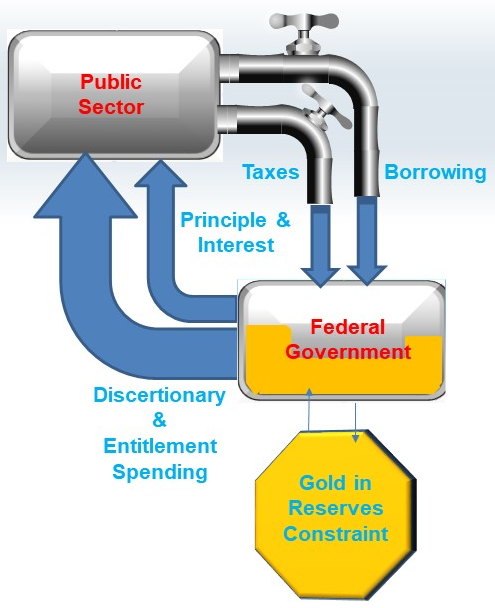
Under a gold standard, deficits mattered because the government’s ability to spend was constrained by how much gold it held in reserve. (See Figure 1). Under a gold standard, the U.S. government can’t create unlimited dollars—because each dollar is to be backed, and constrained, by a fixed amount of gold. Under a gold standard, foreign governments could, and did, exchange dollars for actual gold.
A federal deficit simply means that the government spent more than it collected in taxes over a given year.
It’s calculated by subtracting tax revenue from government spending — which usually results in a negative number, hence the term “deficit.” But this isn’t a loss. That “negative” is actually the positive financial surplus created for the rest of the economy.
The word deficit can be deceiving. It sounds like something has to be made up — as if the government has come up short, like a business running at a loss. But all a federal deficit means is that, in a given fiscal year, the government spent more into the economy than it taxed back out. It’s a simple subtraction: tax revenues are subtracted from total spending, and the result is a negative number — labeled a “deficit.” But that’s just the way the math is structured. Reverse the subtraction, and you’d see a positive number — the exact amount of dollars the government added to the private sector. In sports, a team that is behind in the score of their opponent has a deficit.
The Paradox of Surpluses: Subtract to Add
So when people talk about “closing the deficit,” what they’re really talking about is removing dollars from the economy — taking back more in taxes than is spent. Closing the Deficit means reducing (or eliminating) the gap between spending and revenue. In other words, it refers to: cutting spending, raising taxes, or both. If the government (typically the executive in collaboration with the Congress) “balances the Federal budget” the gap is eliminated. A surplus is when revenues exceed spending in a given fiscal year. Most politicians—especially under mainstream (neoclassical or neoliberal) economic frameworks attempt to use, or seek to implement, one or more of the following strategies:
- Raise taxes
- Cut spending
- Grow the Economy (“Grow out of it”)
- Combination of the Above
In this paradigm, the Federal Government is seen as managing a checkbook; debits should match credits. At the end of the fiscal year, (September 30), government credits should match debits – just like on is taught by parents of in accounting 101 in high school.
By raising taxes, it is believed that this directly increases federal revenue. This is typically politically unpopular, especially income or corporate tax hikes. The risk that MMT teaches is that it could, that is most likely, pull too much money from the private sector that can slow economic growth and raise unemployment. From a cash-flow accounting standpoint, the federal government ran budget surpluses from 1998 to 2001. The U.S. Treasury took in more in taxes than it spent — which on the surface sounds great – if one believes the Federal Government needs “revenue.” In 2000, the federal government ran a surplus of ~$236 billion
From an MMT perspective, a government surplus is equal to a non-government (private sector) deficit. In other words: If the government “saves,” the private sector must “dissave.” During Bill Clinton’s second term, private debt levels soared (especially household and corporate); the dot-com bubble burst; and a recession followed in the early 2000s.
When the U.S. federal government ran budget surpluses in the late 1990s under President Clinton, many economists and policymakers initially celebrated it as a sign of fiscal responsibility. But from a Modern Monetary Theory (MMT) perspective, those surpluses were actually harmful to the economy.
What likely happened — and I surmise George W. Bush didn’t consciously execute MMT principles, but the effect of his policy choices resembled what MMT economists would have endorsed. President Bush’s major tax cuts (2001, 2003) and spending increases (especially post-9/11) returned the federal budget to deficit. While not rooted in MMT theory, this shift functionally matched what MMT would advise: injecting net spending to prevent recession. It’s hard to say politicians “figured out” the MMT logic since their language didn't even give a hint. Most likely, the return to deficits was politically driven by the desire for tax cuts and the need for multiple "budget supplementals" to fund the wars in Iraq and Afghanistan.
I say that because of a Warren Mosler story regarding Robert Rubin. I offer it here for reflecting on the above history.
“Ten years ago, around the year 2000 just before it all fell apart, I found myself in a private client meeting at Citibank with Robert Rubin, former U.S. Treasury Secretary under President Clinton, and about 20 Citibank clients. Mr. Rubin gave his take on the economy and indicated that the low savings rate might turn out to be a problem. With just a few minutes left, I told him I agreed about the low savings rate being an issue and added, “Bob, does anyone in Washington realize that the budget surplus takes away savings from the non-government sectors?” He replied, “No, the surplus adds to savings. When the government runs a surplus, it buys Treasury securities in the market, and that adds to savings and investment.” To that I responded, “No, when we run a surplus, we have to sell our securities to the Fed (cash in our savings accounts at the Fed) to get the money to pay our taxes, and our net financial assets and savings go down by the amount of the surplus.” Rubin stated, “No, I think you’re wrong.” I let it go and the meeting was over. My question was answered. If he didn’t understand surpluses removed savings, then no one in the Clinton administration did. And the economy crashed soon afterwards.”
Reducing the deficit might make sense if inflation is too high. But when unemployment is high and businesses are struggling to get loans, a government deficit is not the danger — it’s a sign that the private sector is the one that lacks the gas to keep the engine running. In this case it's common parlance to expect the pulic sector (the federal government) to step in to support demand. History has shown it always does! What happened during the depression of the 1930's may be the best example of what that means in terms of various tools the government can provide to put gas back in a sputtering engine. To round out the sports metaphor, a baseball team that has a deficit of two runs would be most unlikely to take a few players off the field to make up their deficit. While they can't add players to the field, they do use strategies to add pinch hitters, runners, and pitchers with new energy to hopefully close the gap.
Gold as The Governor
The gold standard acts like a spending speedometer. Along with the rules of the game, the law, and observance of the rule of law, it restrains Federal Government spending. The Treasury had to make sure there was enough gold in reserve to back the money it created. It's essential to note however, that deficits could be quite dangerous in this system. Printing too much money could lead to a gold run. A gold drain was a risk, not a certainty. Treasury borrowing was real in the sense that: If the government ran a deficit, it had to borrow from the private sector (sell bonds). It couldn’t just create money; again, that ran the risk of draining the gold reserves.
When the Fed bought Treasury bonds under the gold standard, it was indeed creating new base money (reserves), but because the dollar was convertible into gold, this fiat expansion was constrained by the risk of gold outflows. In that sense, the money was fiat in form, but not in freedom. It was like will versus freewill: will is constrained by predecessor causality but freewill is unconstrained from antecedent causation.
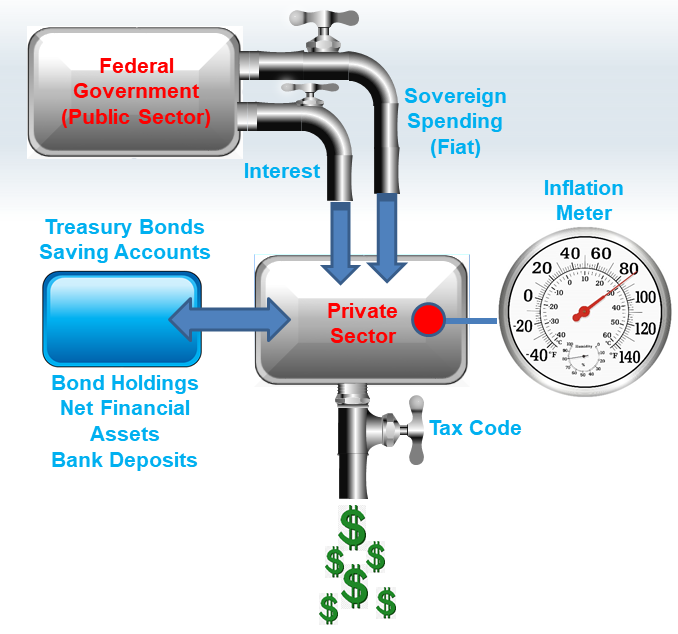
In a post-gold world, the fiat one we currently live in, the U.S. government doesn't need to “raise” money before it spends. The deficit becomes a financial asset in the private sector: bank deposits, bond holdings, or other forms of net financial wealth or net financial assets.
Money was finite, and choices were zero-sum. But in a post-gold world, the fiat one we currently live in, the U.S. government no longer needs to “raise” money before it spends. It issues the currency others use. Its true limit is not solvency, but inflation. It spends first and taxes later. (see Figure 2). And yet, politicians still talk about “balancing the budget” as if they’re managing a household checkbook. They warn that government debt will “burden our grandchildren,” without grasping that what they call debt is actually the private sector’s savings. Savings (and monies in checking accounts) represent the wellspring that holds the energy by which we have to have to do anything.
Why Federal “Debt” is Misinterpreted
When we hear the word "debt," we usually think of something you have to pay back — like a credit card bill. Most people assume government debt works the same way, like the government borrowed money and now owes it back, plus some extra called interest. That interest is accepted as a fee for borrowing, since the lender couldn’t use that money while it was loaned out. But Modern Monetary Theory (MMT) flips the lens: it sees that same government "debt" as the private sector’s financial savings — and not metaphorically, but literally
Here’s why.
When the federal government runs a deficit — say, by spending $1 trillion more than it taxes — that money flows directly into the economy, landing in someone’s bank account. Maybe an individual or family, maybe an employer, maybe a bondholder. The deficit becomes a financial asset in the private sector: bank deposits, bond holdings, or other forms of net financial[ref] wealth or net financial assets.
The term debt is misleading when applied to the federal government. It evokes images of maxed-out credit cards or payday loans — obligations that must be repaid from future earnings under threat of insolvency. But that framing simply doesn’t apply to the issuer of the currency. The U.S. federal government cannot run out of dollars any more than a scoreboard can run out of points. Its so-called “debt” is actually the accumulated savings of the private and foreign sectors, stored in the form of whateer financial asset the holder uses - and there are many!
And to keep the books balanced — as they always must in macroeconomics — that $1 trillion surplus in the private sector is offset by a $1 trillion deficit in the government’s sector. The two always move in opposite directions.
So, the term “savings” is accurate: it reflects net financial assets[ref] held by the private sector, made possible by the government’s (public sector’s[ref]) deficit spending. It’s not a trick or a euphemism — it’s just a different vantage point. What looks like "debt" on the government's balance sheet is, in fact, savings on yours.
Once you see it, it’s hard to unsee.
This is where MMT steps in—not as a policy agenda, but as a description of what is already happening. The U.S. Treasury and the Federal Reserve, are opposite sides of the same coin. (no pun intended). Whether they say it or not, the US is operating under MMT principles every time the government spends dollars into existence.[ref] Every Social Security payment, every military contract, every infrastructure project—all are paid with keystroke-generated money, not assessed against a vault of gold or funded by taxpayer dollars in advance. MMT simply gives language and structure to this system, stripping away the illusions left over from a pre-1971 economy.
The challenge is not that MMT is wrong—it’s that it’s largely invisible, hidden beneath layers of outdated metaphors, accounting confusion, and political language that is unclear. Most people have internalized the language of scarcity: "we can't afford it," "the government is out of money," "taxpayer dollars fund spending"—without realizing these are conceptual holdovers from a system that no longer exists. The new system has been with us for over fifty years, yet few understand it, and fewer still are willing to confront the implications: that money is not limited, but real resources are; that deficits are not inherently bad, but can be essential; and that taxation, far from funding spending, is a tool to regulate demand, not to fill the Treasury's coffers.
MMT isn’t an ivory tower fantasy—it’s the engine under the hood. And this essay aims to lift that hood.
Vertical and Horizontal Money: Understanding the Engine of Modern Economies
In the landscape of modern monetary operations, few distinctions are more important—or more misunderstood—than the difference between vertical and horizontal money. Though often hidden beneath layers of institutional jargon, this distinction holds the key to understanding how money truly enters the economy, who controls it, and why it matters.
In this section, I hope to explain clearly why horizontal money taught as the “money multiplier” is not money that creates unencumbered “new” money. It is actually credit money. Credit money is encumbered because it must eventually be paid back to the bank.[ref]
Only the Government Can Net-Add Financial Assets: Why “Net” Matters
At the heart of Modern Monetary Theory (MMT) is a simple but powerful claim:
Only the federal government, as the monopoly issuer of the currency, can net-add financial assets to the non-government sector. (Cf. footnote #4). This constitutes vertical monies; it comes from the top, hits a horizontal wall and spreads horizontally across the private sector, flowing between households, businesses, and banks—until taxed or saved. Picture that federal government spending enters the economy vertically, like rain falling on a landscape. It pools in some areas, flows into others, and fuels both consumption and investment as it spreads through households, businesses, and financial institutions. This money is recirculated horizontally. It is spent, saved, or used to repay debt—without adding further to net wealth. Another way to envision this verticality: think of vertical money like water from a faucet filling a basin. Once it's in the basin, it can slosh around (horizontal lending and spending), but the water level only rises when more is added from the faucet. The faucet is government spending; the basin is the private sector.

The term “net” is crucial here. It distinguishes true additions to financial wealth from mere rearrangements of existing assets. When a bank issues a loan, it creates both a deposit (asset to the borrower) and a debt (liability to the same borrower). The result is a gross increase in activity but a net increase of zero. The private sector gains no unencumbered wealth.
Contrast this with government spending. When the Treasury pays a Social Security recipient or funds a military contract, it creates a deposit with no offsetting liability for the recipient. This is vertical money—net new financial assets entering the economy. The wealth of the private sector increases by the same amount that the government sector's balance sheet expands (in deficit terms). This is not theoretical; it’s an operational truth of fiat monetary systems.
So, let’s take a segue here by using an analogy that Warren Mosler wrote about a decade ago regarding parents attempting to get their children to do work – household chores.[ref] We’ll blend the familiarity of a household economy with the subtle mechanics of credit, reserves, and temporary money creation, while introducing the flavor of quantum impermanence to describe bank-created credit.
The House, the Printer, and the Neighbor Bank
In the Parker household, the parents, Dorothy and Robert, have come up with an ingenious way to not only teach their children economics but get the kids to enjoy their chores. They print and hand out “Chore Cards” — each redeemable for 15 minutes of screen time — to their kids, Lily, James, and Sophia as payment for tasks completed. In effect, they act as the sovereign issuers of “value.”[ref]
These cards represent real, earned value[ref] in the system. Mr. Harris, the neighbor, has a small stack of these parent-approved cards. This stack is his reserve — a limited supply he’s earned or saved, authorized by the original issuers, mom and dad Parker. Because they trust him, Mr. Harris is allowed to lend out a small portion of his reserves to neighborhood kids, including Lily, Sophia, and James, when they’re short on cards but eager to buy things from each other.These temporary cards might feel like new cards that can continue for exchange around the neighborhood, but they're not. They’re better understood as credit vaporware — ephemeral instruments that enable liquidity[ref] for the child that receives it but ultimately must be repaid. It will eventually leave the system. While a credit multiplier card increases the ability to spend in the short term, it adds no permanent purchasing power to the kids (what economists would call "net financial assets" Cf. footnote #4). Only the parents, through vertical issuance of Chore Cards, can do that. Mr. Harris may act like a mini-central bank within his small sphere, but he can’t create unencumbered cards — he can only temporarily rearrange them. In other words, he can move cards around horizontally. And if too many of his vapor cards are floating around, confidence can falter — and a neighborhood default crisis is never far behind. So essentially Mr. Harris operates defensively; he is always on the lookout if he has too much vaporware in circulation.
The Chore Cards might feel like new money, but they're not net new value. They’re better understood as credit vaporware — ephemeral instruments that enable liquidity but ultimately depend on repayment. While they increase the ability to spend in the short term, they add no net financial assets to the system. Only the parents, through vertical issuance of Chore Cards, can do that. Mr. Harris may act like a mini-central bank within his small sphere, but he can’t create value — he can only temporarily rearrange it. And if too many of his vapor cards are floating around, confidence can falter — and a neighborhood default crisis is never far behind.
(In a future essay, we’ll extend this analogy further: What happens when Mr. Harris needs more reserves? Can he borrow from the Johnsons next door? Is there a neighborhood version of the Fed? Stay tuned to this space as we unpack the rest of the system, one backyard economic truth at a time.)
While the Parker household story simplifies many of the roles and fundamentals of MMT, it highlights a critical distinction: the difference between temporary, private credit and permanent, government-issued money. In the real economy, the U.S. Treasury and the Federal Reserve perform roles analogous to the parents and the printer — with one key difference: the scale and complexity of monetary operations far exceed anything in our backyard allegory. To understand how the federal government actually injects vertical money into the economy — that is, how it adds net financial assets into the private sector — we need to look beyond metaphor and into the institutional processes that power our monetary system. That begins with the Federal Reserve.
How Does Vertical Money Get Added to the Economy?
Contrary to popular belief, the Fed does not independently inject vertical money into the private sector. It cannot “spend” in the fiscal sense.[ref] Instead, it serves as the fiscal agent of the U.S. Treasury, which holds the constitutional and legal authority to spend public funds under the direction of Congress.
Fiscal policy, in the language of economists, refers to tax cuts, increases in public spending, and related measures that aim to stimulate or restrain aggregate demand—the total demand for goods and services in the economy. Thus, the Federal Government is responsible and accountable for fiscal policy which includes Congress and the Executive. Monetary policy, by contrast, involves the central bank’s (i.e., the Fed) management of interest rates and the money supply—typically through operations such as open market purchases or adjusting the federal funds rate—to influence borrowing, investment, and overall liquidity in the economy. In these actions it is independent of the government.
Let me expand upon these two complementary functions. To do that I need to refer back to the Federal Reserve Act of 1913 and the secrecy as to why it was created.
The framers of the Act met in absolute secrecy on Jekyll Island to craft the language of a Bill that was to be presented to Congress. The men who met at Jekyll Island in 1910—notably Senator Nelson Aldrich, Paul Warburg, and representatives from major banking institutions has led to intrigue surrounding the Fed’s creation at Jekyll Island that overstate what the Fed was designed to do. Their primary goal was to create a centralized banking system that could manage monetary stability, prevent banking panics, and provide liquidity through an elastic currency. The 1913 Federal Reserve Act gives the central bank authority over interest rates, reserve requirements, and the issuance of Federal Reserve Notes, but it grants no power over taxation, government spending, or budgeting—functions constitutionally reserved for Congress and executed by the Treasury.[ref]
Some confusion arises largely from the Fed’s powerful role in managing liquidity and influencing markets, especially during crises like the 2008 financial collapse or the COVID-19 pandemic. In these moments, actions like Quantitative Easing appear to mimic fiscal stimulus because they inject money into financial institutions. However, these are asset swaps, not net injections of financial wealth into the private sector.[ref]
By contrast, during both the George W. Bush administration and the COVID-19 pandemic, Congress authorized direct payments—so-called stimulus checks—that were deposited straight into citizens' checking and savings accounts. These payments, disbursed by the Treasury, represented vertical money: financial assets added to household balance sheets without any repayment obligation. This blurring of roles, amplified by public misunderstanding and the mystique surrounding the Fed’s creation at Jekyll Island, has led many to mistakenly conflate monetary operations with fiscal authority.
Here’s how the process works:
- Congress appropriates funds via budget laws.
- Agencies like HUD or the Department of Defense obligate those funds by signing contracts or initiating disbursements.
- The Treasury instructs the Fed to settle the payments.
- The Fed credits reserve balances at commercial banks and simultaneously credits customer deposit accounts.
That is when vertical money is created—at the point of disbursement, not before. The funds didn’t exist “in storage” somewhere. There is no vault. There is no bag of coins in an agency’s basement. There is only authority, and when that authority is exercised, money springs into being as a simple accounting entry.
Do Federal Agencies Hold Vertical Money? Where Is It Stored?
It’s tempting to imagine government departments like HUD, DHS, or the military holding spending accounts like bank customers. But in reality, they don’t “hold” money at all—they operate under budget authority granted by Congress. This authority is not a stockpile of funds; it's a green light to make commitments and eventually to trigger the Treasury’s payment system.
These commitments (obligations) are recorded in the Treasury’s central accounting system, but the money itself doesn’t “sit” anywhere. When HUD or the DoD pays a contractor, the vertical money is created at the moment of payment, with the Fed acting at the Treasury’s instruction.
Even the Treasury’s own account—the Treasury General Account (TGA)—is not a traditional account in operational terms. It functions more like a clearing account, constrained by outdated legal and political rules requiring it to have a positive balance. In reality, if those rules were removed, the Treasury could authorize payments directly through the Fed without any “funding” needed in advance.
Can the Fed Create Horizontal and Vertical Money?
This is a subtle but important question. Technically:
- The Fed can create reserves and make loans to banks, which is horizontal money—assets matched by liabilities.
- The Fed cannot create vertical money independently. Only Congressional fiscal authority, channeled through the Treasury, can cause net new financial assets to enter the private sector.
The Fed does however, “create money” in the public imagination, especially during Quantitative Easing (QE). But QE simply swaps one form of asset (e.g., Treasury bonds) for another (bank reserves). The private sector is not richer—its portfolio just looks different. These swaps do not increase net financial wealth. They are horizontal operations.
It is essential to understand that the Federal Reserve cannot create net financial assets—or what we have argued in this essay that MMT refers to as vertical money—independently. Only Congress holds the constitutional authority to enact fiscal policy that results in the net addition of financial assets to the private sector. Article I, Section 8 of the U.S. Constitution explicitly assigns Congress the power to “coin money” and “borrow money on the credit of the United States.” This establishes that the power of the purse—meaning the authority to inject new financial assets into the economy through public spending—rests solely with the legislative branch.
The Federal Reserve, by contrast, operates under the constraints of the Federal Reserve Act of 1913, which strictly defines its role in the monetary system. While the Fed is authorized to conduct open market operations, manage reserve requirements, and influence interest rates, it cannot spend into the economy or directly fund fiscal deficits. Its operations, such as those under Quantitative Easing (QE), involve swapping financial assets—typically purchasing government bonds in secondary markets in exchange for bank reserves—but these do not increase the net financial wealth of the private sector. These actions are horizontal in nature: they change the composition of assets but not the net total.
Further reinforcing this structural separation, the Public Debt Acts and the 1951 Federal Reserve–Treasury Accord formalized the distinction between fiscal and monetary authority. The Treasury must finance deficits through bond issuance, not by commanding the Fed to create money. The 1951 Accord in particular reasserted the Fed’s independence and prevented the central bank from directly monetizing government debt. Thus, while the Fed can create reserves and influence liquidity, only the Treasury—under Congressional authorization—can inject vertical money by spending more into the economy than it taxes out. In short, net financial asset creation is a function of fiscal policy, not central banking.
Fuel, Scorecards, and the Debt That Isn’t
No conversation about Modern Monetary Theory (MMT) escapes the well-worn worry: What about all that interest the government has to pay on its debt? At a glance, it looks like a burden growing out of control — a ticking time bomb for taxpayers. But MMT invites us to rethink what this “debt” really is, and whether the fear is rooted in outdated metaphors.
Let’s start here: the U.S. federal government doesn’t borrow in a currency it doesn’t control. It issues dollars first, then sells bonds. Those bonds aren't about raising cash — they're about managing interest rates and providing a safe asset for savers. Yes, they come with interest. But that interest is a policy choice, not an unavoidable cost. And the government can choose to pay less — or none at all.
MMT economists like Warren Mosler and Randall Wray have long argued that the Treasury could simply issue zero-interest securities, or even stop issuing bonds entirely. That would eliminate interest payments without touching a single social program. The so-called “debt” is, in their view, just the private sector’s savings, a pile of safe dollars looking for a place to park.
I have a colleague that floated an extremely creative proposal: deploy zero-coupon bonds over 100-year terms. My colleague’s creative proposal — using zero-coupon bonds over 100-year terms — mirrors this post-gold-standard (MMT) logic: that the government’s so-called debt is simply the private sector’s savings, and that interest payments are a policy choice, not a funding necessity. Although it assumes that large expansions of the money supply (M2) are inherently inflationary I believe is overly simplistic. M2 growth does not correlate perfectly with inflation, especially in low-velocity environments. Japan is a textbook example.[ref] But here's where MMT parts ways with monetarist orthodoxy:
MMT treats money as a scorecard, not a fuel line.
In traditional thinking, more money means more pressure — like over-revving an engine with too much fuel. But MMT says: not so fast. Money keeps score of economic activity; it doesn’t drive it. The engine of the economy runs on real resources — people, skills, machines, and materials. And these resources require energy in the form of dollars to crate work and progress. Deficits provide the fuel in the form of demand, but inflation only kicks in when we’re burning more fuel than the engine can handle.
And what about that “fuel line” metaphor? It fits perfectly in our earlier story: the line between the Treasury, the Fed, and the banking system is how Chore Cards enter the neighborhood. Without new Cards — and without parents issuing them — there’s no juice, no gas, to get things going. The kids can’t do chores for the promise of nothing. No Cards, no work. And unless you’re counting on a house full of altruists, even the vacuuming grinds to a halt.
So when we fret about interest payments, we’re often pointing to the wrong dashboard. Interest is not a crisis. It’s a design feature — one that we can retool if we choose. The real risks lie not in the scoreboard numbers, but in the availability of real-world capacity to absorb government spending without overheating.
In the end, MMT isn’t just about funding government programs. It’s about managing the economy with the right levers — recognizing that “debt” is really just another name for the public’s savings, and that interest payments are a thermostat, not a time bomb.
And if we can reframe the metaphors, maybe we can finally start asking the right questions.
// Bob Debold 1st draft June 19, 2025Updated surplus discussion June 24, 2025. -