The Urantia Book’s Model of Personality, Embryology, and Moral Emergence
Urantian Humanity has Reached the Limits of
Our Existing Scientific, Philosophical, and Religious Frameworks
Transcending the Personhood Debate:
The Urantia Book’s Model of Personality, Moral Emergence,
and Embryonic Human Development
AbstractContemporary debates over abortion remain deadlocked largely because they attempt to resolve a metaphysical question—what constitutes a person—through biological and developmental thresholds. This essay examines personhood through the cosmological framework presented in The Urantia Book, arguing that personality is a bestowed ontological reality originating beyond time and space rather than an emergent product of biological or psychological development. By distinguishing biological life from personality bestowal, and ethical choice from moral decision, the analysis clarifies the role of Thought Adjuster indwelling and psychic-circle development in the emergence of full moral agency. The essay further outlines the Nebadonian survival economy and ascension order as a mercy-structured system that preserves all potential personalities across three survival contingencies: pre-birth death, postnatal death prior to Adjuster arrival, and death following Adjuster arrival before conscious destiny decision. These features reframe fetal status, moral accountability, and divine justice without resorting to developmental milestone arguments. The resulting model relocates abortion ethics from disputes over biological thresholds to a broader ontological and developmental context, proposing a shift from polarized legalism toward cosmically informed compassion. Rather than prescribing political positions, the Urantia framework is shown to offer a coherent metaphysical battleground upon which contemporary ethical deliberation may be more fruitfully situated.
Introduction: We've Reached the Limits of Our Existing Frameworks
What a person is and when personhood[ref] exists has increasingly been reduced to a binary dilemma. The terms “Pro-Choice” and “Pro-Life” now function as shorthand labels within the abortion debate, framing opposing positions that implicitly treat the ontology [ref] of personhood as the central, yet often unexamined, point of contention. Public opinion fluctuates along a broad spectrum, influenced by shifting social vectors, many of them political, with biology routinely pressed into service as the decisive fulcrum. Surveys capture these momentary alignments, sometimes registering sharp swings as cultural norms evolve or as medical technologies advance.[ref] Such volatility underscores the fragility of grounding personhood in developmental thresholds rather than ontological foundations.
The terminology itself did not arise from a single defining event but emerged as abortion moved to the center of public consciousness following the prominence of the landmark case Roe v. Wade[ref] and was later supported and reframed by Planned Parenthood of Southeastern Pennsylvania v. Casey[ref]. Both decisions were ultimately overturned by Dobbs v. Jackson Women’s Health Organization on June 24, 2022 when the Supreme Court returned regulatory authority over abortion to the states.[ref]
In the US it is a constitutional saga of immense proportions.
It caused this student of nearly fifty years of the Urantia revelation to reflect deeply upon a question that relates these historic events with the teachings: ‘Do the advanced cosmic revelations provide any guidance that would enable a positive progressive societal reconciliation for resolving what appears to be an intractable battle of absolutes regarding abortion’?
Both sides continually collide because they assume personhood begins at a discrete moment, but at different times. The Pro-Life position fixes it at conception, while the Pro-Choice position locates it at viability. Yet biology offers no such boundary. Human development is continuous; each view imposes a single flash-point of personhood. This creates a near-inscrutable paradox: a seamless biological process is being forced into an all-or-nothing framework that requires a sharp dividing line where none exists. Ironically, both positions agree an offspring from two humans is a human; it is when personhood status is conferred that is in dispute. This timing issue affects almost every other human institution and social system like the legal, ethical, and moral to mention a few.
Western society’s inherited categories[ref] of personhood cannot reconcile the unfolding continuum of biological development with the The Urantia Book’s (UB) discrete revelations of personality, moral will, soul, and Thought Adjuster. Outside of Urantia Book studies, these distinctions rarely appear in public discourse, leaving most debates unequipped to address the deeper metaphysical structure they reveal.
But commitment to the truth compels me to acknowledge that consensus is hardly universal within the Urantia-scholar community either. The revelation does not explicitly state when the Universal Father bestows personality; that omission has opened the door to a wide range of thoughtful speculation. Over the past fifty years of study and dialogue, I’ve encountered four major interpretive positions. Each offers a distinct framework for understanding the developmental interval between conception and birth—one even extends the question into the later stage of moral discernment. I’m not here to pass judgment on any of these views; rather, this essay will present them fairly before articulating the position I find most coherent.
The personhood question creates a genuine philosophical paradox: human development unfolds as a biological continuum, yet personhood, by its very nature, and for the majority of conventional beliefs, does not emerge by degrees.
This point became clear while writing on this topic in 2023, where after drafting more than 19,000 words opining how conventional arguments cannot accommodate the deeper metaphysics of personality, I decided to leave it alone. Others in the Urantia community had covered personality from various long-term student perspectives. However, in that earlier work, it kept haunting me that one premise repeatedly surfaced: we cannot solve a paradox using the very framework that generates it. Earlier Urantia Book scholars have offered careful and nuanced treatments of personality’s components. These interpretations kindredly rely on shared assumptions about conceptual boundaries that are not always made explicit, which contributes to the diversity of conclusions about timing. What I felt required a different direction was not another refinement of the arguments written in public discourse, but a reconfiguration of the canvas of mental coordinates that organizes the discussion. In other words, I perceived a necessity to step outside the inherited framework and ask whether the cosmological paradigm governing these discussions was unknowingly constrained. Bringing that paradigm into view, and exploring the latent explanatory potential it contains, constitutes a primary through line of this essay.
What I mean by this is not that prior scholars neglected the cosmological or spiritual processes involved in personality, but that they rarely extended the inquiry into why the Urantia model of personhood dissolves rather than merely arbitrates, the persistent dilemmas surrounding abortion and related ethical tensions. The discussions remained largely descriptive, cataloging components, sequences, and processes without fully engaging the explanatory power of the paradigm itself. As a result, the differences tend to oscillate between competing timelines of bestowal rather than asking whether the Urantia conception of personality reframes the problem in such a way that the apparent paradox no longer arises. It is precisely a reframing of moving from adjudicating outcomes within the debate to examining the cosmological architecture that this essay seeks to undertake.
The personhood question generates a genuine philosophical paradox: human development unfolds as a biological continuum, yet personhood, by its nature and within most conventional belief systems, does not emerge by degrees. In Urantia Book cosmology, personhood, and likewise being a person, occurs only through the bestowal of personality by God the Father; a being is either a person or not a person; there is no partial personality. By contrast, in most philosophical, legal, and ethical frameworks, personhood functions as a binary status of recognition: either a being is regarded as a person or it is not. Within these non-revelatory models, developing humans who are not yet accorded personhood[ref] are often said to acquire increasing moral value or developmental significance over time, with personhood appearing to “arrive” at a decisive threshold—as though by a quantum leap. Such gradualist frameworks treat moral development as the process by which personhood emerges. The Urantia model inverts this logic: personality is bestowed first, and it is this prior personal endowment that grounds and enables the growth of moral awareness.
While some modern theories attempt to soften their binary position through gradualist or potentiality-based approaches, they typically retain an implicit threshold at which personhood is said to begin. However, even those philosophical approaches that explicitly reject sharp personhood flashpoints often reintroduce functional thresholds at the level of ethical judgment or practical application. In these views, personhood is described as emerging by degrees and moral status as increasing over time, yet decision-making (e.g., legal) still relies on developmental markers rather than a clearly defined ontological boundary.[ref] While these approaches explicitly reject personhood flashpoints, they struggle to operationalize the alternative. In these views: an individual acquires personhood by degrees, moral status increases over time, and there is no sharp ontological boundary—only developmental thresholds.
This is where The Urantia Book offers a materially different and paradigm-resolving architecture. It introduces elements wholly absent from secular, religious, or biomedical discussions. The revelation divulges a wholly revelatory and novel spiritual concept which is new to mankind. Urantia scholar George Park has written[ref] that philosophy, law, and religion are all aware of “personhood,” but man has never conceived of personality as a reality in and of itself. He goes on to say we see the differences between form, substance, and essence, but man has essentially failed to recognize the independent reality of personal presence. Personality is a reality distinct from matter, mind, and spirit; the revelation’s model teaches it is much, much more than mere visible character traits. I posit personality is a protocosmic revelation.
Just as Einstein reframed Newtonian mechanics to account for the relationship among gravity, time, and mass, and Newton and Leibniz reconceived the relationship between geometry and algebra to create calculus, major conceptual impasses have historically required new frameworks of thought. The chaotic modern concept of personhood presents a similar situation. In my view, a solution to this impasse cannot fit within the binary molds of 20th- and 21st-century culture wars; it requires a higher conceptual framework.
The conventional framework is too small for the problem. Within this essay, I explore whether a cosmological framework like that of the UB might address the personhood paradox. That is: What is a person in the Urantia Book’s cosmology? How do personality, identity continuity, and moral agency relate within that framework? And if these distinctions are taken seriously, how might they reframe the modern personhood debate? If the answer to those questions is clear, what meaning do they provide to the abortion issue? It is from within this enlarged conceptual space that the specific categories and methodologies introduced by The Urantia Book are now considered.
What makes The Urantia Book distinctive at this juncture is that it does not attempt to resolve questions of personhood by refining existing biological, psychological, or ethical criteria. Instead, it reframes the entire problem by relocating personhood within a cosmological architecture that precedes—and ultimately grounds—those domains. In doing so, it shifts the inquiry away from adjudicating thresholds and timelines toward understanding the ontological conditions under which personality can exist at all. This spiritual cosmology does not bypass embryology, moral development, or ethical concern; rather, it situates them within a broader explanatory field in which paradoxes generated by competing frameworks can be meaningfully re-examined. It is from within this enlarged conceptual space that the specific categories and mechanisms introduced by The Urantia Book must now be considered.
Again, the revelation introduces elements wholly absent from secular, religious, or biomedical discussions.
For example:
- Personality bestowed by God the Father personally to every ascending and descending being in the Universe of Universes;
- Cosmic mind as the channel of moral intuition;
- The Adjuster as the divine partner in moral choice;
- The morontia soul as the emergent product of human-Adjuster cooperation,
- And the probationary nursery as the cosmic safeguard for unrealized potential identity.
To my knowledge, no existing framework integrates biology, individuality, moral capacity, and eternal destiny into a single ordered developmental system that also weaves mercy into universe purpose. Historically, when thought has reached a conceptual cul-de-sac, new frameworks have been required similar to Leibniz's and Newton’s invention of calculus or Einstein’s reframing of mechanics. In that same spirit, the Urantia Book presents an integrated model that philosophy, science, and jurisprudence can examine: one that aims to dissolve the paradox rather than merely choose sides within it.
The Urantia Book’s cosmology offers the only framework capable of resolving the abortion paradox by showing how biological development and spiritual endowment operate in distinct but harmonized layers.
But before that architecture can be applied, we must acknowledge a more fundamental problem: our inherited mental models are operating at the wrong level of resolution. The abortion discourse assumes that “life,” “human,” “individual,” “person,” and “soul” are interchangeable terms. They are not. The UB sharply distinguishes:
- Biological life;
- Organismic individuality/identity;
- Personality endowment;
- Moral duty;
- Adjuster presence;
- Soul formation;
- And probationary nurseries post material death.
Failing to differentiate these layers guarantees confusion and as an inevitable result—acrimony if not even outright hatred of other.
Beyond Developmental Markers: A Theocosmic Model of Personhood and Moral Agency
This essay is not an attempt to re-litigate the abortion question, nor to champion a political stance, nor to impose a theological verdict. Instead, it is an attempt to do what my 2023 paper gestured toward but had not yet been completed: to construct a coherent, revelation-consistent model of human individuality, personality, and moral emergence that is faithful both to The Urantia Book’s cosmology and to modern embryological science.
This essay consolidates the argument around the following focal themes:
- The distinction between biological development and bestowed personality as separate ontological domains.
- The differentiation of moral choice from moral decision, and the role of moral decision in initiating Thought Adjuster partnership.
- The structure of the survival economy and ascension order as mechanisms preserving all potential personalities across developmental contingencies.
- The scaling of moral accountability with actual capacity for self-determined decision.
- The implications of a mercy-structured universe for reframing ethical deliberation surrounding abortion.
- The relocation of contemporary personhood debates from biological thresholds to ontological foundations.
Most importantly, this essay will make the case that the conceptual architecture surrounding personality as articulated within the Urantia revelation provides not merely an answer, but a coherent spiritually-cosmic framework. It weaves a higher-order composition capable of transcending the abortion paradox by showing how biology, mind, personality, and spirit operate together in a developmental and providence-saturated grace-sustained sequence the world has not yet learned to fully apprehend.
Starting with the End in Mind
Ordinarily, I would construct an essay of this kind very differently. The conventional approach would be to proceed linearly: to begin with the history of abortion in the United States; to lay out the relevant biological foundations; to clarify theological terminology; to survey contemporary ethical frameworks; to analyze the Urantia Book; to review and assess previous UB scholar’s work; and only then to ascend, rung by rung, toward a synthesized position. That method has the advantage of pedagogical clarity, and in many contexts it is exactly the right way to proceed.
The present inquiry, however, turns on a deeper and more generative question, one that a strictly linear sequence tends to defer rather than resolve: namely, whether the conceptual architecture articulated in the Urantia Book can meaningfully ameliorate the abortion paradox itself by coordinating the legal, medical, moral, and religious dimensions that have long remained isolated in mutually bunkered positions. Rather than beginning with origins or adjudicating competing thresholds in isolation, the analysis asks how the UB model of the teleological architecture of human personality, soul, and survival coherently accounts for what a human person is understood to become, toward what end, and—crucially—why key features of development unfold as they do. This includes not only the timing of personality bestowal, but additionally the prerequisites of moral discernment; the distinction between personalized and repersonalized children; the function of the probationary nursery; the significance of birth in universe records; and the assurance that nothing of survival value is ever lost, even for those who die prior to the emergence of individuality and moral choice.
Thus, I have chosen a different path. Because the question of personality bestowal has already generated a wide range of thoughtful conclusions within the Urantia scholarly community, it is more illuminating to begin with those conclusions themselves. By starting with the end in mind namely, six interpretive positions that have emerged over time, we can first see a broad landscape of possible models for resolution before examining the biological, philosophical, and revelatory considerations that give rise to them. This approach allows the reader to appreciate not only what positions exist, but why they do. It prevents readers from misreading later discussions of embryology, abortion frameworks, and Urantia terminology as covert attempts to steer the outcome. By mapping the terrain this way, I believe it makes sense to revisit the foundations and, from there, articulate a coherent synthesis.
Interpretive Models of Personality Bestowal in Urantia Scholarship
Across decades of discussion within the Urantia-scholar community, several interpretive models have emerged to account for the revelation’s silence on the exact moment of personality bestowal. While these views differ substantially, they all attempt to align revelatory statements with developmental milestones: biological, psychological, and spiritual.[ref]
Before turning to these essays, it is important to pause and clarify the nature of the revelatory framework within which they operate. The Urantia revelation presents an immense and carefully coordinated cosmic educational system for humans. It originates in the Grand Universe, passes through the perfect central creation of Havona, and culminates in Paradise itself. This entire structure is portrayed as being in full accordance with the will and purpose of the Universal Father, serving as the arena in which personal growth, experiential learning, and spiritual ascent unfold.
Understanding this system, however, does not come easily. The revelators do not present it as a single, linear exposition; instead, its elements are distributed across dozens of non-contiguous statements, authored from different perspectives and addressing different levels of reality. To grasp the full picture (at least as replete as our own knowledge and experience allows), the reader-student must engage in considerable intellectual and spiritual synthesis, assembling these fragments in a personally coherent and meaningful sequence to discern how they interrelate. After all, we are creatures of time!
This effort is not merely an exercise in cosmic architecture. It is essential to understanding why the system is constructed as it is, what role it plays in the growth and development of each individual personality, and how every sincere choice contributes to the experiential evolution of the Supreme Being. Only within this broader context do the various interpretive essays on personality bestowal along with their differing conclusions, become intelligible as earnest attempts to navigate a vast, purposeful, and deeply interconnected cosmic design. Only by honestly confronting the paradoxes revealed in life’s most painful events, such as miscarriage, stillbirth, or severe childhood disability, can one begin to discern the deeper wisdom of a system willed by God and faithfully implemented by the Creator Sons.
1. Foundational / Metaphysical Models of Personality
This category gathers works that address personality at the deepest possible level: what personality is before asking when it appears, how it develops, or what moral consequences follow from it. Essays such as Byron Belitsos’s The Nature of Personal Reality[ref] and the aforementioned George Park’s Personality and Man treat personality as an irreducible, bestowed reality, not a product of biology, psychology, moral choice, or experiential accumulation. In alignment with The Urantia Book’s cosmology, these authors argue that personality is a unique, unchanging ontological constant—neither mind, spirit, nor energy, yet capable of coordinating all three. Personality is presented as the organizing center of selfhood, the stable “who” that persists through changing identity, experience, and evolutionary growth. By establishing personality as a cosmic given rather than an emergent function, this category provides the metaphysical bedrock upon which developmental, moral, legal, and ethical discussions must rest. Without this foundation, debates about personhood risk collapsing into timing disputes or category errors; with it, the entire inquiry is reframed at the level of being itself.
Belitsos’s essay addresses personality at its deepest philosophical register, asking not when personality emerges or how it functions, but what kind of reality personality must be in order to unify experience at all. Drawing from The Urantia Book while engaging psychology, philosophy, and Eastern religious thought, Belitsos argues that personality cannot be reduced to ego, mind, soul, or behavioral identity. Instead, personality is presented as a bestowed, irreducible, and unchanging cosmic reality—the stable “who” that persists through all changes of experience and growth. This view challenges both Western ego-centric models, which equate selfhood with psychological content, and Eastern no-self traditions, which dissolve personal identity altogether.
Belitsos emphasizes the paradoxical nature of personality: it is equal before God yet uniquely individual, initially upon bestowal unconditioned by experience yet capable of integrating all experience. Personality functions as an organizing center that coordinates mind, spirit, and evolving identity without being identical to any of them. In this sense, personality precedes development, morality, and survival decisions, providing the metaphysical ground upon which these processes occur. By situating personality as a cosmic given rather than an emergent function, Belitsos offers a foundational framework that reframes later debates about moral agency, personal continuity, and human destiny. His essay thus serves as a conceptual keystone for understanding personhood within a revelatory cosmology, establishing the ontological bedrock upon which subsequent developmental and ethical discussions must build.
In addition, in a later work, Your Evolving Soul[ref], Byron expands upon themes only briefly touched in his earlier essay and introduces several reflection-provoking ideas concerning the unifying function of personality. Drawing from The Urantia Book passage 112:1.17 (1227.7), Belitsos highlights the revelatory claim that personality is not only necessary for personal relationships as ends rather than means, but that it also “unifies all factors of reality as well as coordinates all relationships.” The passage further clarifies that relationships are not direct linkages between isolated individuals, but are mediated through the individuality of the whole, since “in a cosmic system the individual members are not connected with each other except in relation to the whole and through the individuality of the whole.” From this, Byron suggests that personality functions as a kind of cosmic systemizer, the organizing center that brings coherence to otherwise disparate aspects of experience. He tentatively proposes that personality may be understood analogically as a divine fractal of the original I AM as the Father of All. Because of this Absolute original source of personality, human personality is capable of integrating multiplicity into unity without collapsing individuality.
George Park’s Personality and Man represents a rigorously metaphysical exploration of personality within the Urantia interpretive tradition. Rather than addressing developmental timing, moral qualification, or survival criteria, Park directs attention to the ontological status of personality itself. He argues that humanity’s persistent difficulty in understanding personhood stems from a habitual conflation of personality with identity, consciousness, mind, or experiential content. Against this tendency, Park insists that personality is a reality in its own right, irreducible to psychological traits, neurological processes, or accumulated experience. Personality, as revealed in The Urantia Book, is not a function of energy, not a derivative of causation, and not bound by space-time constraints. It is instead a bestowed categorically distinct reality, neither produced by nor contained within experiential processes that precedes and coordinates all experiential phenomena.
A central contribution of Park’s essay is his clear and disciplined distinction between personality and identity, a distinction that proves foundational yet notoriously difficult to grasp. George posits that identity evolves, accumulates content, and reflects experience; personality does none of these things. Personality is the invariant “who” that remains constant while identity grows, adapts, and transforms. By emphasizing this distinction, Park dismantles the common assumption that continuity of memory, psychology, or moral behavior constitutes personal continuity. Instead, he presents personality as the metaphysical anchor that allows identity to change without dissolving the self. This framing provides essential groundwork for later discussions of moral agency, survival destiny, and personal continuity beyond material life. Park’s essay thus functions as a philosophical keystone within the Foundational / Metaphysical Models of Personality, clarifying that any serious discourse on personhood must begin not with biology or psychology, but with the recognition of personality as a trans-experiential, bestowal-based reality.
2. Bestowal at Conception/Post-Conception Models
This interpretive path places personality bestowal almost immediately after conception, drawing on revelatory narratives involving special incarnations. This perspective emphasizes that personality is ontologically prior to the arrival of the Thought Adjuster and argues that certain textual patterns (e.g., enmotherment analogies, bestowal precedents) imply that personality is granted at the outset of embodied existence. In this view, the divine gift need not await birth, neurological thresholds, or moral self-awareness.
Exemplary of this model is the essay by George Park which dates back to 1980. The first one “When Does Personality Arrive?”[ref] posits that personality “must be bestowed by the Universal Father very soon after conception.” In this essay, Park argues that personality cannot emerge from biological complexity, psychological maturation, or moral decision-making, but must instead be bestowed directly by the Universal Father, proposing that this bestowal occurs “very soon after conception.” While the precise timing is not Park’s central concern, his deeper contribution lies in rejecting all emergent or functional explanations of personhood. By locating personality bestowal outside genetic causation and developmental processes, Park reinforces the Urantia teaching that personality is neither a property of the organism nor a product of mind, but a distinct reality introduced into the human arena by divine initiative. This early essay thus anticipates Park’s later and more fully developed metaphysical treatment of personality, establishing a foundation that shifts the discussion away from empirical thresholds and toward the ontological nature of personal reality itself.
(Click on the following image to see a full timeline of George’s model.)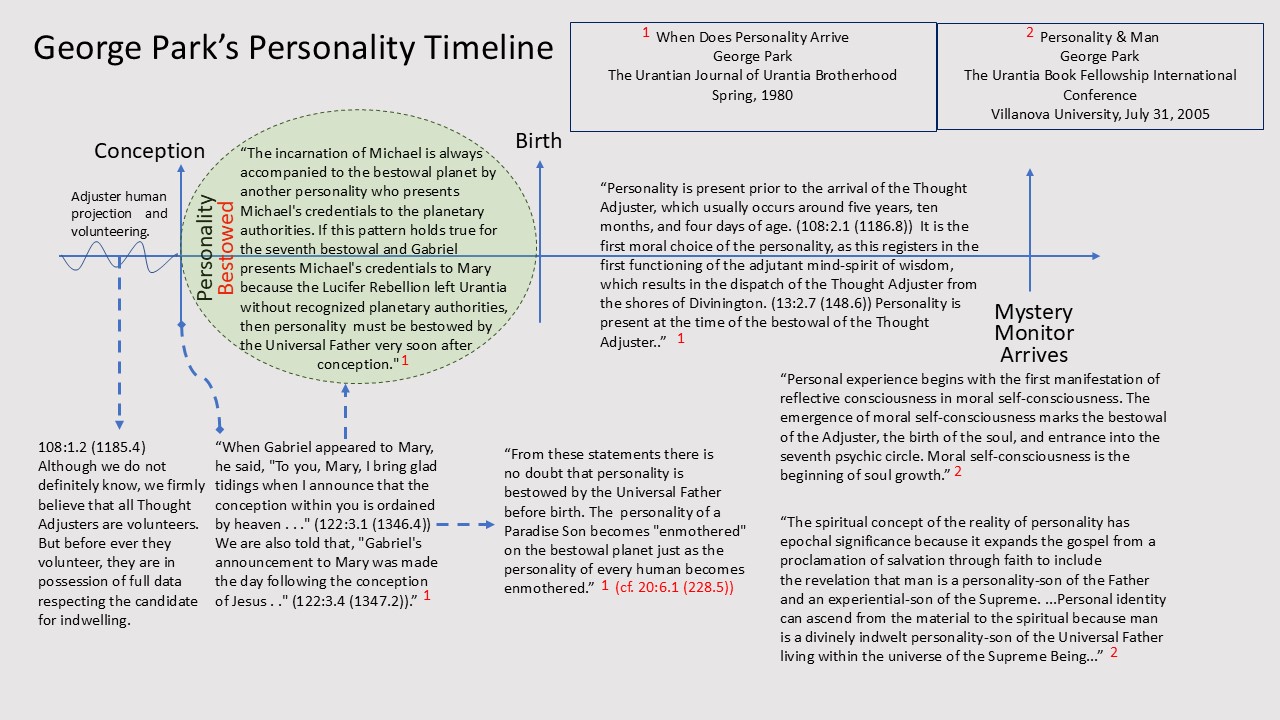
3. Immediately-Post-Conception Models
A second interpretive path places personality bestowal almost immediately after conception, drawing on revelatory narratives involving Andon and Fonta, cosmic mindal capacity, and the revelation of thought Adjuster volunteering outside of space and time. This perspective also emphasizes that personality is ontologically prior to the arrival of the Thought Adjuster and asks to imagine ourselves in his position, as a parent to get a sense of the Father's mind. When would we choose to give personality to our children, assuming that this gift could be given as soon as they have the slightest manifestation of mind function? In this view, the divine gift need not await birth, neurological thresholds, or moral self-awareness.
Studies such as Chuck Thurston’s "When Is Personality Bestowed?"[ref] illustrate a careful and internally consistent attempt to infer timing from revelatory clues. While such analyses offer plausible conclusions, they also demonstrate how interpretive frameworks inevitably step in where the text remains silent—reinforcing the need to examine not only proposed answers, but the assumptions that make the question appear decisive in the first place.
(Click on the following image to see a full timeline of Chuck’s model.)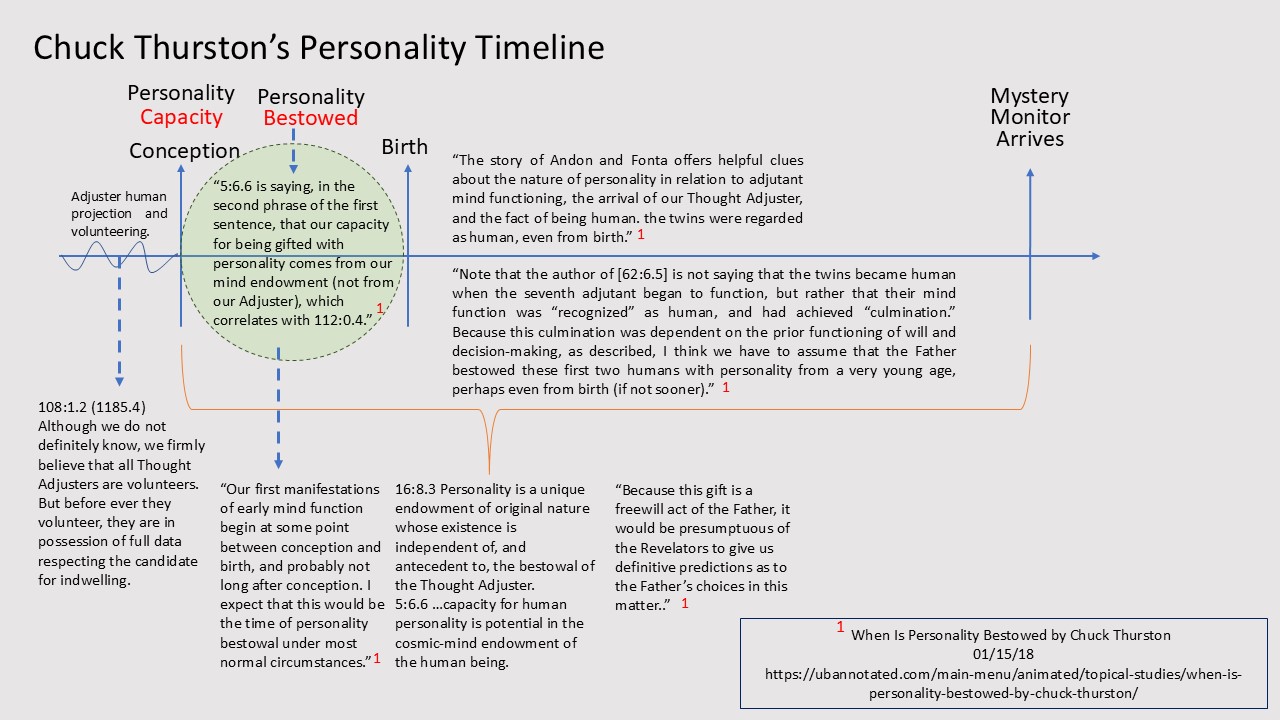
4. Moral-Discernment Models
Another position pushes the decisive moment farther into early childhood, associating personality bestowal with the attainment of moral discernment. This interpretation emphasizes passages suggesting that the personality circuit becomes functionally established when a mortal ascends to the “universe level” of moral discernment. Personality, on this account, may exist only in latency prior to this stage, becoming existentially active when the child’s mind acquires the capacity to apprehend moral meanings, evaluate values, and orient experience forward under a moral umbrella.
JJ Johnson’s essay “Personality Bestowal (Before and After)”[ref] argues that human personality is not bestowed at conception or at birth, but rather at the moment when an individual "[ascends] to the universe level of moral discernment."[ref] Personality, in this view, is a direct bestowal of the Universal Father and is inseparable from activation of the personality circuit. Prior to this event, the human being exists as a biologically living creature with mind endowment but without personal status in the cosmic sense.
Johnson differentiates potential personality (present in pre-personal human life) from actual personality (bestowed upon moral awakening). He treats personality as a unique, non-emergent reality that cannot be gradually developed but must be conferred. Moral discernment is described as the indicator that the human mind has become capable of sustaining personal identity, responsibility, and spiritual survival. The essay is written for readers already conversant with Urantia cosmology and does not translate its conclusions into secular psychological or biological frameworks. Its purpose is doctrinal clarification within the Urantian revelatory system rather than inter-disciplinary synthesis or ethical application.
(Click on the following image to see a full timeline of JJ’s model.)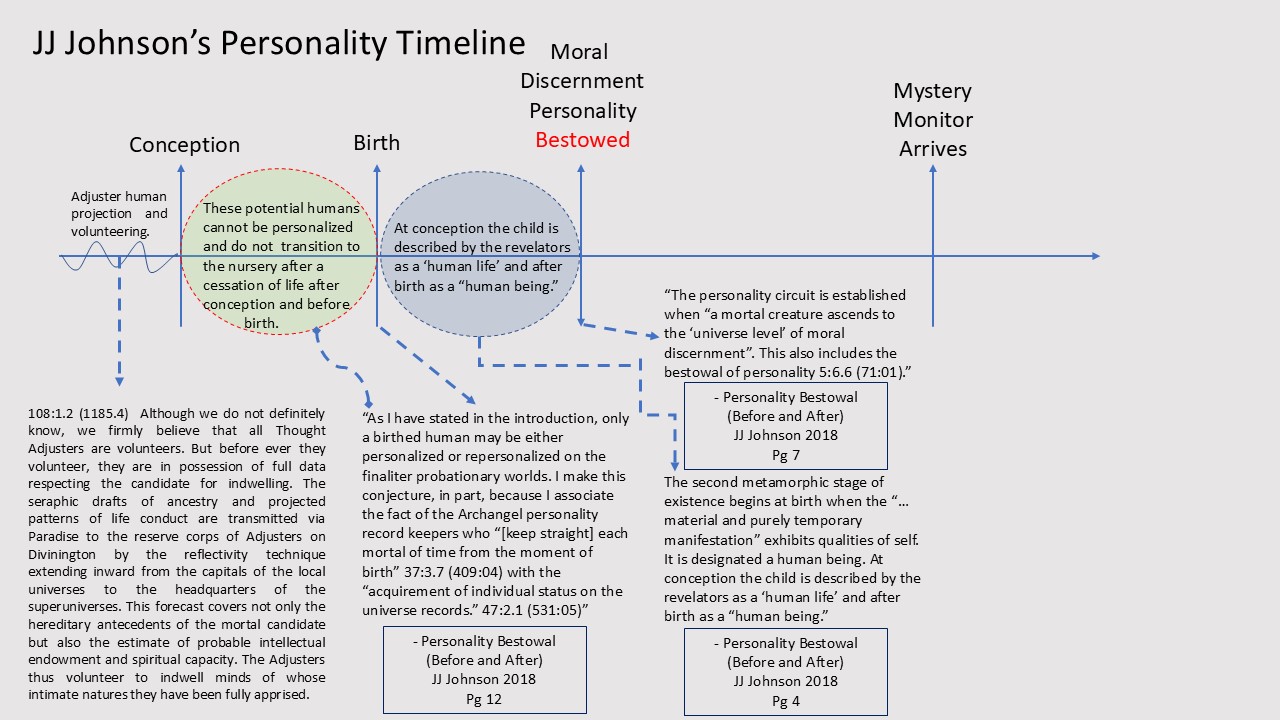
5. Adjutant-Developmental Models
This category includes essays that interpret personality bestowal as a postnatal, developmentally mediated event, grounded primarily in the sequenced operation of the adjutant mind-spirits rather than in biological origin, legal status, or instantaneous moral acts. These models treat personality as a divine endowment bestowed within a bounded developmental window, typically between birth and Thought Adjuster arrival, and infer its presence from emerging capacities such as self-consciousness, free-will choice, worship response, and reflective decision-making. Moral discernment functions not as the metaphysical cause of personality but as an observable indicator that personality has already become operative. Essays in this category emphasize revelatory anthropology, mind-ministry architecture, and developmental sequencing over ethical adjudication or experiential phenomenology.
5a) Jean Royer’s essay "Personality: Identity, Self, and Selfhood"[ref] approaches personality bestowal through a developmental and pedagogical lens, emphasizing the gradual emergence of personal agency as the human mind becomes increasingly responsive to higher adjutant ministry. Rather than positing a precise moment of personality arrival, Royer focuses on how personality becomes functionally manifest through the growth of self-awareness, moral responsibility, and the capacity for spiritual response. His treatment underscores the role of mindal maturation and environmental interaction, portraying personality as a bestowed reality whose effective expression unfolds progressively as the child learns to choose, relate, and value. In this respect, Royer’s contribution aligns with adjutant-developmental interpretations while remaining less concerned with strict chronological boundaries than with the observable transformation from instinct-governed behavior to reflective personal action.
5b) Jacques Dupont's essay "Personality"[ref] presents a structured, revelatory analysis of personality as "a changeless gift of personality" divine gift that the Father bestows. He argues that it inaugurates true humanity through its primary constitutive aspects of self-consciousness and free will. Dupont situates personality bestowal after birth but before Adjuster arrival, grounding this conclusion in adjutant-mind sequencing and revelatory anthropology. Dupont maintains that since Thought Adjusters arrive later (around age five), personality must be bestowed prior to Adjuster indwelling, likely between early infancy and early childhood, when the child first recognizes the self as “I.” The essay repeatedly emphasizes that personality exercises exclusive prerogative over volitional choice, even while mind and spirit ministries influence growth
6. Birth-Centered Models
A fourth line of interpretation holds that personality must be bestowed at or very near physical birth. This view emphasizes statements linking “human being” status to the material independence that begins at birth. This is based upon the revelation that the archangel record keepers’ mandate is to track each mortal “from the moment of birth.” Advocates of this framework note that potential humans who perish before birth are not treated as personalized beings, suggesting that full personal status is contingent upon successful material emergence into an independent biological existence in which personality can be existentially recognized and recorded within the universe system.
A recent short "headscratcher" essay by Lee Smith “Is There a Person in the Womb?”[ref] contemporary with this one here, is exploratory and largely personal. Smith looks at the question of when personality is bestowed, using his interpretation from various passages of The Urantia Book to argue that birth is the most coherent moment for personality bestowal. It invites reflection and raises specific quandaries (e.g., twins and miscarriages) to test competing assumptions. It frames the issue more as a philosophical problem of definition, i.e., what counts as a person rather than as an ethical prescription. This short essay considers the term “personhood” and Smith finds it hard to understand how a zygote can be considered a ‘person’. (Cf. Andrea Barnes follow-up below)
7. Architectural / Expository Analyses
This category includes essays that do not advance a specific claim about when personality is bestowed, but instead seek to clarify the broader architectural framework within which such questions arise. These works focus on explicating the relationships among mind, soul, spirit, personality, and ascension mechanics as presented in the Urantia revelation, often drawing together dispersed passages to illuminate how human development unfolds within a vast cosmic system. While they frequently employ developmental language and temporal metaphors—such as conception, birth, manifestation, or activation—their primary aim is not to identify a decisive bestowal moment. Rather, they provide conceptual scaffolding that helps readers understand why the timing question is difficult, why multiple interpretations emerge, and how divine endowment, experiential growth, and administrative recognition interact across the evolutionary career. As such, these analyses function less as competing answers and more as interpretive frameworks that inform and constrain any responsible discussion of personality within the Urantia model.
7a) In Chris Halvorson’s essay “Conception and Birth of a Mortal Ascender”[ref] he draws a precise distinction between separateness and independence. He treats conception and birth as ontological transitions rather than merely biological milestones. Halvorson argues that conception establishes a being as separate but not yet independent, while birth establishes independence without implying any new metaphysical creation. He then applies this separateness–independence distinction analogically across material, mindal, spiritual, and personal domains, clarifying how similar thresholds operate at different levels of reality.
In this view, birth marks the point at which an already distinct organism becomes materially autonomous: it is no longer physically sustained by the mother, yet is not newly created in any ontological sense. As Halvorson writes, “Material birth marks the beginning of the material independence of the child from the human mother.” Birth therefore functions as a transition in relational and experiential status rather than as the genesis of personality. The metaphysical origin of personhood is not tied to biological events, and Halvorson deliberately leaves its timing unspecified.
7b) David Graves (“Questor”) expansive treatment of personality in "Why Am I?"[ref] approaches the subject not through ethical timing or personhood criteria, but through cosmic purpose. In this view, David writes that personality exists because it is a necessary condition for experiential Deity realization. While this framework decisively excludes prenatal personality, it leaves the abortion dilemma unaddressed—not because it denies moral complexity, but because it operates at a level of teleology that bypasses human ethical classification altogether.
In David's other article "Who Am I"[ref] he gives a reflective, experiential exploration of personal identity. Graves articulates what personality means experientially, how it functions as a bridge between finite selfhood and divine purpose, and why personal existence is central to the universe’s unfolding meaning. David positions the essay as a personal quest narrative rather than a systematic theological argument. As I do, David calls upon George Park's quotation from "Personality & Man" which emphasizes the cosmic expansion of the word personality empowered him to use "personality" for what had heretofore been an "unnamable thought."
7c) Seppo Kanerva's presentation "On Personality"18 in Dourdan France 2002, treats personality as a revelatory subject almost entirely from within the internal logic of Urantia cosmology. In this account, personality is carefully defined as a direct, non-gradual bestowal of the Universal Father, categorically distinct from mind, soul, or spirit, and foundational to moral agency and free will. The analysis is rigorous and coherent, while its primary concern is ontological clarity rather than ethical reflection.
Seppo raises questions surrounding abortion and prenatal life only as downstream implications of when personality can plausibly be said to exist. Kanerva asks but doesn't answer: "At what age is personality bestowed? does a newly born baby possess personality? maybe even an embryo or fetus has personality? Does abortion equal with killing a human personality?" Again, Kanerva's approach clarifies what personality is; it largely brackets the broader dilemma of why debates over personality bestowal generate such persistent moral paradoxes.
7d) In "A Moment of Opportunity,"[ref] Nigel Nunn presents a comprehensive architectural exposition of the Urantia Book’s personality ontology, framing human existence as a transitional window in which finite personality is invited to unite with a pre-personal fragment of the Universal Father. His diagrams, color-coding, and schematic layering are impressive for pre-AI generated images. Central to his thesis is the claim that personality is neither emergent from biology nor derivative of mind, but a primary, absolute bestowal whose destiny is realized through a sequence of developmental “gestations”—material life, soul formation, morontia progression, and eventual spirit and finaliter status. Across the essay, Nunn consistently presents development as occurring through successive gestational environments, implying continuity through staged transformation rather than discrete acts of creation. Much like “nested wombs.”
In addition, Nunn addresses the UB concept of “identity.” He treats identity as something that is preserved across stages of transformation rather than continuously experienced, assuming persistence of the self through transition without analyzing the mechanics involved. He highlights the transfer of the seat of identity from material intellect to the morontial soul as the decisive mechanism of one’s initial survival and resurrection. The essay also elaborates the functional role of the adjutant mind-spirits as evolutionary interfaces preparing the arena for moral choice, while reserving ultimate sovereignty to personality will under personality gravity. Though largely expository and pre-ethical in scope, Nunn’s work provides a foundational cosmological framework that situates later discussions of development, discernment, and moral responsibility within a coherent Urantia model of personality-in-transition.
8. Ontological and Moral Clarifications of Personality
Essays in this category focus on what personality is, rather than on how it develops or when it appears. They emphasize the idea that personality comes directly from God the Father and is complete, unique, and unchanging from the moment it is bestowed. The main concern of these works is not stages of growth or survival mechanics, but the meaning and value of being a person—why every individual has dignity, moral worth, and responsibility. These essays treat persons as ends in themselves, never as tools or means, and they assume that the person endures across life and destiny without trying to explain the technical details of how that endurance works. Their role is to provide a clear moral and spiritual foundation for later discussions about development, identity, and survival.
In his IC’05 talk, Spiritual Genetics: Urantia Book Perspectives on Personality,[ref] Steve Dreier emphasizes the absolute and non-derivative nature of personality as a direct bestowal from the Universal Father. Drawing on the Urantia Book’s description of personality as unique, changeless, self-aware, morally responsive, free, and capable of love, Dreier argues that personality is neither emergent nor developmental, but complete from the moment it is bestowed. His use of “spiritual genetics” functions as an analogy to underscore the direct lineage between God and persons, rather than as a theory of mechanism or timing. While Dreier assumes the persistence of the person across time and destiny, his focus remains ethical and relational, stressing the inherent dignity of every person as an end in themselves. The talk does not address questions of identity transfer, survival mechanics, or the developmental formation of selfhood, but it provides a strong ontological and moral grounding for later discussions of personality, responsibility, and destiny.
9) Personalism's Models without Revelatory Cosmology
Before turning to the final essay by Andrea Barnes, it is useful to pause briefly and consider the broader philosophical tradition of personalism. This short excursion helps clarify why the issues addressed in this study have proven so resistant to resolution when approached without an explicit cosmological framework.
For this purpose, I draw on Kevin Schmiesing’s "A History of Personalism,"[ref] which serves as a valuable context-setting survey. Schmiesing demonstrates that many of the Urantia Book’s core affirmations about personality—its absolute worth, irreducibility, moral primacy, and the treatment of persons as ends rather than means—are not philosophically eccentric, but echo insights reached independently across a wide range of thinkers, including Kant, Scheler, Marcel, and Wojtyła. His account shows that personalist philosophy repeatedly resists attempts to reduce personhood to biology, psychology, or social function.
At the same time, Schmiesing’s historical overview makes clear that personalism, for all its moral clarity, lacks the cosmological architecture needed to resolve deeper questions of origin, persistence, and destiny. In this sense, the Urantia Book’s personality cosmology enters an already crowded philosophical landscape, but does so with a level of metaphysical grounding that allows it to move beyond the conceptual cul-de-sac into which human philosophy has repeatedly found itself drawn.
Schmiesing’s essay provides a historical and comparative survey of philosophical personalism, tracing its development from early nineteenth-century roots through American, German, French, and Polish traditions. Rather than presenting a single theory, he emphasizes that personalism is best understood as an approach or orientation unified by one central conviction: the absolute value and dignity of the human person. From early American personalism (Borden Parker Bowne and the Boston School), through German phenomenological influences (Lotze, Husserl, Scheler, Stein), to French and Polish developments (Marcel, Mounier, Maritain, Wojtyła), Schmiesing shows how personalism repeatedly arises as a response to reductionist pressures—scientism, materialism, collectivism, and abstract idealism. Across its many variants, personalism consistently treats the person as irreducible, morally significant, and oriented toward relationship and transcendence, even while disagreeing on metaphysical details, political implications, and epistemological foundations.
Schmiesing’s overview shows just how often philosophers have recognized the special value of the human person, and how strongly they have pushed back against reducing people to biology, psychology, or social roles. At the same time, his survey makes clear why these efforts often stop short: philosophy can affirm dignity, but it struggles to explain where personality comes from, how it develops, and what ultimately happens to it. This is where Andrea Barnes’s essay becomes especially important. Rather than approaching personality only as a moral or philosophical idea, Barnes places it within the Urantia Book’s larger picture of reality—a universe in which personality has an origin, a purpose, and a future. Her work helps move the discussion beyond the limits of personalist philosophy and toward a framework that can actually address questions of development, identity, and survival. In this way, Barnes provides a natural bridge between the historical context of personalism and the more complete cosmological resolution that follows.
10. The Potential Personhood Model
In response to Lee Smith’s essay “Is There a Person in the Womb?”, Andrea Barnes’ article “The Potential Person in the Womb”[ref] addresses the specific philosophical and theological questions Smith raises. Barnes argues that debate over the precise moment personality is bestowed, while interesting, is no longer essential to the central issue. In her framing, the embryo or fetus is not merely a biological entity but a being possessing intrinsic potential to become a fully realized person if normal development proceeds.
Barnes emphasizes that the absence of explicit revelatory timing for personality bestowal should encourage students of the revelation to reflect on the distinction between potentially being a person and actually being one as recognized in the universe records. Reframing the question as “Is the embryo a potential person?”, she concludes that once stated this way, the answer becomes self-evident: the timing of personality bestowal does not alter the essential truth that the embryo represents the potential of a human being.
Barnes’ central argument seeks to bridge biological and spiritual dimensions of human origin. She urges readers to adopt courageous and independent cosmic thinking when approaching ethically charged questions of this kind, concluding that bringing a child into existence is not merely a biological act but a partnership with the Father — a participation in creation itself.
Commentary on the Potentiality Framework in Relation to the Birth-Centered View
These last two revelatory-based essays represent significantly different interpretive strategies within the Urantia-scholar community. Smith's birth-centered view stakes its claim on revelatory language that ties personality recognition to the moment of birth and the archangelic recordkeeping that begins there.[ref] It treats personhood as something that becomes actual only with material independence and the emergence of self-directed mind function.
However, the potentiality framework as expressed by Barnes, by contrast, moves the discussion away from a metaphysical timing and toward ethical and developmental implications. It reframes the embryo not as a non-person but as a not-yet-actual person—a being whose value stems from its inherent capacity for future personhood. This shift is more than semantic: it broadens the conversation from revelation-based analysis to moral interpretation, inviting readers to consider how the respect owed to developing life might be grounded in potential rather than actuality. And it relates this potentiality to the probationary nursery. It notes that the Father’s care extends beyond our material understanding.
Taken together, these two viewpoints illustrate a natural progression that extends the original ones reported above and gets very close to what I am attempting to do in this essay. The first formulates a clear personalization threshold based on revelatory cues, while the second responds by exploring the moral landscape surrounding that threshold. The author notes that in UB spiritual cosmology a potential human is worthy of survival value. The potentiality perspective does not contradict the birth-centered position; it extends it into meaningful questions of value, ethics, and societal mores.
Why there are so many different interpretations
In short, most interpretive differences arise because the revelatory text does not specify when personality is bestowed in relation to human development, leaving readers to draw inferences from related passages. Those who emphasize biological development tend to lean one way, while those who focus on moral or spiritual readiness lean another; some combine multiple considerations. Because the Urantia Book offers no explicit temporal marker, readers naturally supply interpretive frameworks to account for what the text leaves unstated. Some interpretive differences arise because:
- The text doesn’t give a clear timestamp, so scholars use different revelatory cues to infer timing.
- Urantia’s layers of biology, mind, personality, spirit, and Adjuster presence are complex and can be read in multiple plausible ways.
- Readers bring assumptions from philosophy, science, and ethics into the question, especially when connecting the doctrine to real-world issues like the abortion debate.
- Variations in hermeneutical approach[ref] i.e., literal vs. figurative and developmental vs. theological emphasis, naturally yield different conclusions.
In other words, there isn’t one agreed upon answer because the book leaves this particular moment underspecified, and thoughtful students respond with different but reasonable models. As a result, thoughtful readers are left to infer timing from related passages rather than from a single definitive statement.
This lack of a clear temporal marker creates interpretive space. Readers naturally look for cues—some emphasizing biological milestones, others focusing on moral decision-making, and still others prioritizing spiritual administration or cosmic order. Each of these approaches draws selectively from real elements of the text, but none can claim exclusive textual certainty.
Another source of divergence lies in how readers understand the relationship between biology, mind, and personality. The Urantia Book sharply distinguishes personality from biological life and mental development, yet it also describes personality as functioning through mind and organism. Some readers therefore assume personality must appear only after certain mental capacities emerge, while others conclude that personality must be present earlier, independent of development, in order to guide or unify later growth. The disagreement is not over the importance of personality, but over how tightly it should be tied to observable developmental stages.
External pressures further intensify these differences. Contemporary ethical debates—especially abortion—demand clear answers to questions the text leaves open. When readers attempt to apply Urantia teachings to modern moral and legal frameworks, they often import assumptions from philosophy, medicine, or law to fill the gap. These imported assumptions vary widely, producing different conclusions even among readers who share a commitment to the same revelatory source.
Finally, interpretive differences reflect differing habits of reading the text itself. Some readers prioritize literal statements and explicit definitions; others emphasize broader patterns, purposes, and functional relationships described across multiple papers. Both approaches are reasonable, but they yield different conclusions when the text is suggestive rather than explicit.
In short, the diversity of interpretations is not a failure of scholarship or faith. It is the predictable outcome of a revelatory model that introduces a non-biological concept of personality without assigning it a simple biological timestamp. Where the text is intentionally quiet, readers speak—and they do so from different starting assumptions, priorities, and interpretive strategies.
The present inquiry does not attempt to eliminate this diversity by selecting one interpretive camp over another. Instead, it asks whether the Urantia model itself provides a deeper framework—one that dissolves the timing dispute by re-examining what personality is, how it functions, and why its bestowal resists reduction to developmental milestones. Importantly, the Urantia text itself permits more than one reasonable inference regarding the timing of personality bestowal, and no single interpretation can claim unambiguous revelatory authority.
What follows does not try to settle the debate by pinpointing a single moment in development. Instead, it steps back to examine how personality functions within the Urantia framework, and why questions of timing may be less decisive than they initially appear. Even if one brackets the question of when personality is bestowed, the Urantia model already undermines the dominant framing of abortion ethics by decoupling moral value from biological development altogether.
From Binary Battles to Cosmic Coherence
Restating the Paradox in Plain Terms
That said, the intent of this essay has been to move the reader beyond a cultural conflict that often feels unavoidable and toward a cosmological understanding that renders the conflict unnecessary in the first place.
As the historical and architectural analyses reviewed here consistently suggest, when taken as an integrated whole, the Urantia Book presents a unifying model that distinguishes and coordinates biology, individuality, identity, personality, moral responsibility, Adjuster presence, soul, and survival destiny within a coherent cosmic system. In doing so, it offers a materially grounded yet paradigm-resolving and elevating architecture. It is one that allows the primary dilemma surrounding abortion and its subsidiary paradoxes to be re-envisioned on an expanded conceptual platform, where questions of personhood are no longer forced into biological binaries but are understood within a coherent cosmic order of purpose, mercy, and grace.
The Revelatory Lens: Personality Comes First
Before turning to what a revelatory cosmology adds to the discussion, it is important to acknowledge the substantial common ground shared by the thinkers surveyed in this essay. Across diverse philosophical, theological, and ethical frameworks, these authors converge on a central conviction: human worth is not reducible to function, capacity, or social utility. Whether articulated through natural law, personalism, Christian anthropology, or philosophical realism, there is broad agreement that the human being possesses an intrinsic value that precedes performance, cognition, autonomy, or recognition by others. This shared intuition resists any framework that grounds dignity solely in developmental milestones, neurological thresholds, or relational usefulness.
A second point of convergence lies in the shared rejection of purely materialist accounts of personhood. That's not surprising for UB scholars. Across these essays, human worth is never treated as a byproduct of biology or social usefulness. Nevertheless, non-revelatory personalist thinkers describe the grounding of human value in terms such as soul, self, moral agency, or the image of God.[ref] The Urantia-based authors, by contrast, locate that grounding in bestowed personality as an objective ontological fact. Schmiesing’s historical survey of personalism is especially clear on the common ethical conclusion that is accentuated in the revelation and emphasized by my UB colleagues: the human subject must be treated as an end in itself, never merely as a means. Importantly, this consensus cuts across both pro-life and pro-choice camps at the level of first principles; the disagreement is not about whether human beings have intrinsic worth, but when and how that worth becomes grounded in ontological reality rather than social attribution.
What ultimately divides these Urantia-based approaches from conventional wisdom is not their moral aspiration but their ontological anchoring. Without a cosmology capable of coordinating biological development, individual identity, moral awareness, and destiny into a single coherent frame, even well-intentioned personalist systems are compelled to locate personhood somewhere along the biological-material continuum. This is where the abortion debate becomes trapped in proxy disputes over developmental thresholds and qualifying criteria. The Urantia revelatory lens pursued here does not dismiss the insights of these authors; it operates by a COSAR principle[ref] — a coordination of science and religion — in which empirical knowledge of biological development is fully honored, while revelation supplies the missing ontological category of bestowed personality. In this reciprocal view,[ref] science clarifies the processes by which humans emerge, while revelation clarifies why personality cannot be generated by biology, society, or moral capacity, but only recognized, nurtured, and expressed through them.
Identity as the Experiential Continuity of Personality
Before turning to the Urantia Book’s distinctive usage of the terms personalized and repersonalized, it is helpful to briefly clarify the role of identity in this framework. I have explored identity at greater length in an earlier essay devoted specifically to that subject.[ref] What follows is a condensed summary, included here because identity quietly undergirds nearly every argument in this chapter. Without a clear grasp of how identity functions in Urantia cosmology, the discussions of personality bestowal, moral agency, survival status, and post-mortal continuity risk appearing technical rather than transformative.
In contemporary psychology and philosophy, identity is usually treated as an emergent narrative: a sense of self constructed through memory, social interaction, and developmental experience. The Urantia Book adopts a deeper ontology. Personality is bestowed by the Universal Father as a unique, unrepeatable pattern of being. Identity, by contrast, is the evolving experiential expression of that personality through time — the recognizable continuity of a willing self-making choices, forming values, and integrating meaning. Personality is the gift; identity is the lived unfolding of that gift.
This distinction matters because personality alone does not guarantee survival, nor does biological continuity guarantee personhood. What persists across time — and eventually across death — is not the material organism but the identity that has emerged through moral decision and experiential integration. Identity is therefore the bridge between bestowed personality and eventual destiny. It is the continuity that repersonalization restores, the thread that personalized beings are meant to weave, and the experiential core that gives coherence to the Urantia Book’s otherwise unfamiliar vocabulary of Adjusters, soul growth, and ascension.
With identity thus situated, we can now examine how the revelation uses the terms personalized and repersonalized to describe the bestowal, preservation, and restoration of personality and its associated identity across mortal and post-mortal life.
“Personalized” and “Repersonalized” in Urantia Book Usage
One persistent source of confusion in discussions of abortion and personhood arises from the Urantia Book’s precise use of the terms personalize and repersonalize. These are technical metaphysical verbs loaded with process and cosmic depth, pointing to foundational operations of divine will. In ordinary English, these verbs do not exist in this sense at all. To be personalized in conventional English typically means customized, and repersonalized is virtually absent from common usage. Consequently, readers often import everyday meanings or poetic assumptions where none apply. In Urantia parlance, however, these terms denote distinct events in the bestowal or restoration of personality and identity; misunderstanding this distinction leads directly to category errors in ethical reasoning.
To be “personalized” in Urantia revelatory usage means that a being has been bestowed with personality directly from God the Father. It is a unique, nonmaterial, nonderivative gift of the Universal Father that makes a being a self, capable of relationship, choice, decision, and moral self-will. Personality is not an emergent property of biology, nor is it produced by mind or soul growth. It is bestowed. It either exists or it does not; it is not partial, gradual, or probabilistic.
Importantly, personalization does not imply survival, salvation, or an already-existing soul. Personality is the capacity for destiny, not the guarantee of it. It is the source of free will.
The Urantia Book uses personalized in this technical sense across very different orders of beings at all levels of reality. For example, the Creative Mother Spirit is described as becoming personalized during the origination of the physical energies of the projected local universe the Creator Son (the Michael) projects for life.[ref] This event inaugurates her relationship with a Michael Son as a person. This is an event marking the transition from impersonal cosmic ministry to personal relational existence. Here, “personalized” clearly does not mean resurrected, redeemed, or saved; it means personhood exists, making a divine personal relationship possible between these two divine beings.
The same term applies to the treatment of children who die "before the acquirement of individual status on the universe records." In paper 47 at 47:2.2 (531.6) a Brilliant Evening Star writes: “These wards of the finaliters, these infants of ascending mortals, are always personalized as of their exact physical status[ref] at the time of death except for reproductive potential.” We will come back to the phrase "infants of ascending mortals" later as this aspect of personalization qualification is noteworthy.
Before examining this process in detail below, we must first clarify the relationship between personality and identity. A Divine Counselor instructs that “The higher concepts of universe personality imply: identity, self-consciousness, self-will, and possibility for self-revelation”[ref].
Human identity therefore, does not exist apart from personality; it is one of personality’s inherent expressions: that of identity.
The revelation discloses personality as the foundational and unifying causal factor that inaugurates human identity of an individual. Birth establishes independence of being: it marks the point at which an already distinct organism becomes materially autonomous and is no longer physically sustained by the mother (at least in mammals). Again, personality, as a divine bestowal is that cosmic component which enables self-consciousness, self-will, and the capacity for moral decision-making and spiritual growth. Without personality, there would be no cohesive, enduring self to experience life, nor any basis for persistence beyond physical death through the formation and survival of soul identity.
This distinction is crucial with respect to a post-birth infant. All birthed children who die before acquiring Thought Adjusters also resurrect in the probation nursery. However, they are not newly personalized in these nurseries; they are repersonalized.[ref] The revelators make a crucial distinction respecting identity: such children have not yet achieved "identity in the eyes of the universe"[ref] or made a moral decision; we are taught that upon birth the archangel "personality record keepers" engage. In addition, at birth and an individual's identity continuity is (or will be) provisionally conserved through parental attachment. Identity during this time phase is mind-derivative only and transitions functionally to the nursery. As the revelation states, all Adjusterless children are “reckoned as still attached to their parents,” and upon the survival of either parent are either personalized or repersonalized on the local system finaliter world depending on whether they are unbirthed or birthed respectively.
While the Urantia Book uses the modern philosophical term "agency" broadly, it describes its functional reality with striking precision. Agency, in contemporary terms, refers to the capacity to initiate action from self-determined choice. In Urantia cosmology, moral agency does not emerge gradually from biological complexity but appears when a being becomes capable of moral choice, executes moral decision, and assumes moral responsibility.
Morality would not evolve in a human without personality present.[ref] Personality is the enabler of moral discernment; personality provides the unifying framework and the volitional capacity that make moral discernment and moral choosing possible, but it does not, by itself, directly cause these processes to occur. The Universal Censor from Uversa tells us that "man ascends to the level of a moral being because he is endowed with personality." This indicates that personality is the unifying factor that facilitates moral choosing by integrating intelligence, spiritual insight, and the recognition of values achieving a "universe level" of morality. [ref]
Only personality-endowed beings possess the ability to evaluate not just the means to achieve goals but also the worthiness of the goals themselves. This capacity for value judgment and moral reasoning is a hallmark of personality and is essential for the evolution of morality in humans. Additionally, the text highlights that moral choosing is dependent on cosmic insight, which yields the consciousness of spiritual values. This insight, coupled with the ability to scrutinize meanings and make discriminations, is a function of personality, further affirming that morality cannot evolve in the absence of personality.
Contemporary moral psychology converges on a view of moral agency that closely parallels the Urantia Book’s account of personality, choice, and soul growth. James Rest’s influential four-component model[ref] distinguishes between moral sensitivity (recognizing that a situation has moral significance), moral judgment (discerning which course is better), moral motivation (prioritizing values), and moral character or implementation (following through over time). Read through a Urantia lens, these components map naturally onto discernment, choice, and decision as developing, and hopefully, integrated functions of personality. Moral discernment corresponds to the dawning capacity of mind to recognize value distinctions; moral choice reflects the exercise of self-will among perceived alternatives; and moral decision represents the cumulative stabilization of repeated value-aligned choices into enduring character and soul reality. Crucially, in both frameworks, none of these capacities is fully formed at the outset; they develop through experience and are progressively unified by personality.
This parallel reinforces the Urantia Book’s insistence that personality precedes moral agency rather than results from it. It is necessary but not sufficient alone. Personality is not the product of accumulated decisions; it is the divine bestowal that makes discernment, choice, and decision possible in the first place. Rest’s model presupposes a unified self-capable of recognizing, prioritizing, and committing to values over time—precisely what the Urantia Book identifies as the function of personality in inaugurating identity. Soul growth, in turn, emerges from the repeated exercise of moral decision, not from isolated choices or instinctive discernment alone. This helps clarify why pre-birth humans in the probationary nurseries are personalized prior to moral choice: personality is required to enter the moral arena at all. Repersonalization, therefore, does not confer destiny or completed moral status; it establishes the enduring personal subject in whom discernment may mature, choices may become moral, and decisions may gradually consolidate into the surviving soul.
In fact, without personality, the mind might still function biologically and intellectually, but this functioning would be more akin to adaptive, purposeful but antecedently-caused behavior rather than the purposeful, value-driven growth that characterizes human maturation toward ethics and morality—that which is not antecedently caused. A Universal Censor from Uversa describes this with precision:
16:7.2 (193.1) The selective response of an animal is limited to the motor level of behavior. The supposed insight of the higher animals is on a motor level and usually appears only after the experience of motor trial and error. Man is able to exercise scientific, moral, and spiritual insight prior to all exploration or experimentation.
With animals, the mind lacks the unifying selfhood that allows for the recognition of moral obligations, the pursuit of truth, beauty, and goodness, and the aspiration to align with divine will. Personality is what makes the mind more than a biological organ; it transforms the mind into a tool for spiritual growth and cosmic engagement.
It is precisely because personality anchors identity that the archangels function as universe personality recorders. We now point out how A Brilliant Evening Star of Nebadon reveals this process occurring at birth:
37:3.7 (409.4) The Worlds of the Archangels. The seventh group of the encircling Salvington worlds, with their associated satellites, is assigned to the archangels. Sphere number one and all of its six tributary satellites are occupied by the personality record keepers. This enormous corps of recorders busy themselves with keeping straight the record of each mortal of time from the moment of birth up through the universe career until such an individual either leaves Salvington for the superuniverse regime or is “blotted out of recorded existence” by the mandate of the Ancients of Days.
In paper 47, the Brilliant Evening Star uses two separate passages to explain how and why the pre-birthed potential infant is handled differently—they are personalized and require one of the natural parents to survive to the mansion worlds: “These infant-receiving schools are enterprises devoted to the nurture and training of the children of time, including those who have died on the evolutionary worlds of space before the acquirement of individual status on the universe records.” The following two passages are clear in how this process unfolds; however, this particular personalization event can easily be misinterpreted without understanding the concept of identity—covered in the next section.
47:2.1 (531.5) The infant-receiving schools of Satania are situated on the finaliter world, the first of the Jerusem transition-culture spheres. These infant-receiving schools are enterprises devoted to the nurture and training of the children of time, including those who have died on the evolutionary worlds of space before the acquirement of individual status on the universe records. In the event of the survival of either or both of such a child’s parents, the guardian of destiny deputizes her associated cherubim as the custodian of the child’s potential identity, charging the cherubim with the responsibility of delivering this undeveloped soul into the hands of the Mansion World Teachers in the probationary nurseries of the morontia worlds.
47:2.2 (531.6) It is these same deserted cherubim who, as Mansion World Teachers, under the supervision of the Melchizedeks, maintain such extensive educational facilities for the training of the probationary wards of the finaliters. These wards of the finaliters, these infants of ascending mortals, are always personalized as of their exact physical status at the time of death except for reproductive potential. This awakening occurs at the exact time of the parental arrival on the first mansion world. And then are these children given every opportunity, as they are, to choose the heavenly way just as they would have made such a choice on the worlds where death so untimely terminated their careers.
Here, personalization refers to the activation of the personality record keepers for universe registration of personality status[ref] corresponding to the child’s factual developmental pattern,[ref] not to the implantation of a soul or the assumption of an already chosen eternal destiny. These children are awakened as persons because personality is a prerequisite for any future moral choice—but the choice itself remains open.
The probationary nursery exists precisely to honor this distinction. It neither assumes survival nor denies personhood. Instead, it either preserves previously established personality or administers new personalization without presuming destiny, granting every individual, regardless of biological maturity interruptions, the same moral dignity: the right to choose. The distinction between being a person and becoming an ascender is the quiet hinge on which the entire abortion–personality question turns.
Before examining the details of the probationary nursery, it is necessary to introduce one final concept that completes the framework: agency.
Agency: The Fulcrum of Moral Responsibility.
Agency, in its most basic sense, is the capacity of a being to act as a self—to initiate behavior in reference to goals, values, or meanings rather than merely responding to external forces. Moral agency goes further: it is the capacity to recognize value, deliberate among alternatives, and own the consequences of action as one’s own. In the Urantia Book’s framework, agency does not create personhood; it expresses it. Nor does moral agency arise automatically from biological complexity. It emerges gradually as mind develops the ability to discriminate meaning and discern right from wrong, i.e., morality. Agency, therefore, is not an all-or-nothing property but a developmental achievement, one that must be present for destiny to be chosen but need not yet be present for identity to be real.
Agency is the gateway to moral responsibility. Without agency, there can be no moral culpability or merit; with agency, actions become morally meaningful precisely because they are owned. This is why I believe agency occupies such a central place in discussions regarding abortion. The pregnant woman is a moral agent acting within complex constraints, histories, as well as personal and societal pressures to mention a few implied obligations. However, the developing human is not yet an agent, but is a potential agent—a being whose identity is not yet established and whose future capacity for agency remains open. The ethical tension does not arise because one party lacks value, but because agency is asymmetrically distributed between two connected identities.
While the Urantia Book uses the modern philosophical term "agency" broadly, it describes its functional reality with striking precision. Agency, in contemporary terms, refers to the capacity to initiate action from self-determined choice. In Urantia cosmology, moral agency does not emerge gradually from biological complexity but appears when a being becomes capable of moral choice, executes moral decision, and assumes moral responsibility. These are not abstract attributes; they are operational thresholds explicitly identified as the qualification for entrance into the seventh psychic circle:[ref] “This level is entered when human beings develop the powers of personal choice, individual decision, moral responsibility, and the capacity for the attainment of spiritual individuality” (110:6.13). Circle entrance thus marks the ignition of personal moral agency, not merely increased intelligence or behavioral complexity. Prior to this threshold, living organisms may display adaptive or learning behaviors, but they do not yet function as morally accountable selves.
In Paper Five "God’s Relation to the Individual," a divine Counselor from the Superuniverse Capitol describes in the section on "True Worship" how human worship involves the interaction of agents each of which acts within the confines of the superconscious domain of the individual.
5:3.8 (66.4) The worship experience consists in the sublime attempt of the betrothed Adjuster to communicate to the divine Father the inexpressible longings and the unutterable aspirations of the human soul—the conjoint creation of the God-seeking mortal mind and the God-revealing immortal Adjuster. Worship is, therefore, the act of the material mind’s assenting to the attempt of its spiritualizing self, under the guidance of the associated spirit, to communicate with God as a faith son of the Universal Father. The mortal mind consents to worship; the immortal soul craves and initiates worship; the divine Adjuster presence conducts such worship in behalf of the mortal mind and the evolving immortal soul. True worship, in the last analysis, becomes an experience realized on four cosmic levels: the intellectual, the morontial, the spiritual, and the personal—the consciousness of mind, soul, and spirit, and their unification in personality. (Emphasis mine)
This agency-layered structure of worship demonstrates how the revelation distributes agency across the developing human system of personhood. Worship is a collaborative agency experience: “the mortal mind consents,” “the immortal soul craves and initiates,” and “the divine Adjuster conducts such worship in behalf of the mortal mind and the evolving immortal soul." Here the mortal mind exercises the most rudimentary form of agency — consent — while the soul originates intention and the Adjuster executes and completes the request. This is not metaphorical poetry but a functional diagram: initiation → consent → conduction. These represent distinct levels of agency operating in coordinated ascent. Human agency thus begins as the capacity to assent or refuse Adjuster guidance, grows into more continuous intention through soul development, and is ultimately unified through personality as a result of Adjuster-led spiritual action. Personal agency is therefore layered, developmental, participatory, and potentially progressive. It is never automatic and never reducible to biology alone even though it can be regressive too since it is our thoughts, not our feelings, that lead us Godward. 101:1.3 (1104.6)
Seen this way, circle advancement does not represent a mere quantitative increase in agency but a qualitative threshold emergence, followed by progressive stabilization and enlargement of that capacity. Before moral decision, before circle entry, mind is alive, coordinated by adjutant ministry, capable of reflexive learning and adaptation — yet not morally agentic. After circle entry, first moral decision, a personal self-capable of accountable destiny decision appears. Higher circle progression refines and unifies this agency. Agency therefore functions as the operational bridge between bestowed personality and evolving soul — the dynamic capacity that allows personality to act, choose, and co-create its eternal identity.
A summary of this revealed sequence may be stated succinctly:
- Agency is prerequisite for worship.
- Agency is prerequisite for moral responsibility.
- Agency is prerequisite for survival decision.
- Eternal personhood is actualized only when agency is exercised in making the survival decision to align with divine will and pursue eternal values.
- Moral agency appears when moral choice becomes possible.
It is notable that many of the UB thinkers surveyed in this essay, despite approaching the problem from different angles, converge on agency as a central concern. Whether framed as moral agency, personal responsibility, or progressive selfhood, agency marks the point at which ethics becomes possible, because personality presupposes the capacity to act as a self. But ethics alone does not presume moral meaning. In Urantia cosmology, moral choice enables ethical action, while moral decision carries enduring universe significance. Ethics concerns doing things right within circumstance; moral decision concerns doing the right thing as the self which one is actually becoming.
Up to this point, the discussion has been concerned with describing the Urantia Book’s model of personality, identity continuity, and moral agency on its own terms. What follows later is a separate step: the consideration of ethical implications that arise if this model is taken seriously. That later section will move from cosmological description to ethical interpretation, examining how the distinctions developed here may reframe contemporary debates about personhood and moral responsibility. For now, the task is simply to lay out the conceptual architecture itself.
From Choice to Decision: The Dynamics of Moral Agency
Despite the Urantia Book’s primary emphasis on personality as a bestowed ontological reality, it is equally important to distinguish that personhood alone does not fully explain the lived experience of moral selfhood. Personality, as the revelation consistently affirms, is an invariant “who” — a cosmic endowment that grounds identity and enables a being to exist as a person in the Universe of Universes. But personal agency, that is, the capacity to choose, to assent, to decide, and to act morally, is not personality itself, nor does it emerge automatically upon personality bestowal. Rather, moral agency is the functional expression of personality through mind, soul, and Adjuster in the arena of moral value-choice and self-determined decision.
Moral agency begins only when personality becomes capable of self-determined choice. This functional distinction matters because the revelation’s compact language by a Solitary Messenger in discussing prerequisites of Adjuster Indwelling in 108:2.1, folds two separate realities into a single statement: 1) the bestowal of personality as an ontological fact, and 2) the capacity for self-directed decision as an experiential achievement. In doing so, the text speaks simultaneously to what a human being is by divine endowment and to what that being can do through emerging moral will. Recognizing this dual compression prevents us from mistaking agency for personality itself. It also provides the conceptual bridge needed to interpret the revelation’s shorthand — and to see how agency and personality cooperate in human spiritual emergence without being identical.
The Messenger's wording in 108:2.1[ref] is deceptively compact, and readers who move past it too quickly will miss how much conceptual architecture is carried by two closely paired phrases: “first moral personality decision” and “first moral choice.” The revelators are not being stylistic. They are distinguishing two layers of moral awakening that modern debates routinely collapse. The “first moral choice” names an observable event in the evolving human mind—an instance in which the seventh mind-adjutant registers that a child has begun to discriminate value and select among alternatives in a genuinely moral way. That is why a Solitary Messenger of Orvonton says this choice is “automatically indicated” and can be instantaneously relayed across universe circuits from Urantia through the local universe, the superuniverse, all the way to the Father in Paradise: instantly! It is a functional threshold in the evolution of moral cognition. But the revelators deepen the meaning by calling the next human threshold a “first moral personality decision.” Here “decision” is not merely a selection among options; it is the first time personality, since being administratively recognized and recorded by the archangel corps, meaningfully appropriates a moral act as its own. Choice describes what occurs in mind; decision describes what that occurrence means when it becomes personally, and freewillfully, owned.
This distinction prevents two common errors. First, it guards against the assumption that personhood begins with moral choice. A “moral choice” presupposes personality; there must already be a personal self for a decision to be a personality decision at all. Second, it prevents the inference that the absence of Adjuster indwelling implies the absence of personhood or moral significance. The Urantia model is more exact: personality exists without Adjuster indwelling, and moral choice may be absent not because a being is “not a person,” but because the developmental threshold of moral agency was not yet reached in mortal post-birth life.
The revelation does not assert anywhere that a pre-birth fetus possesses achieved personal identity or individual universe-record status. It does, however, imply the existence of identity potential preserved in divine custody across biological interruption. Upon arrival in the finaliter probation nursery, this potential identity is provisionally attached to parental universe-record identity, while the child is activated through administrative processes including personalization. “Birth” in this morontial domain thus functions not as the metaphysical creation of identity, but as the earliest point at which a morontial analogue of physical embodiment and postnatal mindal development can support the eventual emergence of moral agency. Seen in this light, the requirement that at least one parent survive material death becomes administratively necessary rather than theologically arbitrary.
This is precisely where the probationary nursery fits with quiet cosmic brilliance. The probationary nursery does not manufacture personhood, nor does it presume prior autonomous personal existence; rather, it provides the setting in which personality—originating with the Universal Father and provisionally conserved through parental attachment—may be consciously activated. For children who die before achieving individual status on the universe records, this "awakening" occurs when parental survival is secured. As the revelation states, such children are personalized as of their exact physical status at the time of death, and this awakening takes place at the moment of the parent’s (at least one) arrival on the first mansion world. The nursery then supplies what mortal post-birth life could not: an environment in which moral decision may occur without biological pressure. In this way, personhood is honored as a divine reality, while destiny remains wholly dependent on free and uncoerced choice.
Developmental Windows of Identity Custody
The revelators’ administrative handling of personality becomes clearer when we recognize that different developmental windows carry different identity conditions. The Urantia Book never treats gestation, infancy, or childhood as metaphysically uniform states. Instead, it describes a graded administrative sequence that determines how identity is initiated and preserved if mortal life is interrupted either pre-birth, or pre-Adjuster in post birth time frames.
From conception through birth, the developing human possesses identity potential, not yet individual universe-record status. The text explicitly states that some children die “before the acquirement of individual status on the universe records,” and that in such cases a guardian of destiny assigns cherubim as custodians of the child’s potential identity (47:2.1). During this stage the gestating human has not yet acquired physical entity (49:6.12) and has not yet entered independent administrative recognition. Identity already exists in continuity at the level of living-creature identity,[ref] the persistent organization by which a being remains this being rather than another; what is not yet present is personal identity — the conscious, administratively recorded personally self-capable of moral agency.
From birth until the arrival of the Thought Adjuster, the child now possesses physical entity and developing mind, yet still lacks individual universe record-level status. Should death occur in this interval, the child’s identity continuity remains provisionally attached to the parents, and such children are described as being repersonalized upon parental arrival on the first mansion world (49:6.12). Here repersonalization does not presuppose prior moral agency or Adjuster indwelling; it signifies the re-establishment of a personality whose continued existence had been safeguarded through at least one of the parents’ universe identity rather than stored under its own individual record.[ref]
After the arrival of the Thought Adjuster, individual universe-record status is achieved. If death occurs before the child has made a conscious Paradise-career decision, the personality is again repersonalized, this time directly as an individualized ascender on the mansion worlds (47:2.4). The probationary nursery then supplies what mortal life could not: an environment where moral personality decision can unfold free from biological interruption.
Seen together, these three developmental windows show that the Urantia Book neither collapses personhood into biology nor postpones identity until moral agency appears. Instead, identity continuity is conserved administratively across each stage, while agency and destiny remain progressively emergent achievements.
Toward Cosmically Informed Compassion: Reframing the Ethical Debate
In this essay we traced the architecture of personality presented in the Urantia cosmology, distinguished it from biological development, positioned identity as key to the dynamic manifestation of selfhood, and examined how moral agency emerges upon an already-bestowed personal foundation. That groundwork was necessary because the abortion debate does not ultimately hinge on biology, neurology, or viability. It hinges on what kind of reality personality is — and on how the theocosmic order preserves equitable moral opportunity across three survival contingencies: death before birth; postnatal death prior to the arrival of a Thought Adjuster; and death following Adjuster arrival but before a conscious decision regarding the Paradise career. Within this framework, the survival economy ensures that potential personality receives equal opportunity for final decision despite untimely death; mercy operates as a built-in feature rather than an exception. With this structure in view, we can now approach ethical questions without collapsing back into threshold disputes.
This final section therefore returns to the purpose stated at the outset, now equipped with a theocosmically coherent analytical framework. I am not proposing a timeline for the bestowal of personality, nor validating any existing one. Threshold arguments that attempt to ground personhood in developmental milestones remain confined to bottom-up material or psychological models. The Urantia cosmology proceeds from the opposite direction: personality is bestowed directly by the Father, originating outside time and space, and enters mortal existence as an ontological given rather than an achievement of development. The revelation doesn’t legislate morality; it frames it so discussions become about coherent cosmology rather than political warfare. I'm certain that one of the reasons that we aren't given the timing of personality bestowal is because ubiquitous certainty works against cosmic truth; absolute answers are less useful than coherent frameworks.
Accordingly, the focus here is not concerned with the timing of personality bestowal, but on how the ascension order carries bestowed personality forward through death, morontial transition, adjudication, and eventual participation in the finaliter corps. Within this model, mortal birth marks the administrative recordation of personality in the universe registers, while personalization in the system nursery re-potentializes unfortunate pre-birth death, ensuring “these children are given every opportunity, to choose the heavenly way just as they would have made such a choice on the worlds where death so untimely terminated their careers.” The survival–ascension architecture unfolds along the evolutionary trajectory of the Grand Universe toward light and life, extending toward future service in the outer universes. From within this horizon, the moral tensions surrounding abortion's conventional wisdom may finally see beyond the constrained worldview that now renders them nearly irresolvable. With this distinction in place, we can now consider what this model implies, and does not imply, for the ethical questions at hand.
Several implications follow from this model. Personhood is no longer a status achieved or forfeited through biological development, but an ontological reality bestowed and preserved by the universal theocosmic survival system. Moral accountability therefore scales with the actual capacity for self-determined decision present in the agent, dissolving both absolutist condemnation and moral trivialization. No potential personality is lost through miscarriage, abortion, or infant death, reframing fetal value without resorting to developmental threshold arguments. At the same time, abortion remains a serious moral event precisely because it occurs within constrained and often tragic human circumstances, not because it determines another being’s eternal fate. The debate thus shifts from metaphysical dispute over when personhood begins to ethical discernment about how finite moral agents act under pressure within a mercy-structured universe.
The questions that remain are therefore not primarily political or legal but ontological and developmental. What is a person? What degree of moral decision capacity is present in the agent making a grave ethical choice? How does a mercy-structured survival economy preserve every potential personality across tragedy, immaturity, coercion, or untimely death? These are the questions that determine the moral landscape, yet they are almost entirely absent from contemporary abortion discourse. Technical disputes over biological milestones—conception, viability, neurological activity, or birth—will never resolve the ethical deadlock, because they attempt to answer a metaphysical question with physiological metrics. Until the question itself changes, the debate remains trapped in circular contention.
The revelation's cosmology does not dictate a political position, nor does it offer a legislative program. What it does offer is a different battleground altogether: the nature of personhood, the origin of personality, and the structure of the ascension order that carries personal beings toward destiny. The Nebadonian theocosmic survival system reframes the entire field of moral vision, guiding the divisions of belief from a cultural fight to discovering the cosmic reality that quietly dissolves the premise of the fight itself. From this horizon, the path forward is no longer polarized legalism but cosmically informed compassion—an ethic that takes moral responsibility seriously while recognizing that justice and mercy operate within a universe designed for the eventual triumph of both.
// Bob Debold December 2025.Updated "personalization / repersonalization" March 2026