Restating the Gospel in an Age That No Longer Speaks Its Language
When Language Lives, Truth Bears Fruit
Restating the Gospel in an Age That No Longer Speaks Its Language
AbstractThis essay argues that the gospel of Jesus, as expanded in The Urantia Book, must be restated if it is to remain intelligible and effective in a rapidly evolving linguistic and cultural landscape. Religion, properly understood, originates as a living personal experience but inevitably seeks outward expression through symbols, language, and shared practices. Over time, however, these symbolic forms can obscure rather than convey the original meaning they were meant to transmit. Through examples such as the historical evolution of communion, the reinterpretation of Jonah, and modern cultural narratives, the essay demonstrates how enduring spiritual truths persist while their forms require continual renewal.
A central focus is the transformation of the term “cult,” which once denoted the necessary social and symbolic structure of religion but now carries strongly negative connotations. This shift illustrates a broader breakdown in the relationship between language and lived religious meaning. To clarify this dynamic, the essay presents a layered model of religious development: from person, to primary relationships, to culture, to symbolic structure (cult), and finally to lived enactment (cultus). This framework reveals that religion becomes fully real only when inward experience is embodied in shared, repeatable forms.
The essay further contends that while the Urantia movement has preserved the revelation’s intellectual and cosmological integrity, it has underdeveloped the communal and enacted dimensions of religious life. Drawing on insights from contemporary Urantia scholars, it proposes that the next phase of development lies in fostering decentralized, experiential forms of shared life. Ultimately, restatement is not merely linguistic but functional: it enables truth to move from abstraction into lived reality, where the gospel can once again be experienced, shared, and sustained across generations.
When the Words Stop Working
Religion, as the revelation presents it, is fundamentally a living and evolving experience. That is, it is an inward, dynamic relationship between human personality and divine reality, which inevitably expresses itself through the ever-changing channels of human life. 99:4.3 (1089.11); 99:4.5 (1090.1); 101:9.3 (1115.4) It is much more than an abstraction; it flows through language, symbols, practices, and shared patterns of life. 92:1.3 (1004.1)
Thus, as a lived reality, religion, cannot remain enclosed within the interior life of the individual; it presses outward through the individual toward expression. The inward experience of relationship with the divine presses outward into form: language, gesture, shared action, and eventually into symbol. In this sense, symbol is not an optional addition to religion; it is the necessary means by which personal spiritual experience becomes communicable, shareable, and sustainable across time and community. (I often think of the top two adjutants as “wiring” us for worship and connection to the divine.) Every living faith, if it is to endure beyond the moment of individual insight, must take on some outward pattern—a form that one can comfortably enter into, repeat, and relate seamlessly with others. Accordingly, what begins as direct experience gradually clothes itself in symbolic structure.
Yet this unfolding introduces a persistent and unavoidable tension. A symbol is meant to point beyond itself, to carry and transmit the original worshipful meaning born of experience. But it can just as easily begin to stand in for that meaning. As the revelation notes, symbolism is good or bad precisely to the extent that it does or does not displace the original idea. What arises organically from religious living can, over time, harden into something that obscures the very reality it once illuminated. And still, the revelation’s recommended approach is not to abandon symbol, but to renew it. Each generation, facing new conditions of life and thought, must rediscover forms that remain transparent to the living relationship they are meant to express; it must produce symbols that emerge organically from experience rather than manufacturing it, and that remain rooted in the enduring ideals of divine fatherhood and human brotherhood.
Let’s explore communion in this context.
How a Living Practice Became a Symbol
In the earliest communities subsequent to Pentecost, what later becomes symbolized as “communion” is simply a shared meal. Believers gathered in homes, broke bread, and remembered Jesus in the midst of ordinary eating, as a ritual commemorating his Last Supper with the apostles. The language was informal; the symbol became embedded in daily life, and the practice was inseparable from secular fellowship. There was no sharp line between sacred and common; life itself carried the symbolic meaning of breaking bread.[ref]
Biblical historian Dennis E. Smith reports how Greco-Roman banquet traditions shaped the form, meaning, and development of communal meals in pre-Christian society, merging into the Christian Eucharist.
Indeed, to dine with one's friends was one of the most significant social occasions to be experienced in the ancient world. But it was more than a mere social event. At various times, it could serve as the setting for a variety of important cultural functions, from initiation of youth into adult male society to communion with the gods.[ref]
By the second and third centuries, in the Christian communities, the shared meal as a remembrance took on a formal identity identified as the Eucharist.[ref] The symbol intensified: bread and wine were no longer just reminders but became understood, through doctrines like transubstantiation, as the literal body and blood of Christ. Over the ensuing “dark age” centuries, especially as Latin replaced the vernacular and sacramental theology hardened, the practice became increasingly mediated by clergy and less accessible to the laity in both language and understanding. The practice moved from homes to cathedrals; participation became structured, reverent, and mediated through priestly authority. The shared meal developed into a sacred rite, a sacrament. In fact, the Catholic catechism calls it “The source and summit of the Christian life.”[ref]
Religion survives only when eternal meaning finds new language. The revelation does not preserve wording; it preserves meaning.
Then, sparked by Martin Luther in 1517, the Reformation reinterpreted the same symbol once again.[ref] Language shifted into the vernacular;[ref] religion reframed the symbol. It signified less metaphysical transformation than in prior centuries. It carried with it more memorial or spiritual presence, depending on the tradition. The practice simplified in many ways. There resulted in fewer ritual layers with more emphasis on preaching and personal faith. The communal meal remained, but reformers redirected its meaning toward the individual believer’s inward relationship.[ref]
In yet another subsequent reframing a significant transition emerged and is playing out in contemporary religions. In some places, communion is highly structured; in others, it happens in living rooms or even over livestreams. Language is modern-day. Symbols have adapted—prepackaged cups, gluten-free bread. The practice bends to present-day life: speed, accessibility, global reach. The shared pattern persists, but it adjusts to the realities of a mobile, digital culture. What’s constant is not the form but the through-line: an attempt to participate, remember, and take part in a living relationship with the divine.[ref]
Nevertheless, religious examples like this point to a central tension: a stress point between the dynamic, living nature of religion as personal spiritual experience and the necessarily structured forms of language, symbol, and practice. These advancing forms of breaking bread did communicate adequately across generations, but inevitably, over time, obscured what they were originally meant to represent from Jesus’ last supper: “a symbol of the new dispensation wherein the enslaved individual emerges from the bondage of ceremonialism and selfishness into the spiritual joy of the brotherhood and fellowship of the liberated faith sons of the living God.” 179:5.2 (1942.1)
When Symbols Stop Pointing Beyond Themselves
In another context, consider the story of Jonah and the “whale.” In its original setting, the image of a man being swallowed by a great fish conveyed, with unmistakable force, the experience of being overwhelmed, cut off, and brought face to face with a reality he could no longer evade. The symbol spoke without question to its intended audience. Today, however, this image can become a stumbling block. It can be perceived as myth, dismissed as impossibility, or reduced to a literal curiosity rather than a vehicle of meaning. Clearly the underlying message is a spiritual one and carries eternal truth. “The spirit of religion is eternal, but the form of its expression must be restated every time the dictionary of human language is revised.” 99:1.6 (1087.3) But is the story, the symbol of the whale, one that resonates with current society? Maybe not.
A modern restatement however might echo of a person overtaken by a personal or existential crisis: a failure, loss, or collapse that strips away illusion and compels a deeper reckoning with truth. Think of Willy Loman in “Death of a Salesman.” Willy is a restated Jonah, but unlike Jonah, Willy is one who fails to emerge from the whale with a more cosmic perspective of life. In the story of Jonah, the whale becomes a physical place of recognition, surrender, and reorientation. In Willy’s case, the “whale” becomes described as a more inward, psychological enclosure of entrapment without transformation. The “whale” or the “psychic enclosure” is not the point; each serve as a form that conveys a timeless spiritual reality. Each protagonist displays a moment of spiritual awakening precipitated by the collapse of illusion, in which the individual is confronted with truth and invited into reorientation. And again, as language and cultural conditions shift, each form must be rearticulated if the experience it was meant to reveal is to remain accessible.
If this pattern feels fictional when seen through Jonah or Willy Loman, it becomes unmistakably concrete when encountered in lived experience. Saskia Praamsma’s compilation How I Found the Urantia Book: 367 Inspiring True Stories reads, in many ways, like a modern archive of such moments. Across decades, cultures, and circumstances, individuals repeatedly describe arriving at a point where prior frameworks can no longer resolve their psychic tension. Many discuss where inherited beliefs, material assumptions, or personal narratives collapsed under the weight of experience. It is often in these moments, quietly or abruptly, that something new breaks through. A chance encounter with the book in a library, an unexpected recommendation from a stranger, a volume discovered in a time of grief or dislocation. However, these are not, in themselves, the cause. They function more like the “whale” in Jonah’s story: the situational enclosure in which illusion gives way and reorientation becomes possible.
What is striking in these accounts is not their uniformity of circumstance, but their consistency of structure. One reader describes a period of profound personal loss in which previously held religious forms no longer carried meaning, only to find in the text a reframing that restored coherence and purpose. Another recounts a long intellectual search, moving through philosophies and sciences, until a point of exhaustion gave way to a recognition that analysis alone could not assemble truth. Still another tells of a seemingly accidental discovery; she found the book misplaced on a shelf, only to experience an immediate and disorienting sense of recognition, as though she finally identified something long intuited. In each case, the moment is not merely informational; it is transformational. I account that in my reading, all 367 individuals confronted either a truth or multiple truths that did not simply add to prior understanding of some life aspect but reorganized it.
Taken together, these stories show that the recurring pattern of illusion collapsing, truth emerging, and life being reoriented does not belong to texts or traditions alone; they become embedded in the structure of human experience itself. The collapse of illusion, the encounter with a deeper reality, and the invitation to reorientation appear again and again, irrespective of cultural setting or personal history. But they also expose a further necessity. While the initial awakening is deeply personal, many if not most of the stories describe their experience as “too deep for words.” I call this “truth bells” ringing loudly in their persona. Many of these individuals go on to seek others, to share, to discuss, to gather. The experience to a person always presses outward. It begins to look for form. And it is precisely at this juncture, between the ineffable moment and its expression in shared life, that the challenge of language, symbol, and ultimately the cultivation of a living religious form becomes unavoidable.
When Words No Longer Carry Reality
We have seen that the structures and forms that stabilize and transmit religious meaning across generations depend on terms and context that evolve with language and cultural perception. One such term, rich in both structure and form, is “cult.” It is used fairly extensively in the UB. However, its meaning has shifted so dramatically that what once clarified religion now often obscures it. It is now a pejorative term that conjures up awful visions beginning in the latter half of the 20th century proceeding to the present. Think of the Moonies, of the Branch Davidians, ISIS, and Boko Haram to mention some. This swing demands that preservation of the original meaning behind the symbol is all but impossible now. UB students who recognize the need for restatement from the use in the revelation must actively reflect upon rearticulating the forms and language that communicate religious experience, ensuring that where a revelatory term that served as a clear vessel for truth does not become an unintended barrier.
To see the problem clearly, it helps to recover not only what “cult” originally meant, but why it was the appropriate word to use in the Urantia revelation in the 1930’s. The term traces back to the Latin cultus, derived from colere: to cultivate, to care for, to inhabit, to worship. In its earliest sense, a cult was not a fringe group but a pattern of devoted practice: the cultivation of relationship between the human and the divine through shared acts, symbols, and observances. By the early twentieth century, scholars like Henry Nelson Wieman and Regina Westcott-Wieman used the term in this functional sense. For the Wieman’s, cult described the outward structure that formed around inward experience. For them, cult was a way of organizing human response to ultimate concerns.[ref] The Urantia Papers adopted this same framework, describing the cult as a kind of “skeletal structure” around which living spiritual experience grows. In this light, the choice of the word is not incidental. It emphasizes that religion must be cultivated; it takes shape through repeated, shared forms that give continuity and expression to what would otherwise remain diffuse and unanchored. A cult, properly understood in the first third of the twentieth century, is not the essence of religion, but neither is it optional; it is understood as the symbol and the necessary form through which living religion becomes social, transmissible, and enduring.
Personal religious experience becomes durable only when it enters shared life.
When we locate the Wiemans’ functional description within the broader structure of human experience, the mystery of why a cult is necessary gives way to clarity. Religion does not arise in isolation, nor does it persist as an abstract system. Religion unfolds through identifiable layers of embodiment, beginning in the person and extending outward into shared life. So, while religion may originate in personal experience, but it only becomes religion as it progresses beyond the individual into social life. When viewed in this way, the role of the cult becomes more precise, and its necessity more apparent. (Cf Fig. 1)
What I’m sketching is a layered account of how religious meaning actually lives—not as an abstraction, but as something that must pass through successive levels of embodiment to become real in human experience. It begins with the person: a center of personality and identity in formation, capable of responding to value, truth, and the divine. But the person does not exist in isolation. Primary groups shape the first response. This happens within family and intimate relations, where patterns of trust, language, and early meaning take root. These immediate relationships form the initial matrix in which any later spiritual orientation becomes either possible or distorted.
Person (personality, identity in development) ⇒ Primary groups (family, intimate relations)
Beyond this, culture surrounds and effectively immerses the individual and the small group into the wider field of shared meanings, narratives, symbols, and linguistic habits that make experience intelligible. Culture does not dictate belief, but it provides the vocabulary and assumptions to express beliefs. It is the ambient medium that either clarifies or obscures spiritual reality. Within that field, more defined patterns emerge. This is what earlier thinkers called the cult: the structured symbolic system that organizes response to the divine. A cult, in this sense, is not the experience itself but the form that stabilizes it: rituals, symbols, observances, and shared practices that give continuity and transmissibility to what would otherwise remain diffuse and private.
Person (personality, identity in development) ⇒ Primary groups (family, intimate relations) ⇒
Culture (shared meanings, norms, narratives, language) ⇒ Cult (structured symbolic system)
But structure alone does not automatically instantiate the progression. Something must inhabit the cult. That is, the cult enacts, lives, and continuously renews life, identity, and relationships. This is the cultus. It is the lived expression of meaning through repeated, shared acts. If the cult is the skeleton, the cultus is the living body. It is here that religion either becomes real or remains inert. A system of symbols, however well-constructed, cannot sustain itself unless it collectively enacts the rhythms of actual life, into memory, practice, and communal participation. Culture provides the field, the cult shapes the circuit, and the cultus is the current, the voltage, that moves through both, transforming static structure into living meaning.
Person (personality, identity in development) ⇒ Primary groups (family, intimate relations) ⇒
Culture (shared meanings, norms, narratives, language) ⇒ Cult (structured symbolic system) ⇒
Cultus (lived enactment of meaning)
Figure 1. True religion’s structural progression.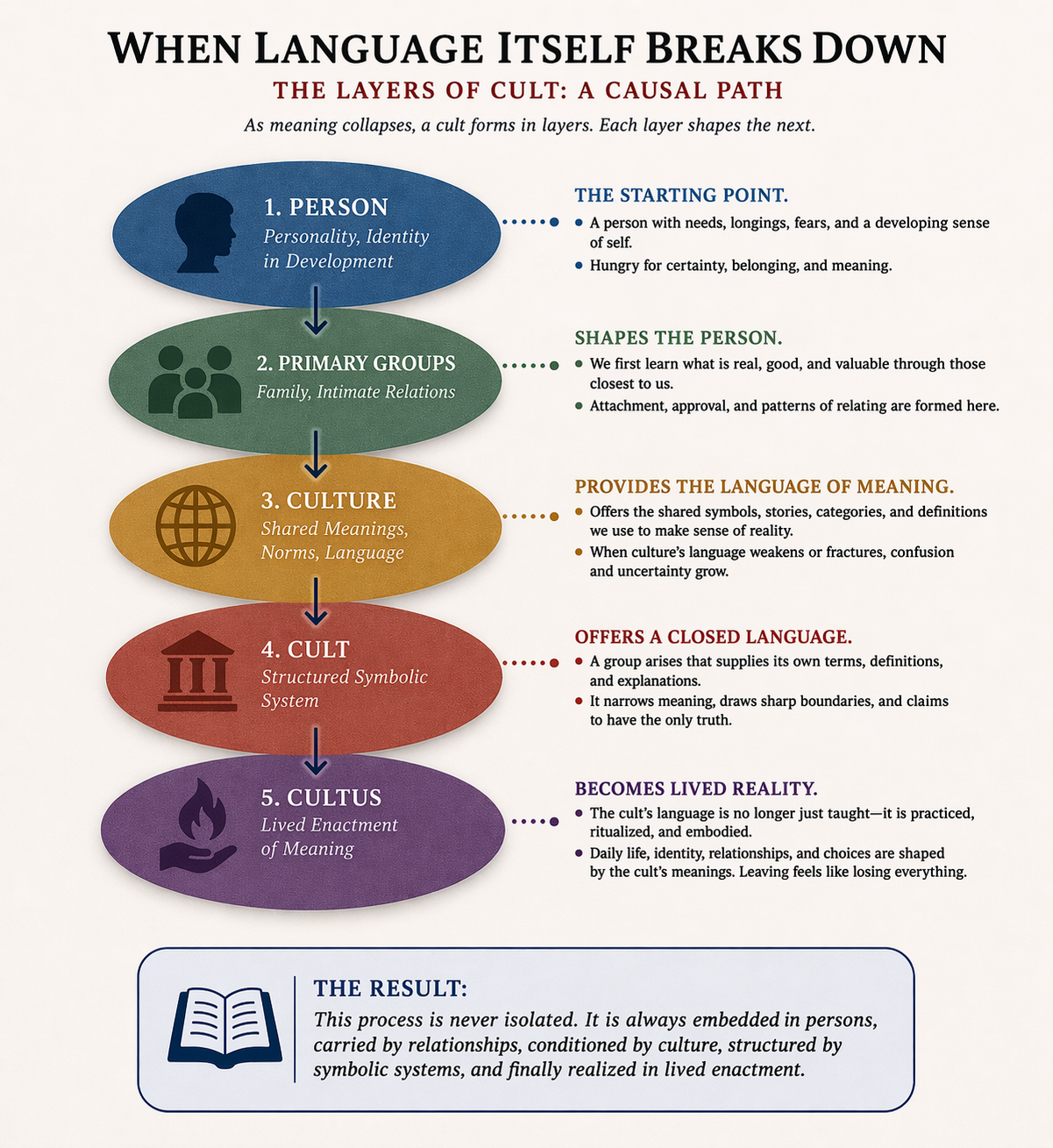
This layered movement—from person, to primary group, to culture, to cult, to cultus—closely parallels the functional understanding advanced by Henry Nelson Wieman and Regina Westcott-Wieman. For the Wiemans, religion was not primarily a set of doctrines but a process of human response to what they called “creative good.” Within that process, the cult played a necessary role: it gathered and organized the practices through which individuals and communities oriented themselves toward ultimate value. They treated the cult not as an aberration, but as an indispensable instrument. The cult is a way of cultivating responsiveness, shaping perception, and sustaining shared meaning over time. What this layering makes explicit is something their work implies: that this process is never isolated. It is always embedded in persons, carried by relationships, conditioned by culture, structured by symbolic systems, and finally realized in lived enactment.
Seen this way, the modern difficulty with the word “cult” is not merely semantic; it reflects a breakdown in our ability to perceive this layered reality. When the term collapses into its pathological meaning, we lose sight of the legitimate and necessary function it once named. The challenge, then, is not to discard the structure, but to recover its place within the larger ecology of lived religion. Religion is thus that ambient field where form serves life, and life continually renews form.
How ‘Cult’ Became a Warning Label
Sadly, the word’s usage has not remained fixed. Events of sensational significance during the 1950’s and 1960’s set the stage for a radical change in meaning. In contemporary convention, “cult” now suggests coercion, manipulation, and loss of personal autonomy. This shift has not been subtle. What was once a neutral description of religious structure has become a warning label. And yet, the underlying human need has not changed. People still require shared symbols, practices, and forms through which to express and stabilize their spiritual lives. The structure remains necessary; the word symbol no longer serves it. Did you ever consider the Crips, the Bloods, and Hells Angels as embodying shared symbols, practices, and forms through which to express and stabilize their lives? While primarily focused on criminal enterprise and territorial control rather than theological, spiritual, or ideological balance, they nevertheless do exhibit many "cult-like" aspects, where “cult” is seen only under the new pejorative usage.
Thus, the word “cult” once named something ordinary. Today it triggers suspicion, even alarm. That shift alone tells us something important: language moves, sometimes dramatically, while the realities it once described remain. If religion is to remain alive, it cannot ignore seismic shifts in terminology, culture, and knowledge that describe this all-to-important human need. Religion must translate itself into forms to connect with both intellectually and emotionally. So, for the student of the revelation the question is not whether the language has changed (it has) but whether Jesus’ gospel (as advanced in the Urantia Book) can be restated in a way that keeps pace with those changes. My premise is that it hasn’t—so far.
Two passages in the Urantia Book set the standard. We are told that religion “must…keep pace with all these advances in civilization” and that “the form of its expression must be restated every time the dictionary of human language is revised.” 99:1.6 (1087.3) We are also told that the Spirit of Truth works within each generation to provide “a new and up-to-date version of the gospel,” one that can address the “ever-new and varied spiritual difficulties” of the time. 194:2.1 (2060.6) Taken together, these statements leave little room for complacency. The issue is not preservation of wording, but preservation of meaning under changing conditions.
This is precisely where the demand for restatement becomes urgent. The revelation anticipates change. It does not assume that its original phrasing will remain transparent across generations. It teaches that changing the symbols, in fact, having a valid symbol is necessary. It places responsibility on those who receive it. The Spirit of Truth does not rewrite texts or update vocabulary from the outside. It works through individuals—through their insight, clarity, and willingness to translate enduring truths into living language. Revelation, in this sense, is not self-translating. It depends on participation—living and engaged participation.
The Gap No One Is Filling
Here, a deficiency begins to show when evaluating the more than seventy years after publication of the Urantia papers into a book. The Urantia movement has, in many ways, avoided the dangers associated with modern “cultism.” It has no central charismatic authority, no coercive structure, and places strong emphasis on individual study and experience. These are real strengths. But alongside them is a hesitation—a reluctance to reinterpret terms whose meanings have shifted. And that includes the additional task of introducing cosmically uplifted terms like soul, personality, Adjuster, Ultimate, the Supreme, or Paradise which are all more deeply problematic to symbolize. Faced with culturally crippled words like the contemporary “cult,” the instinct is often to defend the original usage rather than to figure out how to restate it. The result is a subtle but significant misfire. In the current dictionary of human language, the taint from applying “cult” to a true religious endeavor risks dismissal or outright avoidance, not because it is wrong, but because it carries with it seriously negative cultural baggage in the ears of the present age.
The revelation has been preserved more successfully than it has been socially embodied.
Here, however, a deeper structural issue begins to emerge. The Urantia movement has, in many ways, successfully avoided the dangers associated with modern “cultism.” It has no central charismatic authority, no coercive hierarchy, and places strong emphasis on individual study and personal religious experience. These are not small achievements; they represent a conscious or unconscious insulation from the very pathologies that have plagued institutional religion across history. But this success carries an unintended consequence. The very conditions that have preserved the movement from distortion have also inhibited the full emergence of religion as a shared, embodied, and socially transmissible reality. What has been avoided is not only pathological cultism, but, to a significant degree, cultism itself in its original and necessary sense.
This is not merely an external critique; it is increasingly recognized from within. The Urantia Revelation scholar Byron Belitsos, in his reflection on “Fostering Religion Where the Believers Are Gathered,” draws a distinction that cuts to the heart of the matter. Study groups and organizations, he observes, serve important educational and fraternal purposes, but they do not constitute religion in its fuller sense. Indeed, he states plainly that “study groups and societies are not ideal religious groups,” and more pointedly, that they may “actually replace or displace the functioning of a true religion or religious group.”[ref] What is missing is not information, nor even inspiration, but what he calls religious socialization—the unfolding by which personal experience becomes shared life, and shared life becomes a living vehicle for the gospel.
This distinction maps directly onto the layered structure already described above. Religion begins in the person, takes root in primary relationships, is shaped by culture, and is then stabilized through symbolic systems—the cult. But it is only in the cultus, the lived enactment of meaning, that religion becomes fully real. What Belitsos names as “the gathering of the believers” is precisely this missing layer: the point at which inward experience passes into shared practice, worship, service, and communal identity. Without this transition, religion remains largely interior and conceptual. It may be understood, even admired, but it is not fully embodied. In this light, the absence of developed communal forms is not a neutral omission; it represents a break in the natural movement from experience to expression.
Belitsos sharpens this further by recovering the original meaning of cultism within the revelation itself. “The cult is the skeletal structure around which grows the living and dynamic body of personal spiritual experience, i.e., true religion.” This is not a warning but a description of necessity. Every effective religion develops symbolic structure because human beings require shared forms to stabilize meaning, foster loyalty, and sustain continuity across generations. The issue, then, is not whether cultic structure will emerge, but whether it will emerge in a healthy, transparent, and experience-rooted way. To avoid it altogether is not to preserve religion in purity, but to arrest its development.
This brings the “misfire” into clearer focus. The movement has rightly resisted centralization, standardization, and institutional control. Belitsos himself insists that authentic religious groups “must not be centralized, standardized, or overly institutionalized.” But he is equally clear that some form of gathered, embodied religious life is non-negotiable. The presence of Christ “where two or three are gathered” is not a metaphor but a lived phenomenon—what he even describes, suggestively, as a kind of “field effect” arising when believers come together in shared spiritual intent. This presence does not attach itself to isolated individuals alone; it emerges in relationship, in shared practice, in the lived dynamics of the group.
Seen this way, the current configuration of the Urantia movement and its communities reflects a subtle substitution. The preservation and study of the text, the dissemination of ideas, and the cultivation of individual understanding have, in many cases, taken the place of religion as a shared and enacted life. The result is a community rich in insight but comparatively thin in shared religious embodiment. The community understands the leavened gospel, but less frequently enacted in the full range of communal forms: worship, ministry, sacrament, and service. These practices allow the expanded and corrected gospel of the revelation to become a lived and transmissible reality capable of shaping others through shared life. This is not a failure of intention, but a structural outcome of the movement’s historical posture.
And yet, the path forward is not obscure. Belitsos points toward a model that aligns closely with the demands already implicit in the revelation: decentralized, non-creedal, and non-hierarchical gatherings of believers; experimental forms of worship and ministry; networks of communities rather than centralized institutions. Such forms would allow the necessary emergence of symbolism and shared practice without reproducing the rigidities of traditional religion. They would represent not a retreat into institutionalism, but a maturation into religious life—an environment in which symbol remains transparent to experience, structure remains subordinate to meaning, and the living presence at the heart of religion can once again find full expression in the shared life of believers.
In this light, the issue is not simply that certain terms—especially “cult”—have become culturally impaired, requiring restatement. It is that the realities those terms once named have not yet been fully reconstituted in contemporary language and form. The movement has preserved the message with remarkable fidelity. The next step is to allow that message to take on life. That is, to pass from text into symbol, from symbol into practice, and from practice into a shared, living expression of the religion of Jesus. Only then does restatement achieve its true aim: not merely clearer language, but a renewed capacity for religion to be lived, together.
In his first book “Up close and Personal with the Urantia Book,” in the prologue to Part II, JJ Johnson quotes a Melchizedek of Nebadon with the statement “It is high time that man had a religious experience so personal and so sublime that it could be realized and expressed only by “feelings that lie too deep for words.”” He goes on to point out that one’s personal experience is the only positive proof of God that one individual can offer to another. In his subsequent recently published book “Exploring the Urantia Revelation Bridging the Science and Spirit with the Truth of Reality,” JJ explains in the section regarding his “spiritual birthday” how sharing experiences with spiritual realities is global:
All over the world, I met dignitaries, shopkeepers, and scores of others, rich or poor, who were eager to learn the truths contained in The Urantia Book. While in Islamabad, in what was the poorest part of town, I introduced the book to a young girl who started translating it so that she could share it with her family. Soon we had a group of eighteen young Pakistanis who wanted to know more. At least one of them learned English by reading the book. I could tell comparable stories from at least a dozen other faraway cities and towns.[ref]
What Johnson describes helps bring the entire discussion down out of abstraction and into lived reality. His citation of the Melchizedek regarding religious experience “so personal and so sublime” that it can only be expressed by “feelings that lie too deep for words,” cuts straight to the originating point of everything we have been tracing. Religion begins there: in the interior life, prior to language, prior even to symbol. And JJ’s further observation that such experience is the only positive proof one individual can offer another underscores a crucial limit. Religion cannot be transferred as information. It cannot be argued into existence. One and others must awaken, encounter, and live shared experiences.
But what JJ then goes on to describe in his travels reveals the next movement—the one that neither he nor Belitsos allows us to ignore. These deeply personal experiences do not remain sealed within the individual. They seek connection. They draw response. A young girl in Islamabad begins translating the book so her family can share in it. A small group forms. Others learn a new language simply to access the material. Across cultures, classes, and conditions, the same pattern repeats: the inward experience presses outward into shared life. What begins as something “too deep for words” nonetheless generates words, relationships, and eventually community.
This is precisely the transition Belitsos points to. The personal experience, while indispensable, is not self-sufficient. Left to itself, it remains private, incommunicable, and ultimately unsustainable across generations. It requires embodiment. It requires what he calls the “gathering of the believers,” that is, the socialization of that experience into forms that can be shared, enacted, and lived together. JJ’s accounts, though not framed in these terms, illustrate the same dynamic organically. Wherever the experience takes hold, it begins to create its own small ecosystems of meaning: symbol sharing, fellowshipping, study, and sharing experiences. These are the early stirrings of what the revelation would call cult and cultus: the symbolic and lived structures through which religion becomes real in the world.
Seen in this light, JJ’s global encounters both affirm and quietly expose the current limitations in the Urantia Book readership-student community. The revelation is reaching individuals. It is awakening personal religious experience across cultural boundaries. But what follows that awakening remains uneven. In many cases, the movement advances as dissemination, translation, study, and intellectual engagement all without consistently maturing into stable forms of shared religious life. The same energy that produces eighteen eager students in Pakistan is present throughout the community, but its next phase, its consolidation into enduring patterns of worship, ministry, and communal identity, is far less developed. (And it might not actually be possible in some cultures).
This brings us back to the central tension. Personal religious experience is the irreducible core; without it, religion is empty form. But without some form, however fluid and adaptive, that experience cannot be sustained, shared, or transmitted. JJ’s stories show the ignition point. Belitsos names the missing architecture. Together, they reveal the full trajectory: from inward encounter, to outward expression, to shared embodiment. The present moment of the Urantia movement appears to be rich in the first, active in the second, and still emerging in the third. The task ahead is not to manufacture religion, but to allow what is already awakening within individuals to find forms adequate to its expression. These are forms that remain transparent to the experience while enabling it to live, grow, and endure in the shared life of believers.
What Restatement Actually Requires
This is a particularly rich topic to address further concerns and questions. Many others such as: ‘Exactly what part of the gospel deserves restating?’ are beyond the scope of this essay. However, I will reiterate what I feel is a key theme of this essay: ‘What would acceptable restatements do?’ We looked at the term “cult” at some length to show that, in roughly just two short decades, events altered its meaning so profoundly that the word is now well-nigh unrecognizable from its original structure, form, meaning, and visceral image. The statement in the revelation “Regardless of the drawbacks and handicaps, every new revelation of truth has given rise to a new cult, and even the restatement of the religion of Jesus must develop a new and appropriate symbolism” 87:7.6 (966.1) does not register very well with contemporary society. How does one go about stating to a potential seeker that not only does the religion of Jesus require a new and appropriate symbolism, but a cult is that which a Brilliant Evening Star of Nebadon writes is the social vehicle to that will best do that? Master Seraphim … Help!
So, the question of function is where this essay landed. Restatements, new symbols, would not dilute an idea, even a concept; they would recast it and remove the offending habiliments. Instead of insisting on words and symbols that today may obscure original meaning, recastings would express the same reality in language that clarifies them and hopefully carrying with them cosmic representations. Every enduring spiritual insight generates shared practices, symbols, and communal forms. These can support growth, or they can become systems of control. The task is not to eliminate structure, but to ensure that it remains subordinate to living experience. The original insight then remains, now made intelligible without impediments from the changing mores.
I believe it is instructive to see how this kind of restatement works by looking beyond formal religion into secular society. Consider the movie It's a Wonderful Life.[ref] The film never quotes Jesus, yet it functions as a modern parable. Through a simple yet revealing story, the film demonstrates that an individual life holds value far beyond what we can see or measure. It restates the logic of the parable about the Good Shepherd. The individual matters, even when the system might treat one as expendable. At the same time, the film carries a Jonah-like movement: crisis, confrontation, and return. The protagonist does not escape his life; he learns to see it differently. Meaning was present all along, but hidden by a distorted measure of one’s value to humanity. I will show it took the community, a global community, that produced a cult acting through a cultus to bring this out and fuse new meaning from the story of George Bailey.
Even for someone unfamiliar with It's a Wonderful Life, one can see the pattern clearly. The story follows an ordinary man who, after years of quiet sacrifice for others, reaches a point of despair and comes to believe his life has amounted to nothing. Through a kind of imaginative reversal—an angel-in-training shows the main character, George Baily, what the world would have been like had he never existed. It is through these insights that he begins to perceive the hidden significance of his actions. What had seemed small and inconsequential reveals George has shaped an entire community.
It is here that George’s “spiritual birthday” becomes visible not only to him but the audience. The film offers a symbolic structure: the claim that a single life carries immeasurable value, even though the individual cannot measure or see it. But that claim does not remain confined to the screen. Time and again, viewers have returned to the story, often at Christmas, sometimes as a family ritual, and in doing so seemingly revere its perspective. Many have said they recognize their own lives in the protagonist’s struggle, and the film’s meaning becomes something more than an idea. The storyline opens a lens through which George can interpret his life’s experiences. This is especially striking given the film’s early negative reception. In its own time, It's a Wonderful Life was viewed with suspicion. It critiqued financial power and it emphasized communal care that drew even scrutiny from the Federal Bureau of Investigation (FBI) during an era wary of perceived collectivist ideas. Yet over the decades, the film has undergone its own kind of cultural transformation. It has become a staple of the Christmas season, not by institutional design, but through repeated, voluntary return. In that very process, it has taken on the character of a shared cultural practice; the story has been revisited, reinterpreted, and quietly enacted across generations.
Community preserves meaning. Movement carries it forward.
In this way, the film provides aspects of a cult: a shared symbolic narrative. And through repeated engagement—watching, discussing, recalling key moments—it’s narrative moves toward cultus: a lived enactment of its meaning. The audience does not merely understand the story; they begin to see their own lives differently because of it. By taking up the film's symbolic message, the audience completes its movement from a static idea into a lived reality, which allows the central insight to take root and quietly reshape their perception of value, purpose, and human connection.
I use this as an example to demonstrate that what unfolds here is not unique to a supposed secular film; it is the same pattern by which religion instantiates, lives, and endures. A religious tradition begins as a narrative disclosure. It is a way of seeing reality, but it persists only as a community assimilates and internalizes it over time. In taking up the narrative (returning to it, sharing it, and organizing life around it) the community, often unconsciously, comes to a structured field of meaning. And this develops as a cult in the original sense.
Community Holds It—Movement Carries It
Returning to the Urantia “community” or the Urantia “movement,” we should define what both mean and then apply these to the discussions that I addressed earlier by Belitsos and Johnson.
Community and movement name two different ways meaning takes shape and acts in the world. A community gathers around belonging. It stabilizes shared meaning through relationships, continuity, and mutual recognition over time. It answers the question, Who are we together? A movement gathers around purpose; it mobilizes meaning into action, direction, and spreads toward some change or outcome. It answers the question, What are we trying to change? Communities tend to endure; movements tend to surge. Communities hold identity; movements carry it forward. The expanded framework around the cult idea in fig. 2 clarifies this distinction: community organizes relationships and culture to preserve and transmit meaning, while movement carries that meaning into action, making it visible, repeatable, and capable of propagation. When the underlying symbolic system remains open, community deepens and movement becomes generative; on the flip side, when it closes, community can harden into enclosure and movement becomes the vehicle by which that closure spreads.
Figure 2. Community and Movement are both strong components available to the revelation’s adherents.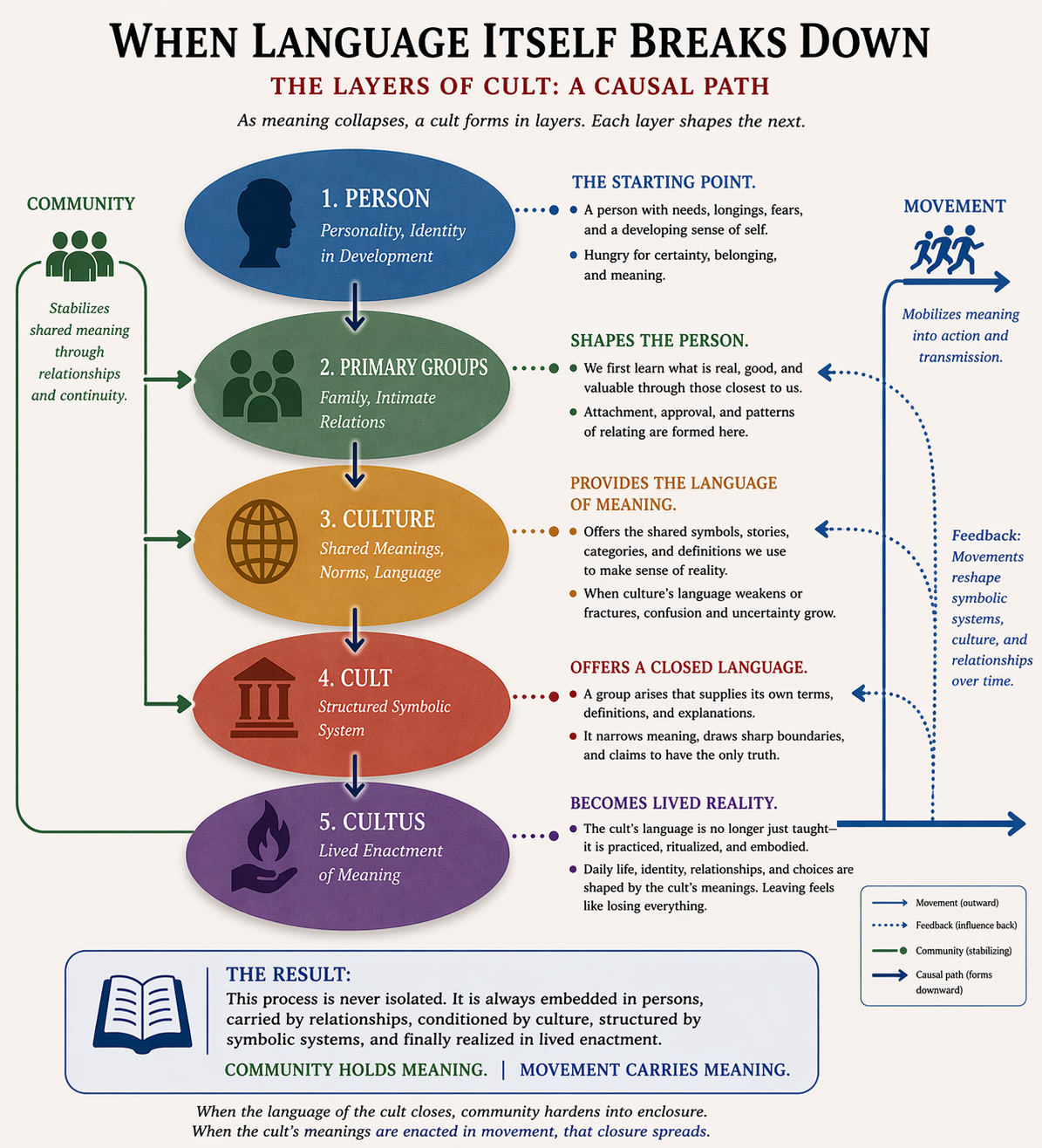
Figure 2 can be read as the interaction of two feedback dynamics moving through the same structure. Community operates as a stabilizing loop: it holds and transmits meaning through relationships and shared life, tending to preserve coherence over time. Movement operates as an amplifying loop: it carries meaning into visible, repeatable action, extending it outward through momentum and spread. Neither dynamic is inherently corrective or distorting. Their effect depends on what the symbolic system at the center is actually holding. When that system remains open and responsive to reality, community deepens shared life and movement extends living truth. When it closes upon itself, community stabilizes that closure as enclosure, and movement amplifies it as propagation.
Seen through the lens articulated by Belitsos where a living religion requires not only insight but embodied, shared forms, the historical development of the Urantia movement presents a mixed but intelligible pattern. The movement has clearly established robust structures at the level of community: decentralized study groups across the globe function as the primary social unit, fostering understanding, fellowship, and mutual correction of interpretation. Conferences, summer study sessions, and international gatherings, some drawing hundreds of participants, further reinforce shared identity and cultural continuity. Organizational bodies such as the Urantia Foundation and the Urantia Book Fellowship have ensured preservation, publication, and dissemination of the text, maintaining the integrity of the symbolic system at scale. In terms of Figure 2, layers 2–4 (relationships, culture, and symbolic structure) are clearly present and functioning, and the community loop (the stabilizing dynamic) is well developed.
What we see less fully realized, however, is the corresponding movement loop. This should provide a consistent, shared enactment of those meanings in forms that become socially visible, repeatable, and transmissible beyond the readership itself. While study groups occasionally incorporate worship, service, or informal ritual, and while the Fellowship explicitly envisions socialization, worship, and service as part of its purpose, the movement as a whole remains largely non-institutional and non-liturgical, with no clergy, formal congregational structures, or widely adopted communal practices. This aligns with its historical posture of “slow growth” and limited proselytizing, which has preserved openness but also constrained the development of a fully embodied cultus. The result is a system in which meaning is richly stabilized but only selectively mobilized. In this situation the community loop is strong, but the reinforcing movement loop operates intermittently rather than structurally. If Belitsos is correct that religion becomes globally generative only when people enact meaning in shared, living forms, then the present configuration reflects not a failure but an incomplete coupling of the two loops required for a religion to take durable, transmissible shape in the world.
Belitsos deserves plaudits for pressing the point that religion must become lived, shared, and embodied if it is to take root beyond the individual. He keeps the focus where it belongs: insight alone does not transmit; only enacted meaning does. Where the present framework extends his contribution is in showing more precisely where that embodiment must occur and how it can take shape. It does not arise at the level of doctrine or interpretation, but at the level of shared practice—where meaning becomes visible, repeatable, and capable of being carried forward. At the same time, the caution is essential: we cannot design a cultus from the top down without risking artificiality or coercion. Any attempt to prescribe forms too tightly would close the very openness that has been carefully preserved. What can be done—what should be done—is more restrained and more generative: create the conditions in which a living cultus can emerge naturally.
Any evaluation of the present moment should begin with the movement’s own governing vision and its contemporary self-reflection. The Constitution of the Urantia Book Fellowship lays out the formal intent: to foster study, disseminate the teachings through organized association, explicitly grounding these aims in a network of Local Societies joined in fraternal relationship. Ken Keyser’s open letter revisits that same foundation from lived experience, urging renewed attention to the primacy of societies as relational centers and cautioning against drift toward overly centralized or individualistic models. Taken together, these two sources, one structural, one interpretive, offer a coherent picture of what the movement has aimed to be and how it understands its own trajectory.
Even if societies are not themselves the final form of a lived religion, they may preserve the associative and relational framework necessary for one to emerge without coercion or centralization. They just may be the religious baby in the cultural bathwater.
The existing organizations already provide a strong framework for community and preservation, as both the Constitution and Keyser emphasize. What remains underdeveloped is not structure but enactment—the shared, repeatable forms through which meaning becomes visible and transmissible. These cannot be prescribed from above without risking artificiality, but they can be cultivated by encouraging local experimentation, recognizing emergent practices, and allowing them to circulate across the existing network of societies and projects. In this way, the organizations need not redesign themselves; they need only create space for the movement dynamic to arise from within the very community structures they already sustain.
Keyser argues that the center of gravity must remain relational, not institutional; the organization serves the societies, it doesn’t replace them. And this perspective identifies the threat as a drift toward individualized or bureaucratic models. He says plainly: “The success of the national/international organization was never the goal; it was to be a by-product. The success of the national/international organization was to be measured by the success of the constituent parts, the local Societies.” Thus, the threat is not merely a drift in organizational style, but a structural displacement: either toward individualism, where meaning remains private and unshared, or toward bureaucratization, where institutional forms begin to substitute for lived relationships. In both cases, local societies embody the relational center of gravity; but individualism or bureaucratization sunder a living, transmissible religion from ever emerging via the societies.
Keyser’s argument deserves strong affirmation because it protects the very condition without which nothing further can grow. By insisting that the center of gravity remain relational, he safeguards the local society as the primary locus of continuity, trust, and shared life. In my opinion, he reads the Constitution rightly: the organization exists to serve these societies, not to replace them, and its success should be measured by their vitality. In the platforms identified in this essay, he is defending the integrity of the community loop—the stabilizing dynamic that holds meaning in lived relationships over time. That is not a secondary concern; it is foundational. Without durable, face-to-face associations, meaning fragments into private interpretation or gets absorbed into institutional form. Keyser is therefore not simply resisting change; he is preserving the only environment in which a lived religion can take root at all.
What we are proposing here is not without precedent, even if it runs against the grain of nearly all historical religion on this world. The revelators themselves offer a striking example in The Urantia Book, Paper 72, describing a neighboring planet whose religious life develops without priests, ecclesiastical institutions, or formalized ritual systems. In paragraph 72:3.5, religion there aligns closely with philosophy and finds expression within the ordinary structures of social life rather than through a separate religious apparatus. That model comes surprisingly close to what the society-centered vision implies: a setting in which meaning is held relationally and expressed organically, rather than codified institutionally. Measured against the long arc of Urantian history religion has almost invariably crystallized into priesthoods, hierarchies, and formal cults. This model we’re suggesting represents a profound departure. And yet, it is not speculative. We are told plainly: it can work.
At this point, it becomes useful to introduce Alexis de Tocqueville, not as a historical aside but as an observer of a social pattern that directly bears on what is being proposed. In Democracy in America,[ref] Tocqueville identified a distinctive feature of early American life: the spontaneous formation of voluntary associations that mediated between isolated individuals and centralized institutions. In an earlier work, Reframing the Global Endeavor’s Regional Structures[ref] I described a similar dynamic as the “invisible motor.” This is the underlying force by which meaning, once shared in relationship, moves outward through lived activity rather than imposed structure. What Tocqueville observed externally, this concept attempts to name internally. The overlap is not accidental. What we are calling societies, when understood at their full depth, begin to resemble these associative forms. They are not merely gatherings for study, but substantive groups in which meaning is held, enacted, and made visible. Tocqueville helps clarify why this matters: without such groups, meaning either remains private or becomes institutionalized; with them, it can circulate organically. In this sense, his work provides a concrete, historical instance of the very mechanism by which the movement dynamic we are describing can emerge and sustain itself.
This is where the parallel with Alexis de Tocqueville becomes more than illustrative. In his observations of early American life, Tocqueville identified a social fabric woven not primarily through centralized authority, but through voluntary associations—small, self-organizing groups that sustained civic life, transmitted values, and generated collective action. These associations functioned as a kind of living intermediary between the individual and the state, preserving both freedom and cohesion. What Tocqueville saw in the civic domain closely mirrors what is needed here in the religious domain: societies that are neither isolated individuals nor bureaucratic institutions, but relational centers where meaning is shared, enacted, and carried forward. In this light, the “soil-tilling” we are describing is not an invention, but a recovery of a pattern—one that has proven itself in human social life, and one that, according to the revelators, is capable of sustaining religion without the historical burden of institutionalization.
The Work Still Ahead
What this essay set out to show, and what I trust has demonstrated, is that much of the gospel of Jesus, as amplified in The Urantia Book, now requires restatement if it is to reach the minds and hearts of the present generation. Language has not stood still. In the seventy years since publication, the meanings of key terms have shifted, in some cases dramatically (and maybe even more so since the early twentieth century from which much of its phrasing derives).
The word “cult” provides a striking example of this transformation. Once denoting a necessary psychic and social structure for the development of religion, it has taken on a largely pejorative meaning. Likewise, symbols such as communion, originally intended as lived expressions of shared spiritual life, now risk being received as abstractions—representations mistaken for reality rather than vehicles for entering it. Through examples as varied as Jonah and Death of a Salesman, we see that symbols can still carry enduring truths, particularly the value of the individual, however only when they remain connected to lived experience.
This led to a deeper question: if the structure once named “cult” remains necessary, but the word itself has become unusable, what replaces it? Exploring that question revealed a layered process: person; primary groups; culture; symbolic structure; and finally lived enactment. This unfolding gave rise to the model presented in Figure 1. Seen as a layered and holonic progression, the role of cultus became clearer: not as an abstraction, but as an actualization of meaning in shared life.
At this point, a critical gap came into focus. The community of reader-students that formed around the revelation post-publication is rich in intellectual and cosmological understanding. It was, and is, vastly different than the original Forum. It has, in many cases, remained hesitant to embody these truths in shared, lived forms. Having distanced itself from institutional religion, it now faces a self-created chasm: strong in insight, but comparatively underdeveloped in religious socialization.
Here the insights of Byron Belitsos become especially relevant. What is lacking is not information, nor even inspiration, but the process by which personal religious experience becomes shared life. And shared life becomes a living vehicle for the gospel. This insight aligns naturally with the preservation of societies and with the concept of Global Endeavor “substantive groups,” suggesting a structural path forward.
What emerges, then, is not merely critique but opportunity. Community and movement need not be opposed; they can be differentiated and integrated. Community stabilizes meaning; movement enacts and extends it. Together, they form a dynamic system capable of sustaining both truth and life. This realization gives rise to the model represented in Figure 2.
The challenge is clear: to develop forms of shared life that do not merely preserve the revelation, but embody it. These are forms that allow individuals to step into the reality the symbols were always meant to convey. Without such forms, even the highest truths risk remaining inert. With them, the gospel becomes once again what it was always intended to be: not simply understood, but lived.
// Bob Debold May 2026.