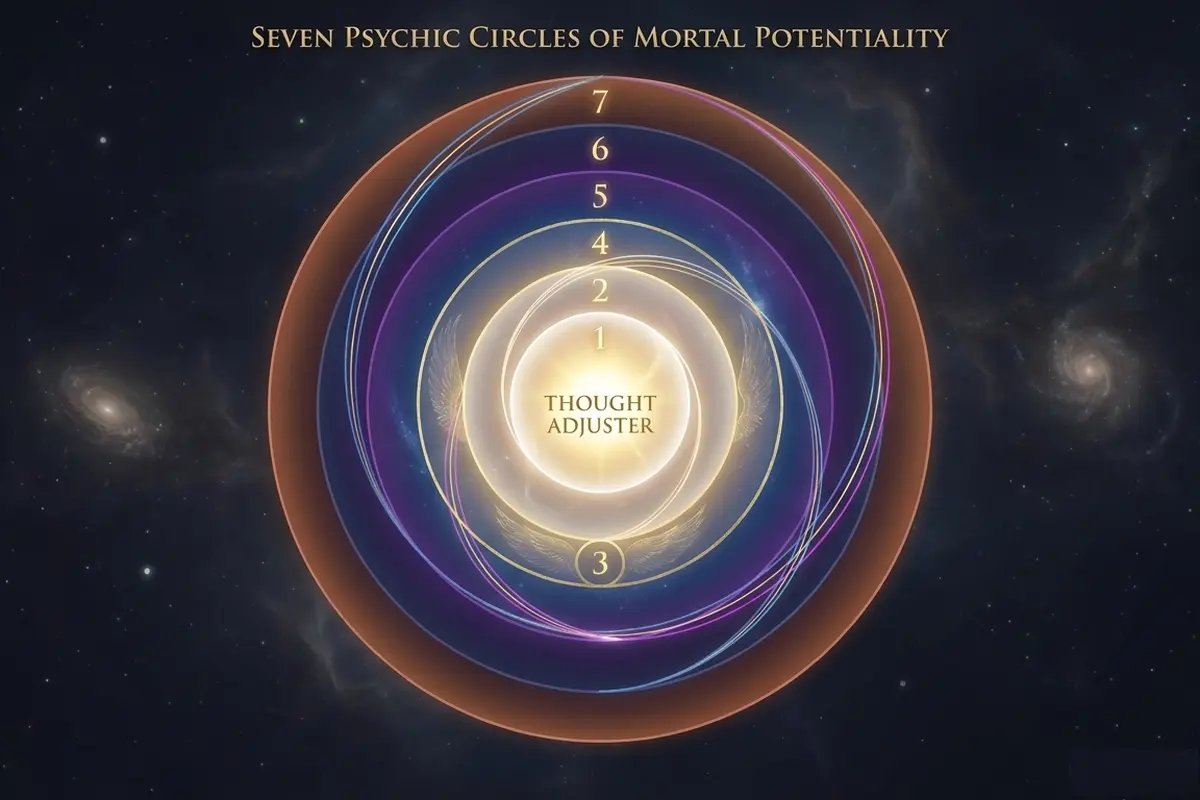
The psychic circles of mortal progression are actual meaning grasps and value realizations of the progressive approach to the super-material consciousness of one's initial relationship of the evolutionary soul with the emerging Supreme Being. The psychic circles are not exclusively intellectual, neither are they wholly morontial; they have to do with personality status, mind attainment, soul growth, and Adjuster attunement.
The Seven Psychic Circles
Abstract
In "The Seven Psychic Circles," Linda Buselli opens a window into one of the most experiential teachings in The Urantia Book: that spiritual growth is not merely believed, studied, or symbolized—it is lived. The circles do not describe a system to be mastered intellectually; they map a life to be enacted from the inside out.
This emphasis on lived experience resonates directly with the central concern of my recent essay, Restating the Gospel in an Age That No Longer Speaks Its Language. There, the challenge is clear: when language, symbols, and inherited forms lose their immediacy, meaning risks becoming abstract—something discussed rather than embodied. The psychic circles offer a corrective response to the modern tendency to substitute language, symbols, and inherited forms for the lived experience they were meant to convey. They relocate religion from the level of explanation to the level of participation.
This drift from participation to abstraction did not emerge overnight; it has deep historical roots. As the early Jesus movement spread beyond its original setting, the emphasis gradually shifted, especially in the wake of Paul the Apostle. The locus shifted from the lived, shared experience of the kingdom of God to increasingly articulated beliefs about the person and work of Jesus. What began as a religion of Jesus which Jesus taught centered on doing the Father’s will, living truth in relationship, and embodying the gospel in daily life, became progressively reframed into a religion about Jesus, where theological interpretation, doctrinal formulation, and symbolic representation took on greater prominence. This development was not without value; it helped preserve and transmit the message across cultures and generations. But it also introduced a subtle shift: the center of gravity moved from participation in a transforming way of life to assent to a system of meanings about that life. The result is a tension that persists to this day between a gospel that must be lived and a religion that can be “too easily explained.” In other words, as one that has been reduced to ideas that describe, defend, and systematize—without necessarily being lived, struggled through, or embodied.
What Buselli’s essay makes plain is that spiritual progress unfolds through decisions—real choices made in the friction of daily life. Each circle represents a deeper integration of personality, mind, and soul, achieved not through passive assent but through active alignment with truth, beauty, and goodness. In this way, the circles function less like theological categories and more like a lived grammar of the spirit.
This is precisely where the connection sharpens. If the earlier essay asks how the gospel can be restated so that it once again speaks to modern minds, the doctrine of the psychic circles answers by showing how it can once again be lived. It bypasses the instability of language by rooting meaning in experience itself—within the person, within relationships, within the unfolding pattern of a life choosing toward higher values.
To place it plainly: where symbols can drift, experience anchors. Where language evolves, lived reality persists.
Seen in this light, the seven psychic circles are not only a map of individual growth but also a bridge between revelation and relevance. They demonstrate that the enduring power of the gospel does not depend solely on how it is stated, but on how it is embodied—how it takes form in the decisions, loyalties, and inner transformations of those who live it.
As this essay finds its place among the Topics to be explored and revisited, it serves as a reminder that the deepest truths do not wait on perfect language. They wait on participation.
// Bob Debold 1st draft May 12, 2025
Updated April 27, 2026 -
Updated April 27, 2026 -