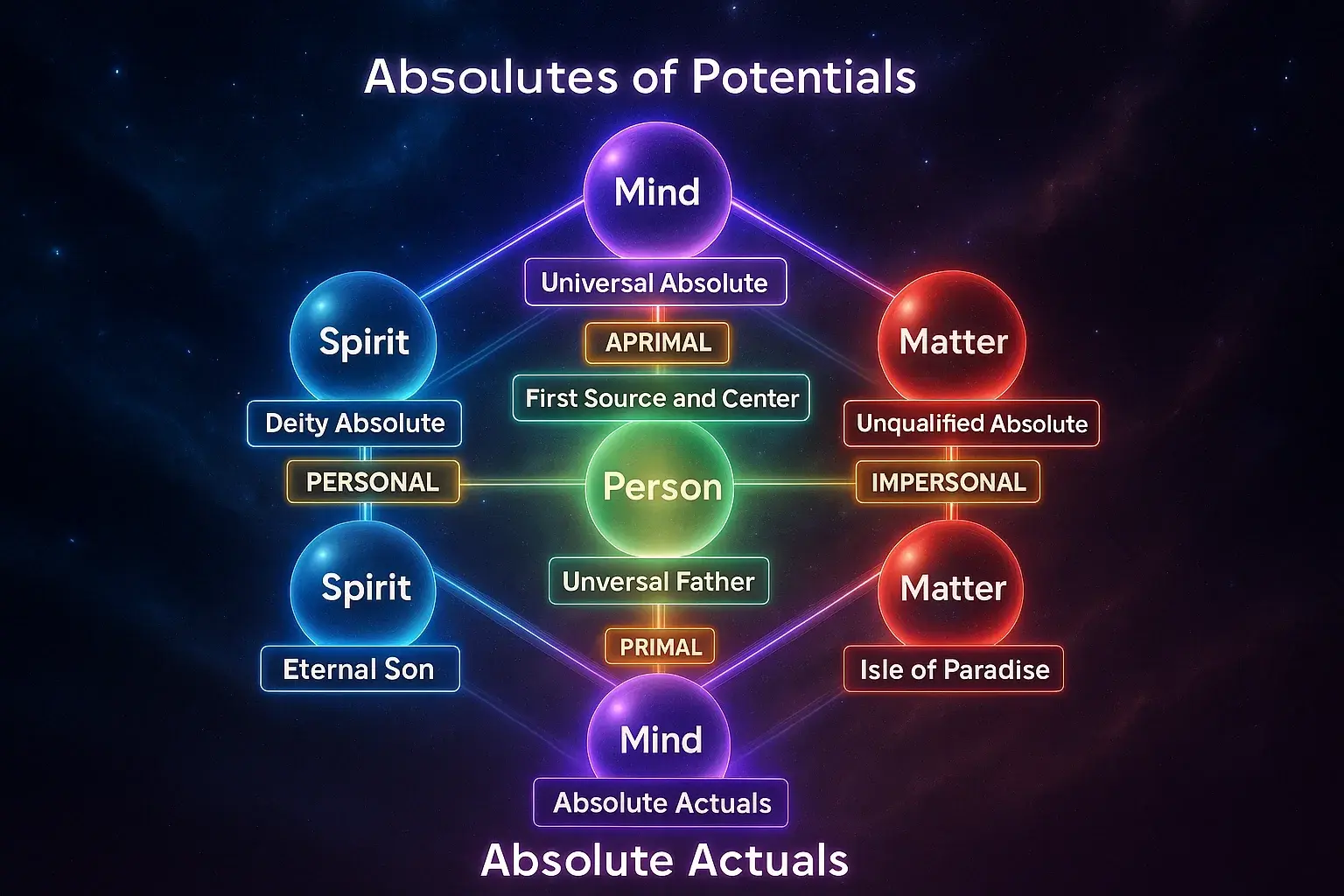
(Thanks to Stuart Kerr for the diagram)
Trinities and Triunities: Expanded Relationships Between all Seven Absolutes
Abstract
This essay explores the profound distinctions between the concepts of Trinity and Triunity as revealed in The Urantia Book, with a focus on the nuanced explanations provided in Papers 10 and 104. The analysis begins by examining the structured nature of the Paradise Trinity, a unified, absolute reality composed of the Universal Father, Eternal Son, and Infinite Spirit—three divine Persons acting in perfect harmony as a single Deity. In contrast, Triunities are described as associative relationships, not unified entities, where three Absolutes, one of which must always be the Universal Father, function cooperatively without becoming a singular divine being. Using the metaphor of a tree—where the trunk represents the structured unity of the Trinity, the roots signify the divine potentials, and the branches embody the dynamic expression of divine reality—the essay clarifies how these two concepts operate within the grand cosmology of divine existence. This exploration reveals how the Paradise Trinity provides a stable, unifying center for divine action, while the Triunities enable a dynamic, relational interplay between divine principles, ensuring that the cosmos is both unified and infinitely diverse.
Prologue
This essay represents an evolving exploration. It is my personal interpretation of the far-reaching concepts that the revelators have presented to Urantia, a world with a complex and often turbulent history. Notably, for matters “beyond the borders of the local universe of Nebadon,” the Ancients of Days—Trinity-origin personalities and administrators of superuniverse number seven—commissioned "the papers that portray the nature and attributes of God.”[ref] In my opinion, one should not take this aspect of who was involved in the content of the revelation lightly; this fact alone merits some serious reflective thought.
The trinity concept that a monothetic God is simultaneously a member of a union of three equal infinite partner personalities, can only arise in humanity via revelation; the staff of the Planetary Prince (Caligastia) instantiated the first revelation leading to the comprehension of the Paradise Trinity about one-half million years ago on Urantia. However, I note that Eastern philosophies while mimicking the theological Paradise Trinity—a standard feature of Western Christianity as an organic triad, ironically provide the capacity to expand cosmic reflection for further relationships God has with respect to non-personal non-Father aspects of His universe. And this is where the almost ineffable idea of triunities comes to the forefront. A Melchizedek of Nebadon brings this point home:
104:2.6 (1146.2) The conceptual grasp of the Trinity association of Father, Son, and Spirit prepares the human mind for the further presentation of certain other threefold relationships. Theological reason may be fully satisfied by the concept of the Paradise Trinity, but philosophical and cosmological reason demand the recognition of the other triune associations of the First Source and Center, those triunities in which the Infinite functions in various non-Father capacities of universal manifestation—the relationships of the God of force, energy, power, causation, reaction, potentiality, actuality, gravity, tension, pattern, principle, and unity.
Nevertheless, in spite of the fact that Urantian humanity benefitted from 300,000 years of spiritual instruction, the unsettled times following the planetary rebellion nearly eradicated this earliest Trinity concept to the world.[ref]
Over 160,000 years passed after the rebellion before Adam and Eve rekindled the concept of the Trinity around 37,000 BCE. Unfortunately, their default caused this spiritual flame to diminish, leaving only glowing embers until Melchizedek revitalized it around 4000 BCE. The revelation clearly states that the concept of a true trinitarian postulate—three gods, cosmic values, or godheads forming an organic entity—exists in the cosmos and specifically on Urantia. I emphasize that the previous four revelations offered little explanation of the Trinity’s function or purpose. Our study group has been examining this concept as presented in Paper 104. In my view, this fifth revelation to Urantian humanity provides the first comprehensive explanation of why, what, and how the Paradise Trinity functions, along with the related concepts like the triunities.
The cosmology of the Fifth Epochal Revelation that begins with the separation of the I AM into the seven Absolutes of Infinity certainly challenges all who attempt to fathom the depth of this revelation. It may be part of the reason why the book hasn’t gained more traction across humanity just yet. However, that night during the study session all the participants were quite willing to grapple with these lofty concepts. While extremely challenging, and sometimes admitting to partial understanding, the effort was actually invigorating not only intellectually but spiritually.
Holistically Whole
Understanding the profound difference between a Trinity and a Triunity is key to grasping the divine architecture described in The Urantia Book. In this paper, particularly in section 3, the Melchizedek distinguishes these two concepts through the terms “structured” and “associative.” He emphasizes that a Trinity is a structured divine entity, consisting of three infinite divine persons—Father, Son, and Spirit—united as a single, unified Deity. This is a holistically structured relationship, where these three infinite Deities merge into one divine entity with specific functions and roles.
In contrast, a Triunity is an associative relationship, not a structured entity. At the existential level of reality discussed in Paper 104, a Triunity consists of three of the seven Absolute entities—one of which must be the Universal Father—collaborating in a coordinated but non-structured manner. Unlike the Trinity, which is a unified whole, the Triunity represents three distinct Absolutes functioning together as a cooperative team. The rest of this essay will flesh these differences out both metaphorically and technically.
Before doing that one quick thought: In the discussion of the Triunities in The Urantia Book, specifically the idea of seven variations of three of the Seven Absolutes of Infinity, are best described as combinations, not permutations. The Triunities are defined as groupings of three Absolutes, but the order in which these three are considered within any Triunity does not change the nature or function of that Triunity. For example, the combination of First Source and Center, Universal Absolute, and Deity Absolute is one Triunity, and reordering them does not create a new or distinct Triunity - thus a combination.
Since each Triunity must include the Universal Father, this restriction dramatically reduces the total number of possible Triunities from 35 to 15. We are revealed only 7. Even though mathematically 15 Triunities are possible under this Father rule, the Melchizedek only specifies seven Triunities because these seven are spiritually and theologically significant. They each represent distinct relationships and functions essential to the cosmic and divine structure.
104:4.45 (1150.12) These approximations are sufficient to elucidate the concept of the triunities. Not knowing the ultimate level of the triunities, you cannot fully comprehend the first seven. While we do not deem it wise to attempt any further elaboration, we may state that there are fifteen triune associations of the First Source and Center, eight of which are unrevealed in these papers. These unrevealed associations are concerned with realities, actualities, and potentialities which are beyond the experiential level of supremacy.
Let’s expand upon the idea of what the Melchizedek means by “structured.”
A structured entity is where three individual actors are inseparably one; outcomes, decisions, and roles consummate as a singular output, presumably of joint deliberation. In the Trinity, the Father, Son, and Spirit function as a combined entity, not as individual persons. In other words, they perform in a nonpersonal way when the Trinity acts. A Universal Censor says his illustration is crude, but a father, son, and grandson could form a corporate entity which would be nonpersonal but nonetheless subject to their personal wills.[ref] Another way the Universal Censor explains this conjoint functioning is by calling it an “organic entity.”
While I bow to the Universal Censor as dwarfing my rather limited finite mortal mind, I submit a corporation has some limitations perceiving it as an organic entity. Especially when we usually think of organic as something living, like a tree as opposed to a rock. A corporation is an abstraction that doesn’t appear to me to fit the definition of “living” which is typically associated with "organic."
I’ll begin with organic unity because it provides a foundational concept where a whole is more than the sum of its parts.
Organic Unity: One Whole Formed by Many Parts
In philosophy and metaphysics, organic unity refers to a whole made up of interdependent parts that together form a single, integrated entity. In such a unity, the parts need each other and work together so closely that the whole is “greater than the sum of its parts.” For example, a living body is composed of organs that cooperate; each organ is part of one organism and cannot function in the same way on its own. In contrast to a random collection of items, an organic whole has an internal cohesion – every part contributes to the whole, and removing one part would harm or disrupt the unity. Philosophy, literature, and theology present the idea of organic unity when they describe a oneness formed by distinct elements working as one.
Organic vs. Mechanical vs Aggregate Wholes
Let’s take a deep dive and take a look now how an organic whole differs from other kinds of wholes, like a mechanical or associative whole, and an aggregated whole:
Mechanical/Associative Whole (Machine)
These are systems where the parts interact to produce effects or functional outputs that are more than just their combined capabilities. They do not self-repair or reproduce, but they achieve synergy through their interaction. Think of a car or a mechanical clock. It’s made of parts put together in a designed way. In fact, the parts interact; if one gear breaks, it stops the clock or the car's transmission falters. However, you can replace each individual part with a similar one.[ref] Nevertheless, an external plan or assembly creates a unity through intelligent design. The parts are means to an end – they serve the machine’s intelligently designed function but, in most cases, don’t have much purpose by themselves. Engineering generally calls a mechanical whole an assembly; if you take one piece out, the other pieces are mostly unchanged (though the machine might stop working). With a clock or watch the parts by themselves won’t give you the time; it takes the whole unified assembly to do that.
Mechanical wholes do not self-repair or reproduce, but they do achieve synergy through their interaction.
Let’s look at three examples.
Jet Engine
A jet engine is a remarkable example of a mechanical whole, where multiple interdependent components come together to produce a unified effect far greater than any of the individual parts could achieve alone. At its core, a jet engine is composed of a compressor, a turbine, fuel injectors, a combustion chamber, and an exhaust system. Each of these components has a specific role: the compressor pressurizes incoming air, the fuel injectors introduce fuel, the combustion chamber ignites the mixture, and the turbine converts the exhaust’s energy into mechanical motion. Together, they form a system designed for one primary purpose—propulsion.
The true power of the jet engine is its ability to generate thrust, a force that propels aircraft at incredible speeds. This thrust is not an inherent property of any single part of the engine but rather a product of their combined and carefully coordinated interaction. The compressor alone cannot create thrust; the turbine alone is merely a spinning device; the fuel without ignition is inert. It is only when all parts work together that the engine achieves a continuous cycle of air intake, compression, combustion, and exhaust, producing a steady stream of forward force.
This intricate interaction is what makes the jet engine a mechanical whole. It depicts how a triunity functions—each part is essential, but the effect they produce is far greater than the sum of their individual functions. The engine is not an organic system; it cannot self-repair or adapt, but it is a dynamic whole where the failure of one part can render the entire system useless. Its greatness lies in its synergy—the combined action of the parts to achieve a purpose they could never achieve independently.
Digital Computer
Example two is a digital computer. A digital computer exemplifies a mechanical whole in which diverse, highly specialized components interact to produce a synergistic effect—computational power. A computer generally contains a central processing unit (CPU), memory (RAM), storage devices (HDD or SSD), input devices (keyboard, mouse), and output devices (monitor). Each of these parts has a distinct function: the CPU performs calculations, the RAM temporarily holds data for active tasks, the storage retains files, and the input/output devices allow user interaction. On their own, these components are static, but when connected, they create a system capable of logic, communication, and complex problem-solving.
The true magic of a computer lies in its ability to perform functions that no single component can achieve alone. It can run sophisticated software, execute billions of calculations per second, connect to global networks, and store vast amounts of information. None of this is possible with just a CPU or just a monitor. It is the coordinated action of all these components, working under a unified operating system, that makes the computer more than just a sum of parts.
Unlike an organic system, a computer cannot self-repair or reproduce. If the CPU fails, the computer ceases to function until someone or something replaces the part. Yet this lack of organic self-repair does not diminish its status as a mechanical whole. The computer is a system of interdependent components, each essential to the unified function of the whole. It is a prime example of a mechanical triunity—its true power comes from the precise coordination of diverse parts.
Laser System
The last example is a laser system. A laser system is another clear example of a mechanical whole where the unified function is far greater than the capabilities of any single part. The essential components of a laser include a gain medium (such as a crystal, gas, or semiconductor), an energy source (often an electrical power supply), mirrors for light amplification, and a focusing lens. Each component has a distinct role: the gain medium amplifies light, the energy source excites the medium, the mirrors direct the light, and the lens focuses it into a coherent beam.
The unique quality of a laser is its capability to emit a highly focused, coherent beam of light. Not any one component individually produces this property. The gain medium alone can absorb energy but cannot produce a laser beam. The mirrors reflect light but do not generate it. The lens can focus light but cannot create it. Only through the combined interaction of all these parts does the system produce a laser beam—a phenomenon characterized by a precise wavelength, direction, and intensity.
This is why a laser is a mechanical whole rather than an aggregate of parts. It is a triunity of components that together achieve a purpose beyond their individual capabilities. Yet, like other mechanical wholes, a laser cannot self-repair or reproduce. If we disconnect the energy source, the laser stops working. Yet its power lies in the synergy of its parts—an interconnected system that transforms raw energy into a precisely controlled, coherent light beam.
Associative Whole (Aggregate)
This is a loose collection where parts are just together by coincidence or simple association. Imagine a pile of stones or a group of people who happen to be in the same room. There’s no internal unity or common purpose; the parts don’t form a single organism or mechanism. Removing or adding parts doesn’t really change the character of the collection. It’s basically just a set of individual components.
An organic whole maintains an unbalanced equilibrium, repairs itself, reproduces, grows, and changes over time. It can learn and adapt, follows an internal purpose, and sometimes exhibits emergent properties.
Organic Whole (Organism)
An organic whole differs fundamentally from a mechanical or aggregate whole. It maintains an unbalanced equilibrium, repairs itself, reproduces, grows, and changes over time. It can learn and adapt, follows an internal purpose, and sometimes exhibits emergent properties—behaviors of the whole that you cannot fully predict by examining the behaviors of its individual parts.[ref]
Let’s look at a couple of organic whole examples.
Think of a living body (a human or a plant). Its parts (organs, cells) unify from within. They are not just stuck together; they grow together and mutually depend on each other. Each part exists for the sake of the others and for the whole, and in turn the whole sustains each part. As one philosopher noted, in an organism “the parts are both means and ends” for each other.[ref] If one removes or disrupts an individual part, the others suffer and the whole becomes fundamentally changed (unlike a machine where you can swap a gear). In an organic unity, the whole defines the identity and function of each part; in substance, the whole exists before the parts. The parts only truly exist as parts of the one whole. This makes the whole indivisible in a deep way. For example, you can’t split a living cell into independent pieces and still have it function as before.
The concept of organic unity becomes clear in the challenges of organ transplantation, especially heart transplants. In a machine, you can replace a damaged part with an identical one without affecting the function of the whole. However, living organisms resist such substitution because each part is biologically and immunologically integrated into the whole. When surgeons transplant a heart into a new body, the recipient’s immune system often recognizes the new heart as a foreign object, triggering an immune response called rejection. The body identifies the transplanted heart as "not-self," even if it is biologically compatible.
To address this problem, doctors use immunosuppressive drugs that weaken the body's rejection response. Unfortunately, these drugs also make the patient more vulnerable to infections. This situation reveals that an organic system is not just a collection of parts but an interconnected living unity, where each part depends on its relationship with the whole. For the new heart to function properly, it must become an integrated part of the patient’s organic unity. This integration is complex because living systems are not merely assemblies of interchangeable parts.
When Organic Parts are Replaced ...
The phenomenon of some transplant recipients reporting personality changes they attribute to their donors offers a provocative illustration of organic unity. Although these cases are largely anecdotal and not fully understood by science, they suggest that the integration of a donor organ into a recipient's body may coincide with profound psychological and emotional shifts. Such experiences, whether due to psychological factors, cellular memory theories, or other unknown mechanisms, reinforce the concept that in an organic system, the whole is greater than the sum of its interconnected parts. It is my opinion that these stories reflect the idea that in an organic system, the whole interconnects the parts as a result of the bold claim that the whole exists before the parts.
This idea—that the whole exists before the parts—is not an isolated notion. It draws upon a rich tradition of philosophical thought. Aristotle first articulated a foundational concept of this idea, declaring that “the whole is greater than the sum of its parts.” For Aristotle, living organisms were not merely collections of independent parts but unified wholes where each part derived its identity and purpose from the whole. Similarly, the philosopher Gottfried Wilhelm Leibniz introduced the concept of monads, where each indivisible entity mirrored the entire cosmos, suggesting that each part exists in a pre-established harmony with the whole. This theme of interconnectedness was further developed by Alfred North Whitehead, who proposed in his process philosophy that reality is an ongoing process of becoming, where the whole is a dynamic unity that precedes and integrates all individual events.
Modern thinkers have continued to support this view. Jan Smuts, in his work Holism and Evolution, emphasized that wholes possess qualities that cannot be reduced to the sum of their parts, a view that directly aligns with the concept of organic unity. Physicist David Bohm expanded this idea into the realm of quantum physics with his theory of the implicate order, where all reality is an interconnected whole, and the parts we observe are simply unfolded aspects of a deeper, unified reality. Even in biological contexts, the ideas of Michael Polanyi affirm that complex organisms demonstrate emergent properties—capabilities that cannot be predicted by analyzing their individual parts. Such perspectives align with the teachings of The Urantia Book, which consistently presents the universe as an interconnected whole where divine and cosmic unity govern the relationships of all components. This is especially apparent in the revelation of the Supreme.
The organic whole is not merely an aggregation of independent parts but a dynamic unity where each part has meaning only within the context of the whole.
From the ancients to the moderns, the consistent theme remains: in an authentic organic unity, the whole precedes the parts. The behavior, purpose, and even identity of each part are defined by its relationship within the larger whole. These philosophical insights lend further credence to the concept that in any true organic system, whether a living organism, a family, a society, or even a universe, the whole is not merely an aggregation of independent parts but a dynamic unity where each part has meaning only within the context of the whole.
Claire Sylvia, the first recipient of a heart-lung transplant at Yale-New Haven Hospital, reported unexpected changes in her preferences and behaviors following her surgery. Notably, she developed cravings for foods she previously disliked and exhibited mannerisms reminiscent of her donor, an 18-year-old male. Sylvia's experiences were documented in her book A Change of Heart and have been cited in discussions about cellular memory and personality changes post-transplant.
A nine-year-old boy who received the heart of a three-year-old girl who had drowned developed an intense fear of water post-transplant. This phobia was unexplained by his prior experiences and was only understood after learning about his donor's cause of death.
And Kevin Mashford, after receiving a heart transplant, developed a sudden passion for cycling, a sport he had never engaged in before. Upon discovering that his donor was an avid cyclist, Mashford attributed his newfound interest to a connection with his donor's passions.
These instances underscore the idea that organs may carry more than just biological functions; they might also transmit aspects of the donor's personality characteristics, preferences, or memories. Such phenomena challenge the mechanistic view of the human body and support the concept of organic unity, where each part is not only integral to the whole but also carries the essence of the whole within it.
Let's look at one more example to show how an organic whole is a unified system that sometimes may be a system in a system. In fact, this example for me comes closest to providing a metaphor for how a Trinity inter-associates with a triunity.
The Tree as an Organic Whole: A Living System of Unity and Triunity
The tree is one of nature’s most profound examples of an organic whole, an interconnected living system where multiple distinct parts work together as a single, unified entity. But beneath its towering structure and spreading canopy lies a complex, triune relationship among roots, trunk, and branches—a relationship that not only sustains life but also reveals a deep and elegant pattern of organic unity as exemplified by the trunk.
1. Roots: The Search for Potential
At the base of the tree, the root system is an intricate network of fibers that reaches deep into the soil, seeking out water, minerals, and nutrients. The roots are not merely anchors; they are active agents of absorption, pulling in life-sustaining resources from the environment. The root hairs, the smallest extensions of the roots, greatly increase the surface area for nutrient uptake, making this underground network a dynamic, adaptive system.
Yet the roots are not independent. They are part of a living relationship, drawing in not only water and minerals but also interacting with a complex ecosystem of soil microorganisms—bacteria, fungi, and other organisms. In a symbiotic partnership known as mycorrhizae, certain fungi form a cooperative relationship with the roots, extending the reach of the tree’s nutrient-absorbing capabilities while receiving sugars produced by the tree in return. Here, the roots are the tree’s means of accessing potential energy and matter from the environment, but they do so in a way that is organically integrated with the life of the tree.
Even at this foundational level, the root system demonstrates a kind of triunity—it is a complex, cooperative network, not a single part but many parts acting as one. The root system is diversified, with some roots going deep for stability while others spread wide for maximum absorption. This diversity in unity is the first glimpse of the organic triunity that characterizes the entire tree.
2. The Trunk: The Organic Conduit
The trunk of the tree is its most visibly unified structure, a sturdy, upright column that connects the subdivided underground root system with the branching canopy above. But the trunk is far more than a simple support structure—it is an active, living bridge, a vital part of the organic whole.
Inside the trunk, two main vascular systems—xylem and phloem—work in opposite directions, creating a continuous flow of life. The xylem carries water and dissolved minerals upward from the roots to the leaves. This movement is driven by a process known as transpiration, where water evaporates from the leaves, creating a negative pressure that pulls water upward like a chain through the xylem tubes. The phloem, on the other hand, transports the sugars and nutrients produced by photosynthesis in the leaves downward, delivering energy to the roots and other growing parts.
But the trunk is not just a pipeline. It is an organic structure that also stores energy, protects the inner vascular tissues with its tough, woody bark, and constantly adapts to environmental conditions. As the tree grows, new layers of xylem and phloem are created, with the old xylem becoming the tree’s sturdy, supportive heartwood. This continuous cycle of growth and adaptation makes the trunk an essential symbol of organic unity. It is the living bridge where the potential of the roots (raw nutrients) is transformed into the active, life-sustaining energy that supports the entire tree.
3. Branches: Individualized Expression and Energy Exchange
Above the trunk, the branches extend outward, each reaching for sunlight, a source of radiant energy that the tree converts into life through photosynthesis. Each leaf is an independent energy converter, capturing light and using it to transform carbon dioxide (CO₂) and water (H₂O) into glucose and oxygen (O₂). The branches are like the arms of the tree, each an independent unit but all unified by their connection to the trunk.
But the branches are not just passive collectors of light. They also serve as a dynamic system of carbon exchange. Leaves absorb carbon dioxide from the air and release oxygen—a vital process that benefits the entire ecosystem. Some of the oxygen produced is even used by the tree itself for cellular respiration, maintaining its own living processes. Through this dual role, the branches are more than appendages; they are an active, breathing part of the organic whole.
And just as the roots depend on the trunk for water and minerals, the branches depend on it for the nutrients produced in the leaves. Through the phloem, these sugars are sent downward, sustaining the roots and feeding the tree’s expanding structure. The branches are individuated—they spread outward in different directions, each with its own reach and exposure to sunlight—but they are inseparably part of the one tree.
4. The Tree as an Overall Organic System: Roots, Trunk, and Branches
Together, the roots, trunk, and branches form a perfect illustration of organic triunity:
- The roots are the seeking, absorbing aspect—reaching into the environment to access potential resources.
- The trunk is the stabilizing, connecting aspect—an organic bridge that transforms and distributes life-sustaining energy.
- The branches are the expressing, interacting aspect—capturing sunlight and exchanging gases with the air.
Yet these three aspects are not separate. They are one living being—the tree. The tree’s ability to adapt, repair itself, and reproduce (through seeds) makes it a complete organic whole, not merely a mechanical structure. It is a unity of diversified functions, each essential but none independent. The tree’s entire being is an organic unity, a living system where the many work as one.
In summary, an organic unity is like a living whole: integrated, internally connected, and greater than just the sum of components, whereas a mechanical unity is externally assembled and an aggregate is just a grouping. In an organic whole, each part “feels” the effect of the others and of the whole (for instance, if you catch a cold, many systems of your body react). This is why it can be said an organic unity implies a kind of living wholeness.
The Tree of Divine Integration: Rooted in Trinity, Reaching Through Triunity
In the grand narrative of divine relationships presented in The Urantia Book, the Trinity and the Triunity serve as two distinct, yet profoundly interconnected realities. The Paradise Trinity, as described in Paper 10, is a structured, unified entity composed of three divine Persons—Father, Son, and Spirit—operating in perfect harmony. This Trinity is not merely an association but a true divine union, embodying the coordinated action of three absolute Deities who transcend their individual existences to function as a singular divine authority.
On the other hand, the concept of Triunity, detailed in Paper 104, introduces an associative dimension to divine relationship. Unlike the fixed structure of the Trinity, a Triunity is a cooperative association of three entities—one of which must always be the Universal Father—working together without becoming a single entity. Triunities embody a dynamic, functional relationship, a framework of divine interaction that allows for the coordination of absolute, existential, and experiential realities.
The metaphor of the tree provides a clarifying illustration of these complex concepts. The root system, reaching into the unseen depths of divine potentials, draws spiritual nourishment and foundational energy. The branches, stretching outward into the cosmos, represent the manifestations and expressions of divine action and creative diversity. But these two systems—roots and branches—are not directly connected. They are unified and given form by the trunk, a structured, living pillar that integrates the drawing power of the roots with the outreaching dynamism of the branches.
The Paradise Trinity is this trunk—structured, strong, and central—an eternal reality that integrates divine personality, purpose, and presence. The Triunities are the associative interrelationships of divine potentials and actuals, the branches and roots of divine action and experience that rely on the trunk for stability and coordination.
As we contemplate the Trinity and the Triunities within this metaphor, we begin to see that divine reality is both unified and infinitely diverse. The structured unity of the Paradise Trinity provides the basis for divine action, while the associative interplay of the Triunities allows for the dynamic, relational expression of divine purposes throughout the cosmos. Through this profound model, The Urantia Book invites us to understand that while divine reality is one, its expression is manifold, and that while God is singular in essence, He is endlessly diverse in manifestation.
-