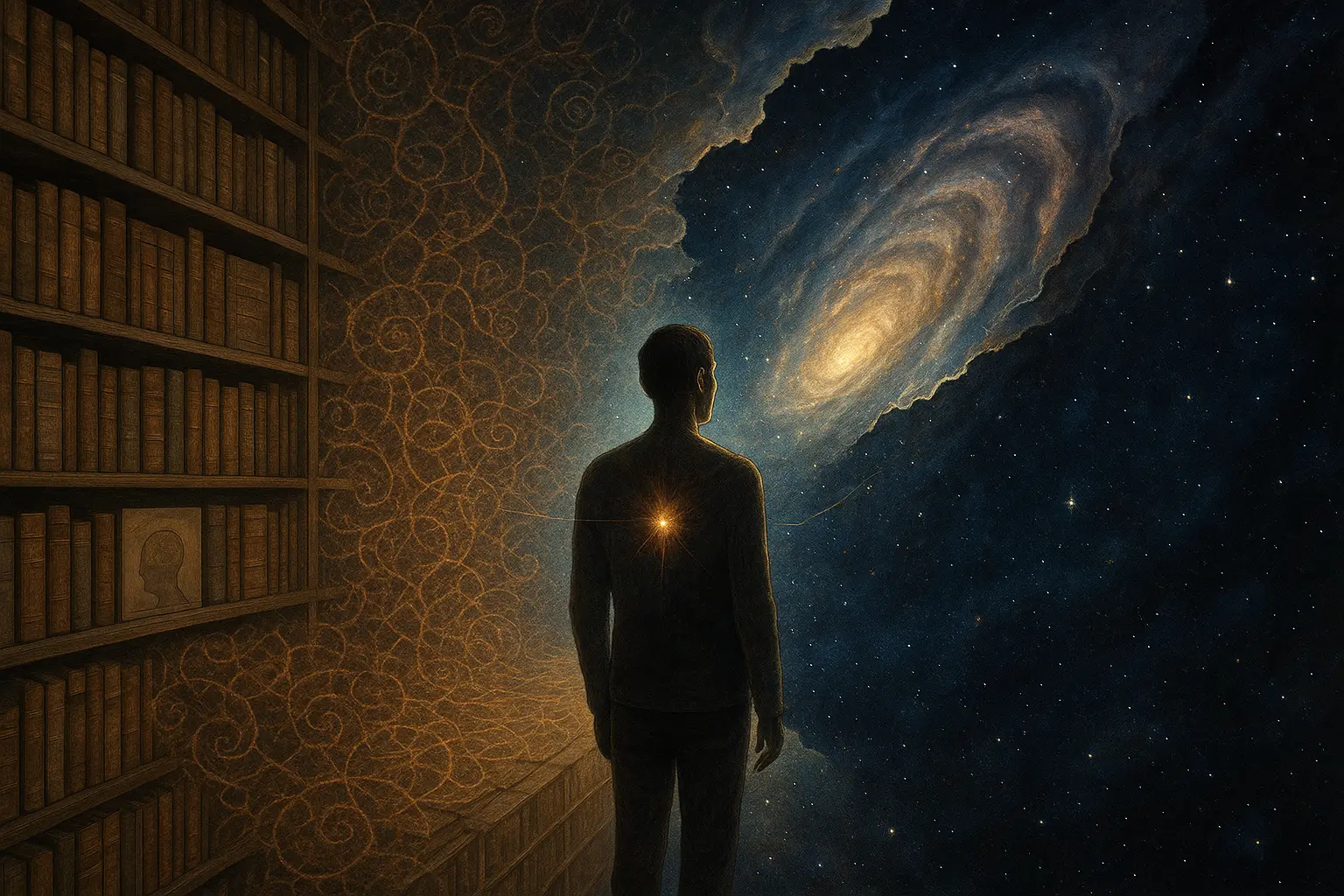
Identity: The Sacred Architecture of Selfhood
I intended to write an essay specifically on personality. But I quickly discovered that to speak meaningfully about personality in the Urantia Book sense, I had to untangle a similarly deep and equally important conceptual concept: identity. And as I ventured into that territory, the idea of the self also emerged as a third crucial node. Self is neither reducible to Freud’s idea of ego nor fully synonymous with the revelation's portrayal of soul.[ref] What began what I thought was a simple inquiry into one very unique revelation soon expanded into a constellation of cosmic ideas, each radiating from a core truth: that the journey of becoming a perfected person in the universe is neither random nor automatic, but a sacred process of integration, guided by divine presence, and rooted in existential origins.
This essay is my attempt to chart that journey. It begins not with the self as we commonly understand it: ego, personality traits, or psychological self-image. But rather with the I AM, the pre-reality source of all of Everything—from Absolutes to Infinity. From this infinite origin that we worship as the Universal Father/Father Infinite arises personality, self, identity, and the astonishing possibility that a mortal creature may grow into an eternal, unified, perfected self. We can become a being so harmonized with the Will of God that fusion with the indwelling infinite Thought Adjuster fragment becomes inevitable.
In this essay I distinguish personality from identity, trace the development of selfhood from material infancy to morontia maturity, explore the meaning of the psychic circles, and visit the idea of “identity fusion” not as a psychological shortcut but as the climactic affirmation of a final and irrevocable choice for the eternal career. This self develops progressively through what the revelation calls "psychic circles," or "cosmic levels." We are informed there are seven levels. We might think of these as a universal calibration system marking the soul's progressive mastery of self, mind, and improvement with Adjuster communication.[ref]
The revelation’s cosmic identity fusion which it reveals about an ascending human's soul and his/her Thought Adjuster, foreshadowed the late 20th century’s material-mindal conception of this very idea—an insight that emerged from human intellect but lacked the spiritual framing inherent in the Adjuster’s influence.[ref]
I contrast true personality as a cosmic constant with how modern society misreads personality as behavior, traits, psychic perceptions, or social position in society. To wit: For much of human history, attempts to understand personality and identity have unfolded within a limited framework, shaped by biology, psychology, culture, and the bounds of material life. These models are not inherently flawed so much as they are incomplete. They represent honest human efforts to navigate the mystery of personhood in a world where cosmic reference points are dimmed. In the absence of sustained guidance from planetary spiritual leadership interrupted by real ancient spiritual rebellions and defaults, humankind has been left to work largely from the inside out, inferring higher meanings from fragmentary inner experiences and outward behaviors, i.e., self-revelation. The result is a psychology of personality that, while useful in its own domain, stops short of recognizing the origin, unchangeability, and divine purpose of personality itself.
Modern society, then, does not so much misinterpret personality as it mistakes its reflection for its reality. In a world where the lens of spirit is fogged by materialism and spiritual isolation, people often build their identities on mutable foundations: roles, affiliations, emotions, appearance, or performance. Identity becomes a label, a brand, a story to tell; or worse, a story to control. And yet, beneath this psychological patchwork, there remains a quiet, universal hunger for coherence, a longing to feel like a whole person. This longing, often unnamed, is not a flaw but a sign: the cosmos has not left us empty, only unaware. For embedded in the very structure of human mind are intuitive responses to truth, beauty, and goodness—insights which, if cultivated, would lead the soul naturally toward a fuller grasp of both identity and destiny.
Cosmic mind endowment creates the need to unify experience, memory, Adjuster guidance, and volition into a meaningful narrative.It was perhaps inevitable, then, that thinkers like Erik Erikson would arise in the twentieth century to name and explore this elusive concept of identity.[ref] In doing so, Erikson tapped into something deeper than ego or personality traits. I sense he was truly attempting to define the felt experience of being a coherent, enduring self across time. His concept of identity though left its definition deliberately vague in his writings. They represent an intuitive reach toward the spiritual reality of pattern and purpose embedded in human consciousness.
In a way, Erikson was responding to the very hunger that cosmic mind endowment creates: the need to unify experience, memory, Adjuster guidance, and volition into a meaningful narrative. While his framework remained anchored in psychosocial development and cultural formation, it nonetheless acknowledged that identity was not merely what one did or thought, but who one was becoming. In this light, Erikson’s work teases out the faint image of identity as something more than a psychological milestone—perhaps the early glimmer of a deeper reality. And though the theories that followed in his wake often orbit this concept without fully grasping its cosmic scope, they resemble the early detection of a distant galaxy such that an emerging signal becomes clearer, suggesting that something immense and luminous has always been there, awaiting recognition.
For readers of The Urantia Book, I’ve observed and personally experienced these topics to transmute beyond theological abstractions; they become personal. In this sense, the revelation touches the core of what it means to be a child of God: unique, evolving, and spiritually significant. This is not merely an academic journey but a deeply existential one. We seek to understand not just what we are, but who we are becoming.
And yet, it seems to me, and partly the reason for this essay, few pursue these inner responses with consistency. The pressures of culture, conformity, and day-to-day survival tend to drown out the gentle urgings of cosmic thinking. The reflective mind, capable of recognizing its divine roots and eternal trajectory, too often collapses into distraction, cynicism, or escapism. It is not the absence of capacity that limits humanity, it is the neglect of cultivation. A more complete understanding of selfhood does not require more data but more daring—an inner courage to reach past the visible, the measurable, and the socially approved. What secular frameworks overlook is not logic, but light. Without access to spiritual scaffolding, whether through inner revelation or revelatory teachings, the identity of the self remains provisional, patchy, and vulnerable to distortion. The personality remains present, but its purpose stays unrealized.
From the I AM arise all subsequent realities, including the first existential identity: the Universal Father. The Father Infinite is the manifestation of the personal will of the I AM.As with some of my other essays I urge the new- or non-reader of the UB to suspend disbelief and hear me out on these amazing revelations from its cosmic perspective.
To understand the architecture of personhood as portrayed in The Urantia Book, we must begin not with the creature, but with the Creator. More precisely, we must begin with the pre-Deity source of all reality: the I AM. Before identity, before personality, before even the Paradise Trinity, the I AM exists as undivided infinity—static, potential, and self-contained. From this unqualified ground of being arise all subsequent realities, including the first existential identity: the Universal Father, the manifestation of the personal will of the I AM. Understanding this foundational relationship between the I AM and the emergent identities of Deity gives context to everything that follows, especially how identity and personality function within time-bound creatures like ourselves.
From this infinite, absolute, eternal origin, we trace the bestowal of personality. The revelation teaches that personality is the unique, unchanging gift of the Father that unifies experience and enables volition. The Universal Father bestows personality; we humans do not form or earn it. From there, we explore how identity is uniquely personal pattern, formed by the interaction of personality with energy systems (mindal, spiritual, material).
One of the key revelations is that personality initiates a pattern of identity when imposed upon a finite energy system (material, mindal, or spiritual). This identity is neither static nor guaranteed eternal;[ref] it is the evolving record of the self, shaped by experience and capable of eternalization or dissolution. Out of this interaction between personality and pattern arises the self—not merely an ego or psychological construct, but a living, volitional being growing in spiritual potential.
From Origin to Fusion: The Personhood Puzzle
n contemporary discourse, the term personhood operates at the crossroads of numerous domains: legal, medical, philosophical, religious, and political. It appears in debates over abortion and end-of-life care, in arguments for artificial intelligence and animal rights, and in philosophical reflections on identity, autonomy, and moral worth.[ref]
This widespread application reflects a modern need to define what it means to be a person, both as a bearer of rights and as a center of agency. In modern language, personhood functions as a useful shorthand for the state of being a person—not merely biologically or socially, but morally and spiritually. It implies status, agency, and potential for growth.
For students of The Urantia Book, however, the significance of these questions takes on a deeper dimension. The revelation introduces a startlingly new cosmological category: personality. Personality per the revelation is a pre-spiritual endowment that is neither mind, body, nor soul, but an existential reality bestowed by the Universal Father himself. Neither science, philosophy, nor traditional religion has yet fully conceived of personality as an independent reality, let alone one that precedes spirit in eternal standing. This makes The Urantia Book’s conception of personality not only revelatory but revolutionary.
While the text does not use the modern term personhood, it is saturated with over 4,800 references to person, personal, personality, and their variants—indicating that the reality of the personal is absolutely foundational. Given this, I choose personhood as the unifying concept for this essay in an effort to bridge the gap between the two contexts.
In contrast, The Urantia Book consistently uses the term selfhood to describe the evolving expression of a personality-unified energy system. Personhood serves a dual purpose: to remain faithful to the revelation’s intent, and to speak meaningfully to a 21st-century audience. Even though the revelation never uses the word personhood explicitly, it is difficult to ignore the nearly 4,800 appearances of “person,” “personal,” and related variants—strong evidence that the cosmic concept of personality is central to its message. The revelators speak of personal beings, personalities, persons of Deity, and selfhood as the domain of moral will, identity potential, and Adjuster partnership with humans and those Descender personalities that receive them at various times in their existence.
In modern language, personhood functions as a useful shorthand for the state of being a person—not merely biologically or socially, but morally and spiritually. It implies status, agency, and potential for growth. While selfhood in UB terms is technically more precise, the term personhood is used here to gather together the constellation of qualities that define a spiritually significant individual: personality, identity, self-consciousness, volition, Adjuster-indwelling, and the potential for eternal survival. For readers unfamiliar with the revelation, personhood offers a conceptual on-ramp. For dedicated students of the text, this usage aims to echo—though not redefine—the layered meanings embedded in selfhood and personality as revealed.
Therefore, in the sections that follow, personhood will refer to the living expression and spiritual progression of a self who has been endowed with personality. It represents not just what a person is, but who they are becoming in relation to God, to self, and to the universe. With that definition in place, we can now begin tracing the architecture of personhood from its cosmic origin to its ultimate fulfillment in eternal fusion.
Cosmic Origins
To understand the architecture of personhood as portrayed in The Urantia Book, we must begin not with the creature, but with the Creator—or more precisely, with the pre-Deity source of all reality: the I AM. Before identity, before personality, before even the Paradise Trinity, the I AM exists as undivided infinity—static, potential, and self-contained. From this unqualified ground of being arise all subsequent realities, including the first existential identity: the Universal Father, the personal will of the I AM. Understanding this foundational relationship between the I AM and the emergent identities of Deity gives context to everything that follows, especially how identity and personality function within time-bound creatures like ourselves.
The concept of the “I AM” appears across a wide range of the world’s spiritual traditions, often as a symbol of ultimate being, self-existence, or the divine presence within. In the Hebrew Bible, this idea takes center stage in Exodus 3:14, when Moses asks God for a name, and God replies, “I AM WHO I AM” (Ehyeh asher Ehyeh). This is rendered as YHWH—Yahweh, the self-existent One—emphasizing God’s uncaused being, eternal presence, and active existence. In Advaita Vedanta (Hinduism), a similar concept emerges in the Upanishadic phrase “Tat Tvam Asi” (That Thou Art) which affirms the soul’s essential unity with Brahman, the Absolute. The perfected Self (Atman) is understood to be not separate from, but one with, the divine source of all.
The Urantia Book embraces this rich heritage but elevates and expands the concept into a comprehensive metaphysical framework. In its cosmology, the I AM is not simply a self-revealing God but the pre-Deity, pre-personal source of all reality. It is the infinite ground from which personality, identity, energy, and the Seven Absolutes emerge. All subsequent reality, whether personal or impersonal, finite or infinite, originates in this unqualified source. By integrating and transcending earlier formulations, The Urantia Book presents the I AM not just as a divine self-declaration but as the foundational cause of causes and the self-existent origin of all that ever was or can be.
The Foreword makes this abuntantly clear:0:3.21 (6.1) As a time-space creature would view the origin and differentiation of Reality, the eternal and infinite I AM achieved Deity liberation from the fetters of unqualified infinity through the exercise of inherent and eternal free will, and this divorcement from unqualified infinity produced the first absolute divinity-tension. This tension of infinity differential is resolved by the Universal Absolute, which functions to unify and co-ordinate the dynamic infinity of Total Deity and the static infinity of the Unqualified Absolute.
Building on the rich theological legacy of the "I AM" across global traditions, The Urantia Book elevates this metaphysical construct to a foundational cosmological principle. Within its framework, the I AM exists as the undifferentiated, infinite ground of all being—the self-contained source from which all actuals and potentials emerge. However, despite the I AM’s self-will and volitional capacity, the manifestation of personality does not occur in this static, pre-personal, infinite state. This is a crucial distinction in Urantia cosmology: self-will alone does not constitute personality.
As indicated in the Foreword at 0:3.22 and elaborated in Paper 105:1.5, it is only when the I AM differentiates into relational Deity that personality is realized. This transformative event occurs when the I AM becomes the Eternal Father of the Original Son, and simultaneously the Eternal Source of the Isle of Paradise. In this "original transaction," personality emerges not in isolation, but in relation. The Eternal Father becomes a person in relation to another person—the Eternal Son—and in the presence of the newly originated Isle of Paradise. This act completes the Trinity circle with the appearance of the Infinite Spirit, thus anchoring the Father's personality as distinct and preserved rather than diffusely dissolving into Total Deity potential.
In fact, this emergence of relational Deity, wherein the I AM becomes Father to the Son and Source to Paradise, is described succinctly by a Melchizedek marking the primordial act of volition and self-differentiation from our limited time perspective. It is not merely the beginning of personality but the inauguration of triune structure. As the authors of The Urantia Book acknowledge, even the theoretical "first" act of volition within the I AM must be viewed through the lens of threefold expression:
105:2.2 (1154.1) In following the chronological portrayal of the origins of reality, there must be a postulated theoretical moment of “first” volitional expression and “first” repercussional reaction within the I AM. In our attempts to portray the genesis and generation of reality, this stage may be conceived as the self-differentiation of The Infinite One from The Infinitude, but the postulation of this dual relationship must always be expanded to a triune conception by the recognition of the eternal continuum of The Infinity, the I AM.
The I AM before differentiation is like an infinite spherical source of light emanating in all directions filling an infinite vacuum of everythingness—no walls, no surfaces, just absolute potential, unseen and unfelt, because nothing yet exists to receive or return it.
This sequence of the emergence of Reality reinforces a key Urantia teaching: Personality requires relational actuality. It is not sufficient for self-will to exist in a "vacuum"—an infinite but fettered absolutism. Only when another distinct being exists—when relational volition can be expressed and responded to—does personality actualize. This suggests that personality is not merely an internal self-realization but a cosmic relational event that establishes identity within the matrix of other persons and realities. In this view, the supreme archetype of personality is always relational, always participatory, always integrated into a greater network of meaning and value.
An apt metaphor may be drawn from the realm of light: The I AM before differentiation is like an infinite spherical source of light emanating in all directions filling an infinite vacuum of everythingness—no walls, no surfaces, just absolute potential, unseen and unfelt, because nothing yet exists to receive or return it. It holds all frequencies, all colors, all radiant power—but it is nowhere reflected, and so its light is never seen, its warmth never felt. When the sphere opens—when the Son and Paradise emerge—that light is refracted into reality, made manifest in glory and presence. Just as light reveals itself only when it interacts with something else, so too does personality actualize only when it enters into relationship.
Therefore, these passages affirm that the realization of divine personality begins not with solitary will, but with the differentiation of beings within the sublime levels of existential relationships. The I AM, while hypothetically volitional and self-existent, only becomes Father—and thus fully personal—when another person (the Son) exists to receive and reciprocate that volition. This distinction offers profound insight into the origin and nature of personality, not only as divine, but as universally relational, spiritually grounded, and existentially emergent.
Personality: The Unchanging Gift of the Father
The Fifth Epochal Revelation (the UB) to Urantian mankind uses many conventional terms and expands them into cosmic proportions. Personality is one of them. One can only creatively speculate, after learning of the sweeping truths that are enfolded in this word, that somehow by re-contextualizing a conventional English word, the revelators in fact meet the proscriptions of not delivering knowledge before it is ready to be accepted and understood
101:4.1 (1109.2) The laws of revelation hamper us greatly by their proscription of the impartation of unearned or premature knowledge.
If personhood serves as a conceptual on-ramp, then personality, as disclosed in The Urantia Book, is a destination entirely unreachable by the unaided intellect of man. While the term personality appears in human language, the revelators unmistakably expand, and in many ways redefine, its scope, depth, and ontological status. They do not merely clarify; they reveal. From my reading, personality, as it appears in the text, is best understood as pure revelation—something unknown and unknowable by science, unreached by philosophy, and only dimly glimpsed by religion. It is not the product of evolutionary speculation or spiritual mysticism, but a revelational gift it takes a bit of mental "elbow grease" to understand its cosmic and religious significance.
As the revelators themselves caution, their proscriptions are designed to use “word symbols” of the English language to introduce new terms only when the concept to be portrayed finds no terminology in English which can be employed to convey such a new concept partially or even with more or less distortion of meaning. 0:0.2 (1.2). In that light, the concept of personality as a divine endowment, an absolute uniqueness, and a non-material reality bestowed only by the Universal Father, is not derived from human constructs. It is in this spirit that the following section explores personality less as an extension of existing thought, but more as a breakthrough in our understanding of what it means to truly be.
Personality, as revealed in The Urantia Book, is not a byproduct of biology, a construct of society, nor an emergent property of complex mind. It is a direct bestowal from the Universal Father and represents the unifying and organizing endowment that integrates all other elements of creature identity. The revelators make this explicit: Personality is a unique gift of the Universal Father. It is not bestowed by the Eternal Son nor by the Infinite Spirit. Neither is it a function of the physical life vehicle or of the mind endowment 6:5.3 (77.6). Personality, then, is not merely what one has—it is what one is, in the deepest, most enduring sense. It provides cohesion and identity across the otherwise disparate components of body, mind, and spirit, enabling a creature to become an integrated self.
Moreover, personality is defined by two astonishing and seemingly paradoxical qualities: absolute uniqueness and infinite capacity for growth.
Without personality, there can be no true selfhood. Although life, mind, and even soul may exist independently, they do not coalesce into a singular, enduring identity until personality is present. A Solitary Messenger of Orvonton declares that selfhood is dependent on personality and is non-existent in the absence of personality. 112:1.13 (1227.3). This implies that what we typically consider the "self"—with its memories, thoughts, and experiences—is not enough to constitute a personal being. It is the Father-bestowed personality that imparts the positional value necessary for all of these facets to be organized into a functioning system. In this sense, personality is not simply a metaphysical tag—it is the epicenter of meaning, the essential anchoring reality of selfhood in time and eternity.
Moreover, personality is defined by two astonishing and seemingly paradoxical qualities: absolute uniqueness and infinite capacity for growth. A Solitary Messenger, in describing how personality interacts with reality, reveals just how remarkably near boundless Urantian personality is in potential.[ref]
112:1.9 (1226.13) The type of personality bestowed upon Urantia mortals has a potentiality of seven dimensions of self-expression or person-realization. These dimensional phenomena are realizable as three on the finite level, three on the absonite level, and one on the absolute level. On subabsolute levels this seventh or totality dimension is experiencible as the fact of personality. This supreme dimension is an associable absolute and, while not infinite, is dimensionally potential for subinfinite penetration of the absolute.
Let's unpack that some. That passage is dense with metaphysical depth, but it’s one of the most profound revelations about the eternal trajectory of personality in the entire Urantia cosmology. It tells us that personality is not only unique and unrepeatable, but structured to operate across all known and future existential planes—finite, absonite, and even associable with the absolute. It's like saying: you, the person reading this, are built to grow forever, and not arbitrarily, but toward dimensions not yet fully realized in the cosmos itself.
Personality is one thing which can be added to spirit, mind, and energy and still keep them identifiable as individuals. All other characteristics can be similar in numerous individuals; personality never. 0:5.11 (9.1). No two personalities in the universe are alike, nor can they be. This eternal singularity affirms the irreplaceable value of every person and defies reduction to systems, classifications, or evolutionary stages. And yet, despite this fixity of identity to personality, personality remains infinitely elastic in its capacity for expansion and perfection. Through freewill choice, moral growth, and Adjuster cooperation, personality becomes the active co-architect of its own destiny.
Ultimately, personality is the Father’s way of empowering a creature to participate in the grand enterprise of eternal ascension—not as a cog in a cosmic machine, but as a will creature whose destiny is shared in voluntary partnership with God. As such, personality is not merely the gateway to selfhood; it is the divine assurance of one’s potential to become like God while remaining eternally oneself.
So imagine personality as a seven-level cosmic vessel—a living ship outfitted with a divine guidance system. It is equipped with seven sails, each designed to catch the “solar winds” of different existential dimensions. Built for eternal voyage, this ship is structured to navigate through time, space, and beyond—across all seven dimensions of self-realization.
Its core function is to orient toward the Universal Father, guided by a built-in personality-gravity compass. This vessel doesn’t drift; it is designed to channel Godward, attuned to higher meanings and values. When it functions properly, it slipstreams along the currents of the indwelling Thought Adjuster, staying aligned with the Father’s gravitational pull on personality.
The first three sails fill with the winds of finite experience—time, space, and material mind. These are the dimensions we navigate now, where moral choice, struggle, and soul-growth unfold. The next three sails remain furled for now, awaiting the absonite realms—those superfinite dimensions of destiny and ultimate meaning that transcend time and space.
The seventh sail, mounted at the masthead, isn’t for wind at all. It functions like a celestial antenna, tuned to the Absolute—not to enter it (for we are not infinite), but to resonate with it, to associate with its purpose, direction, and essence.
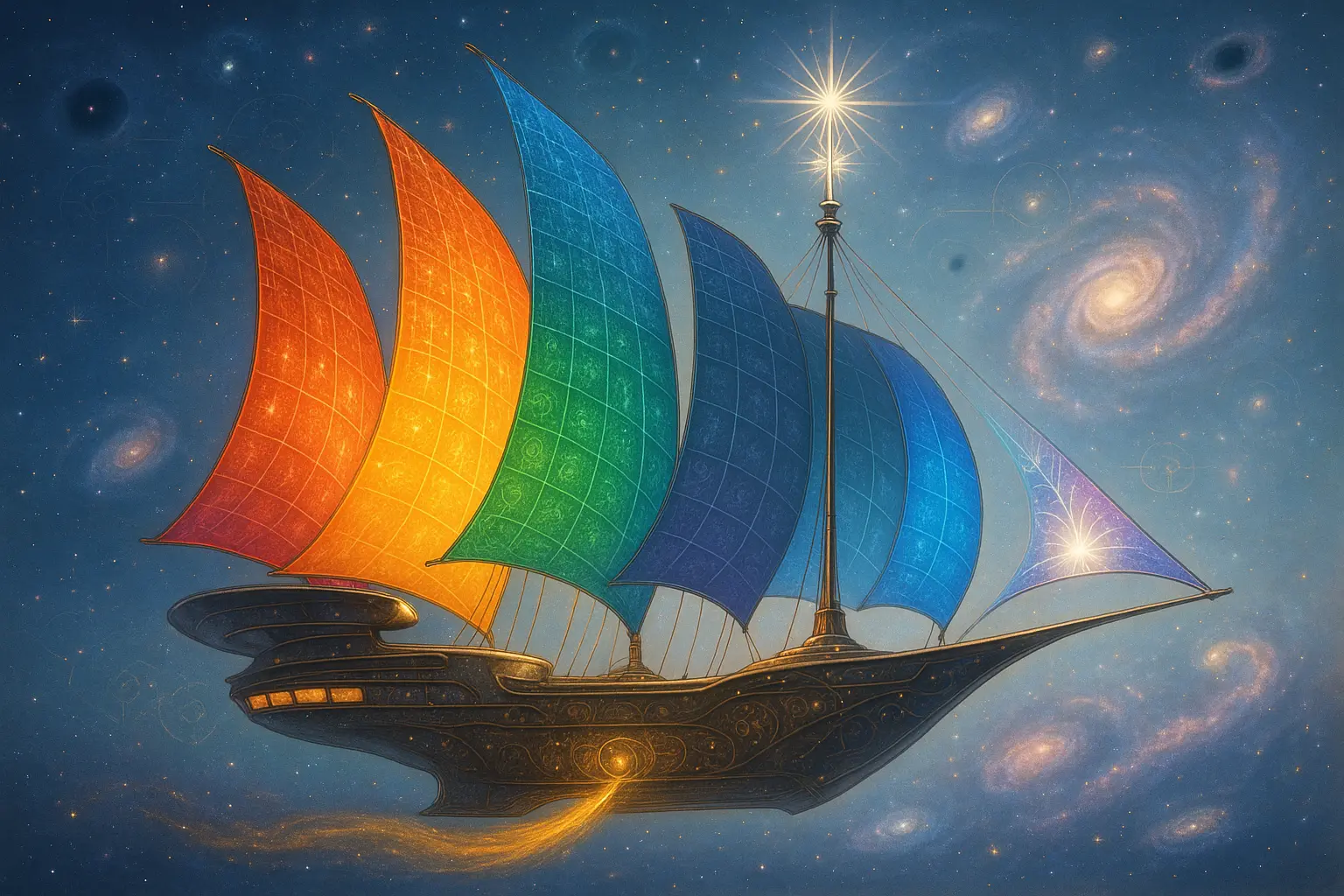
This Urantian personality can only operate as intended if the internal communication system remains active, as long as the captain of the soul maintains conscious and constant communication with the divine GPS—the Adjuster. Built into its very structure is the directional potential toward truth, beauty, goodness, and Paradise itself. The ship’s success, however, depends on the will of the voyager to keep the channel open.
Finite personality can grow without end, but not into infinity. Infinite here is rendered here as eternally extendable or endlessly progressive. It’s not that our personality can absorb all reality (which would require being infinite), but that it can continue growing forever by catching the "winds" of the Infinite—there is no built-in ceiling.
Reflecting on Historical and Contemporary Human Thought about “I”
Across the history of human thought—from ancient philosophy to modern neuroscience—there has been a persistent intuition that something essential lies behind the contents of experience. Whether labeled the soul, self, witness, or subject, thinkers in every age have sought to describe the observer behind the observation: the one who knows, who evaluates, who chooses. In this long arc of reflection, humanity has brushed against the edges of something more than mind—some inner core of awareness that transcends sensation, cognition, and memory. From Descartes’ “thinking thing,” to Kant’s “transcendental unity of apperception,” to James’s “stream of consciousness,” to phenomenologists like Husserl, Western thought has circled ever closer to a recognition that the self who observes is not reducible to its observed contents. And yet, despite these sophisticated models, a breakthrough eludes them.
This is the very threshold where The Urantia Book provides a cosmic upstep. The revelation does not merely refine existing psychological or philosophical definitions—it reveals personality as a distinct, existential bestowal: an unchanging, pre-spiritual, and supra-material reality originating in the Universal Father. Personality is not a byproduct of evolution, not an emergent feature of complex brains, not the constructed “self” of social or cognitive psychology. It is something far more fundamental: a unique organizing endowment that enables identity, integrates experience, and anchors the self across the unfolding levels of body, mind, soul, spirit, and dimensions. As we affirm in the essay: “Neither science, philosophy, nor traditional religion has yet fully conceived of personality as an independent reality, let alone one that precedes spirit in eternal standing.” The revelators confirm this exact limitation: “The observer cannot be the thing observed; evaluation demands some degree of transcendence of the thing which is evaluated” [112:2.12].
Among modern thinkers, Professor Arthur Deikman stands out as a rare voice who ventured beyond the limits of Western cognitive models and approached—perhaps unknowingly—the spiritual threshold of The Urantia Book’s concept of personality.
In this light, the modern intellectual landscape appears to have reached a kind of cul-de-sac—a conceptual dead-end where introspection and analysis can no longer break new ground. The philosophical traditions have given us acute insights into self-awareness, but have failed to define what the “I” actually is.
Science, bound by its materialist assumptions, studies brain activity but cannot locate the experiencer. Religion, often constrained by dogma or metaphor, speaks of soul and spirit without clarifying how personality functions in relation to either. What is needed is a new frame of reference—a cosmic integration of the self within a spiritual and universal architecture. This is precisely what the UB offers: an unveiling of personality not as a conjecture or hypothesis, but as a revealed reality. This section of the essay will trace how human thought has attempted to grasp the observer, and how revelation reframes this mystery as part of a grand cosmology of personal existence and destiny.
Among modern thinkers, Professor Arthur Deikman stands out as a rare voice who ventured beyond the limits of Western cognitive models and approached—perhaps unknowingly—the spiritual threshold of The Urantia Book’s concept of personality. A psychiatrist by training and a student of mysticism, Deikman proposed that the fundamental self is not reducible to memory, identity, or narrative structure. In his 1996 article “I = Awareness,” he argued that the true self is pure awareness—the silent observer behind all mental content.[ref] This is not a theory of behavior or personality traits, but an attempt to name the irreducible knower at the center of conscious experience.
What sets Deikman apart is his deliberate effort to bridge Eastern mystical insight with Western empirical rigor—to rescue Western psychology from its closed-loop materialism by pointing to a deeper substrate of being. In his later writings, he lamented that without recognizing this “elusive, central self,” modern science and philosophy would continue to ask, “Who am I?” without ever reaching the answer. While Deikman did not speak in the metaphysical language of existential bestowals or Father-origin personality, he intuited a reality that exists prior to thought, beyond content, and capable of spiritual recognition. In doing so, he came closer than most to the revelatory framework that The Urantia Book would later clarify: that this observer is not merely awareness—it is personality.
This philosophical trajectory did not begin with Deikman. Over centuries, numerous thinkers have wrestled with the mystery of the observing self—each adding dimension to the concept, but none fully illuminating its cosmic standing. René Descartes, in his foundational cogito, identified thinking as proof of existence but anchored it in a dualistic framework that still could not explain who was doing the thinking.
Later, Immanuel Kant offered his idea of the transcendental unity of apperception, the necessary condition for organizing experience—yet this “unity” remained a logical construct, not a personal being. In the 19th century, Franz Brentano’s notion of intentionality—consciousness always being about something—gave rise to Edmund Husserl’s phenomenology, which began to seriously explore the structure of subjective experience. Husserl’s focus on transcendental consciousness brought philosophy close to acknowledging a knower behind all knowing, but again, it never crossed the threshold into defining that knower as a distinct spiritual reality.
William James, meanwhile, probed the flow of inner life with his stream of consciousness model, distinguishing between the “me” (self as known) and the “I” (self as knower), even speculating about the possibility of a pure “knowing subject.” But lacking a revelatory framework, he could only describe what felt real without knowing its origin or purpose. The existentialists—Kierkegaard, Nietzsche, Sartre—shifted the focus toward freedom, choice, and subjectivity, often with penetrating psychological insight, but they framed the self as a project to be constructed, rather than an unchanging endowment to be cultivated and unified. In each case, human insight managed to circle around the reality of personality—sometimes coming tantalizingly close—but never quite stepping into the light of what the UB boldly reveals: that personality is not content, not construct, not context—it is bestowed existence, divine in origin, and eternal in potential.
Pattern[ref] in Motion[ref]: The Changing Garments of Identity
In the prologue I wrote: “In this essay I distinguish personality from identity, trace the development of selfhood from material infancy to morontia maturity, explore the meaning of the psychic circles, and visit the idea of “identity fusion” not as a psychological shortcut but as the climactic affirmation of a final and irrevocable choice for the eternal career.” I was referring to an individual personality’s hopeful morontia identity fusion with one’s Adjuster of eternal identity. To understand how this stupendous event evolves from our humble beginnings, this section will tackle the relationship of personality to identity with an eye to understand how “selfhood” or “personhood” is a shorthand for describing our personal growth cycle from one identity to another. For example, from material to morontial.
Migratory Identity: From Temporary Self to Eternal Soul
In our cosmic journey, identity is not a fixed possession but a migratory phenomenon. Essentially it is a pattern in motion moving through phases of reality. At birth, we do not have a fully formed, enduring self. Instead, we begin with a provisional identity rooted in material mind and biological function. The Urantia Book is crytsal clear on this point:
112:5.4 (1232.5) Human beings possess identity only in the material sense. Such qualities of the self are expressed by the material mind as it functions in the energy system of the intellect. When it is said that man has identity, it is recognized that he is in possession of a mind circuit which has been placed in subordination to the acts and choosing of the will of the human personality. But this is a material and purely temporary manifestation, just as the human embryo is a transient parasitic stage of human life. Human beings, from a cosmic perspective, are born, live, and die in a relative instant of time; they are not enduring. But mortal personality, through its own choosing, possesses the power of transferring its seat of identity from the passing material-intellect system to the higher morontia-soul system which, in association with the Thought Adjuster, is created as a new vehicle for personality manifestation.
This sobering analogy that compares our earliest sense of self to a dependent embryo confronts us with the impermanence of our material identity. What we often call “the self” is merely a provisional construct, a temporary expression of the personality operating through a brain-based energy system. Even though the human personality exercises moral choice through this mind circuit, this identity is fated to dissolve. The material-intellect system is not the final vehicle for the enduring self. The soul will.
However, within this fleeting framework lies an astonishing potential: personality can choose to transfer the seat of identity. This choice is not symbolic; it is existential. By aligning with truth, choosing goodness, and cultivating soul-consciousness, personality progressively grows a new form—the morontia soul—in cooperation with the indwelling Thought Adjuster. This new identity is not merely a refined version of the material self; it is a qualitatively higher manifestation of selfhood, one capable of enduring beyond death.
This is the spiritual migration at the heart of personal destiny: identity is not static—it is transplantable. The human self begins as a fragile mental construct, but through moral decision and spiritual experience, personality re-seeds its selfhood in a soul structure that survives time. This morontia identity, once sufficiently formed and harmonized with the Adjuster, becomes the foundation for fusion—the climactic unification of eternal personality and divine spirit.
This vision reframes human life: not as a fight to preserve a self we already have, but as a chance to create the self we are meant to become. What we preserve is not the ego, not memory alone, and not even intellect as we know it—but the authentic, soul-born self we forge through our choices in time. It is the product of growth, not merely birth. When all is said and done identity is a projection in time of a personality’s experience.
Personhood in Process: Identity as a Dynamic Reflection of Personality
As we have seen so far identity is not the source of the self; it is the shadow that follows personality through time, shaped by decision, seasoned by experience, and ultimately transfigured by spirit. When viewed from a cosmic perspective, identity reflects the self as a mirror of awareness, a garment of evolving form, and a growth curve of soul potential.[ref] Each is responsive to a deeper function and pattern of personality. This interplay between what is unchanging and what is constantly evolving, between the eternal and the temporal, gives rise to something progressively greater than either alone. This transformed reality is known conventionally as personhood and subsumed via the revelation as selfhood; we use these interchangeably in this essay.
This intensifying realization of revealed selfhood is tracked in part by the soul’s progress through the seven psychic circles of personality development. These circles do not measure behavior or belief, but rather the alignment and maturity of the self in its moral, intellectual, and spiritual dimensions. As the solitary messenger explains, “The degree of selfhood reality is directly determined by circle conquest. Persons become more real as they ascend from the seventh to the first level of mortal existence” (110:6.10). The very term morontia implies “more real,” and so this ascent through the circles is not symbolic; it is ontologically significant. Personhood is not a fixed status but an unfolding experience of greater spiritual actuality, one that becomes progressively more responsive to truth, more unified in purpose, and more luminous in destiny. It is to this dynamic and unifying expression of the self that we now turn.
Personhood: The Living Synthesis of Personality and Identity
Personhood is not a static possession; it is a living, evolving synthesis. It emerges when the changeless pattern of personality begins to find meaningful, value-laden expression through the changing, growing framework of identity. In this sense, personhood is not reducible to either element alone. Personality provides the unique, unrepeatable pattern of will; identity supplies the medium through which that pattern takes form across time. Together, they generate the lived experience of being a self—an experiential reality that is at once uniquely yours and universally significant.
From the cosmic perspective of The Urantia Book, personality is never an emergent phenomenon—it is bestowed. It is a divine act, a sacred entrustment of spiritual potential. Identity, by contrast, is the domain of emergence: it evolves in time, it changes with choice, and it stabilizes only as it becomes spiritually harmonized. Personhood is the space where these two realities meet and begin to cohere. It is what happens when an eternal pattern (personality) expresses itself through temporal experience (identity), gradually forging a soul that can survive the dissolution of the material self.
But this synthesis is not automatic. Personhood must be realized, matured, and eventually eternalized. It grows through moral decision, truth response, and spiritual alignment. The psychic circles mark its maturation. The soul records its story. And the Thought Adjuster tirelessly labors to elevate identity into a form that can withstand eternity. When these factors converge—when the personality becomes unified with a fully developed, Adjuster-compatible identity—personhood becomes not just potential, but destiny.
In this way, personhood is a sacred collaboration. It is the becoming of the self in alignment with the eternal—a dynamic reflection of the Infinite refracted through the finite. It is the highest revelation of individuality in time, and the seed of uniqueness that will blossom in the unending service of eternity.
The Psychic Circles: Evolution of the Inner Cosmos
As addressed in the prologue above, the seven psychic circles of mortal progression, as revealed in The Urantia Book,[ref] represent a divine architecture that is indicative of personality status, mind attainment, soul growth, and Adjuster attunement. Far more than metaphor or mystic concept, the circles map the actual stages of matter, mind, and spiritual integration. Unlike intellectual achievement, emotional development, or moral behavior alone, these circles track the deepening coherence of the self in relation to God, spirit, and universe values; one progresses by combined choice, decison, and action. The Mighty Messenger writes:
110:6.17 (1211.2) The motivation of faith makes experiential the full realization of man’s sonship with God, but action, completion of decisions, is essential to the evolutionary attainment of consciousness of progressive kinship with the cosmic actuality of the Supreme Being.
The circles appear to be, at a minimum, indicators of soul progression, not societal benchmarks—indicators of how far the evolving identity has been unified, morontiaized, spiritualized, and increasingly aligned with the indwelling Adjuster and consequently the Father's will. The phrase “consciousness of progressive kinship with the cosmic actuality of the Supreme Being” is an extraordinary statement that seems to presume an advanced understanding of the revelation. I have written elsewhere[ref] that the concept of the Supreme itself is not self-evident. I wrote: "While the concept of the Supreme is certainly not a hidden or obscure feature of the text, the evolutionary development of the Supreme is not entirely self-evident to beginning readers. Even long-term reader-students are somewhat puzzled at what this mighty Deity is and symbolizes."
Let me stress emphatically, however, that I do not believe progression through the circles is inhibited or constrained by a lack of conscious awareness of one's kinship with the Supreme Being. There exists both the fact and the spirit, i.e., the truth of the Supreme. As we grow spiritually and begin to move beyond the confines of self-centered living, we start to recognize and love others more fully. This expansion of our relational universe—from family, to community, and eventually to all humanity—mirrors the Supreme’s experiential growth. As Jesus taught, this arc of love even extends to our enemies. The spirit and truth of the Supreme are present in every sincere act of inclusion, in every widening of our social and spiritual embrace. In this way, even without explicit knowledge of the Supreme, the soul participates in the very reality of Supreme evolution. The revelation simply helps us comprehend the extent of this growth—pointing us beyond the finite Grand Universe to the larger cosmic panorama of the Master Universe, where the full scope of God’s purpose continues to unfold.
This ascending process is not external or ceremonial or purely intellectual about facts; it is inward, experiential, and cumulative. To ascend the circles is to become more real. As the solitary messenger states: “Persons become more real as they ascend from the seventh to the first level of mortal existence” (110:6.10). This isn't about becoming better in a moralistic sense—it is about becoming more integrated, more God-conscious, and more Adjuster-harmonized. Identity that once flickered with self-assertion and fear begins to stabilize in trust, loyalty, and truth-recognition. The soul ceases to be merely reactive or developmental and begins to co-participate in its own divine becoming.
This concept of progressive becoming resonates with certain models of psychological development, particularly Erik Erikson’s (Cf. footnote 3) well-known psychosocial stages, where identity emerges from the resolution of life’s inner conflicts. Yet the Urantia model goes beyond psychology. While Erikson’s framework concludes with ego integrity vs. despair in old age, the psychic circles describe a parallel but transcendent arc: not only the development of a self in relation to society or history, but the evolution of personhood in response to spirit, eternal meaning, and cosmic citizenship. Linda Buselli, in her article “The Psychic Circles: Stages of Soul Growth,”[ref] draws this same distinction, noting that the circles are not simply psychological or behavioral. They indicate “... “relationships” [as] key in understanding the concept of circle mastery.” In fact, a Solitary Messenger of Orvonton makes this abuntantly clear:
111:2.7 (1218.5) The relationship between material mind and divine spirit, which connotes a value and carries a meaning not found in either of the contributing factors to such an association. The reality of this unique relationship is neither material nor spiritual but morontial. It is the soul. (my emphasis)
Linda's article mirrors my bridging goal of connecting familiar human developmental models (like Erikson’s psychosocial stages of identity) to the higher, cosmological model of personal growth as revealed in The Urantia Book, specifically through the framework of the psychic circles, by explicitly comparing traditional psychological development with the deeper spiritual revelation of the psychic circles. She argues that the circles, unlike ego or behavioral frameworks, concern the unification of mind, personality, and soul, directly aligning with this essay's objective of moving the locus of understanding selfhood/personhood from psychology to cosmology.
This unification of mind, personality, and soul is not simply a state of inner harmony; it is preparation for something far more enduring. As the self ascends through the psychic circles, it becomes increasingly capable of sustaining a conscious partnership with the indwelling Adjuster. Each stage of soul growth draws the evolving identity closer to the point of irrevocable consecration, where personality, now spiritually integrated and morally matured, may make the supreme decision: to eternalize itself through fusion with the divine spirit within. The circles do not merely mark stages of development; they form the inner scaffolding for the soul’s ultimate act of alignment with destiny. It is to this decisive moment—the culmination of all inner growth—that we now turn.
Fusion: The Irrevocable Choice
At its most basic, fusion means joining two things so completely that they become one. In everyday life, we use the word to describe processes like welding metal, melting glass into a single form, or blending musical genres into a new style. Fusion suggests permanence. Once fused, things don’t easily come apart. The distinct elements may retain some trace of their origin, but the result is a new unity—one that expresses the qualities of both, yet cannot be reduced back into either alone.
This image serves us well as we attempt to understand one of the most profound events in the career of a universe ascender. In the teachings of The Urantia Book, fusion refers to the permanent and eternal unification of the human soul with the divine presence of the indwelling Thought Adjuster. It is not symbolic or poetic. It is a literal, cosmic event in which the evolving identity of a mortal creature is spiritually joined with the prepersonal fragment of the Universal Father so thoroughly that the two are now one; the result is a new unity. Personality provides the individual continuity; the Thought Adjuster supplies the divinity and eternal identity. The result is an eternal individual—unchanging in loyalty, unceasing in purpose, and unique in all creation.
This is not a merging of equals; in fact they are so far apart cosmically that one has to wonder how fusion actually can be accomplished. The Adjuster is pure spirit; the human is a creature of time. But through thousands of moral decisions, moments of truth-recognition, and acts of faith, the individual morontia mortal has come to reflect the values and intentions of the indwelling spirit. And when that alignment becomes complete—when personality and soul are prepared to consecrate their will to God without reservation—fusion occurs. It is the divine acknowledgment that the human has chosen to do the Father’s will forever.
Fusion is the universe’s solemn recognition that a mortal creature has made an eternal decision. It is the irrevocable proclamation that this personality, once material and time-bound, has chosen—freely, knowingly, and finally—to do the will of the Universal Father, forever. No longer probationary, no longer in transition, the soul that fuses with its indwelling Thought Adjuster has become eternal in purpose, divine in loyalty, and unique in actualization. What began as the subtle whisper of God within becomes a blazing unity of spirit and self, a permanent spiritualization of personality.
This is the true fulfillment of identity fusion—the term originally introduced in this essay as a hopeful trajectory of the human self. It is not a shortcut or a mystical bypass. It is the final act of a long evolutionary drama, in which personality has anchored itself in divinity and identity has been wholly spiritualized. Fusion is not the beginning of selfhood, but the crowning moment of its clarification. It is the moment when identity, once formed in shifting material and morontial patterns, is eternalized. The self becomes indivisibly one with the indwelling Adjuster, and in doing so, it becomes finally and forever real.
Just as steel cannot be made without intentional labor, neither can an immortal soul emerge without the conscious action of personality.
At fusion, personality becomes fixed—not in rigidity, but in divinely secured uniqueness. The will of the Father has been made the will of the self. No further testing is needed. There will be no failure, no retreat. The fusion candidate becomes a finality-bound ascending son, guaranteed to traverse the spiritual realms and stand eventually in the presence of the Father on Paradise. As The Urantia Book reveals, this act confers upon the soul “final identity,” and with it, “eternal union with the prepersonal spirit of the Universal Father” (40:8.3). Personality is now sealed in divinity, its capacity for selfhood eternally safeguarded within the divine embrace.
Practically speaking, fusion means the ascender has become deathless. The long shadow of uncertainty is lifted. The ascender’s progress is no longer a test of survival but an unfolding of service, creativity, and divine expression. Identity is now secure, not just in time but in destiny. No longer a pilgrim seeking assurance, the fused individual becomes a living assurance to others—an example of the power of free will aligned with eternal purpose. From this point forward, the ascending career is not about proving oneself fit for survival, but about participating joyfully in the evolving perfection of the universes.
Forging Eternity: Personality and the Soul in the Furnace of Time
Let us use a material analogy to bring the image home. The “creation” and “fusion” of iron into steel.
To grasp the meaning of fusion more vividly, imagine the creation of steel. Steel is an alloy, not just a mixture or blend. The atoms of iron and carbon interlock at the molecular level, forming a new crystalline structure with entirely different properties than either component alone. However, iron doesn’t exist in pure form in nature. It comes from iron oxides, elements. Iron (Fe) plus oxygen (O) are potentially usable, but not yet functional. The ore must be smelted (Fe separated from oxygen and impurities) through heat and intention. So even iron requires intelligent effort to be usable—just like the experiential selfhood requires personality will to activate latent potentials in mind, matter, and spirit.
Steel begins with iron. Iron is a strong but limited metal that can bend, rust, or shatter under the wrong conditions. Into this base element is introduced a small amount of carbon, an agent of transformation. Under intense heat and pressure, these two elements don’t just mix. They bond at the molecular level, forming a new material that is stronger, more durable, and more useful than either component alone.
In this analogy, the iron represents the human identity—shaped by experience, choice, and struggle. The carbon is like the Thought Adjuster—a fragment of God quietly working to uplift and spiritualize the self. The heat and pressure are the challenges and decisions of life, the crucible where soul and spirit are tested. And when the alignment becomes perfect—when the soul and the Adjuster are fully harmonized—fusion occurs. Like steel, the resulting being is not merely a better version of what came before, but something new, indivisible, and eternal: a soul whose identity has been spiritualized, whose personality has been secured, and who now lives forever as a unified child of God.
Just as steel cannot be made without intentional labor, neither can an immortal soul emerge without the conscious action of personality. Iron, in its natural state, is locked in oxidized forms—trapped in compounds that render it inert and brittle. But when a craftsman applies intense heat in a furnace, iron is separated from its impurities, and with the addition of carbon, a transformation occurs: the birth of steel, a new substance, stronger than its parts.
To reiterate, the iron represents the raw, evolving self, drawn from the material, mindal, and spiritual potentials of the Supreme. The Thought Adjuster is the divine element—like carbon—entering subtly but powerfully into the soul matrix. But neither iron nor carbon fuses itself. It is the freewill of an individual personality, the unique and sovereign chooser "touched by the liberating divinity of the Universal Father," that applies the direction needed to activate and consummate the process. And the Supreme? The Supreme is the field in which it all takes place—the furnace of finite reality, the living matrix of energy, mind, and spirit potential out of which soul substance is drawn and destiny is shaped.
Fusion, then, is not just a divine gift—it is a co-creative triumph. The Adjuster supplies divinity. The Supreme provides the evolving potential. And personality acts as the indispensable catalyst, the one ingredient without which no immortal soul could ever be realized. In this partnership, mortal man becomes the cog around which the wheels of cosmic purpose turn—first in the Grand Universe, and someday, as finaliters, in the unfolding age of the Master Universe. Fusion is the Father’s final confirmation that the soul one has forged in time will stand forever as a living part of His eternal plan.
Conclusion: The Sacred Journey of Becoming
From the unshaped clay of potential to the fire-forged alloy of eternal soul, the arc of becoming is no mere tale. It is the very structure of reality woven into time. We are not static beings. We are unfolding selves, destined to thread our way through matter, mind, and spirit toward the One in whom all unity abides. This is not an accident. It is the slow bloom of a divine intention.
To become a unified self in the cosmos is to say yes to the divine artistry that seeks partnership. It is to co-author with God a reality that remains unfinished, still alive, still open to the creativity of personality. Every act of will and/or freewill, every decision in favor of truth, beauty, and goodness, imprints something eternal into the evolving face of reality. In this sacred collaboration, God is not only above us and beyond us, but also within us—experiencing the universe as we do, growing with us, and seeking fulfillment through our willing ascent.
I say that primarily based upon one of the most poignant passages to me in the description of the Universal Father made by a Divine Counselor:
3:6.6 (53.4) Does the Paradise Father suffer? I do not know. The Creator Sons most certainly can and sometimes do, even as do mortals. The Eternal Son and the Infinite Spirit suffer in a modified sense. I think the Universal Father does, but I cannot understand how; perhaps through the personality circuit or through the individuality of the Thought Adjusters and other bestowals of his eternal nature. He has said of the mortal races, “In all your afflictions I am afflicted.” He unquestionably experiences a fatherly and sympathetic understanding; he may truly suffer, but I do not comprehend the nature thereof.
You and I my fellow reader, because we are from Urantia, are already on this path discussed at length in this essay. Each step you take into greater awareness, every moment you choose love over fear, every time you honor the dignity of your own becoming, you help bring forth something that has never existed before and will never be repeated. The Supreme is not complete without our contribution. In the crucible of our living and choosing, our soul becomes forged not just for survival, but for potential eternal meaning in the cosmos infinite.
// Bob Debold 1st draft July 14-2, 2025Updated 8/12/2025. -