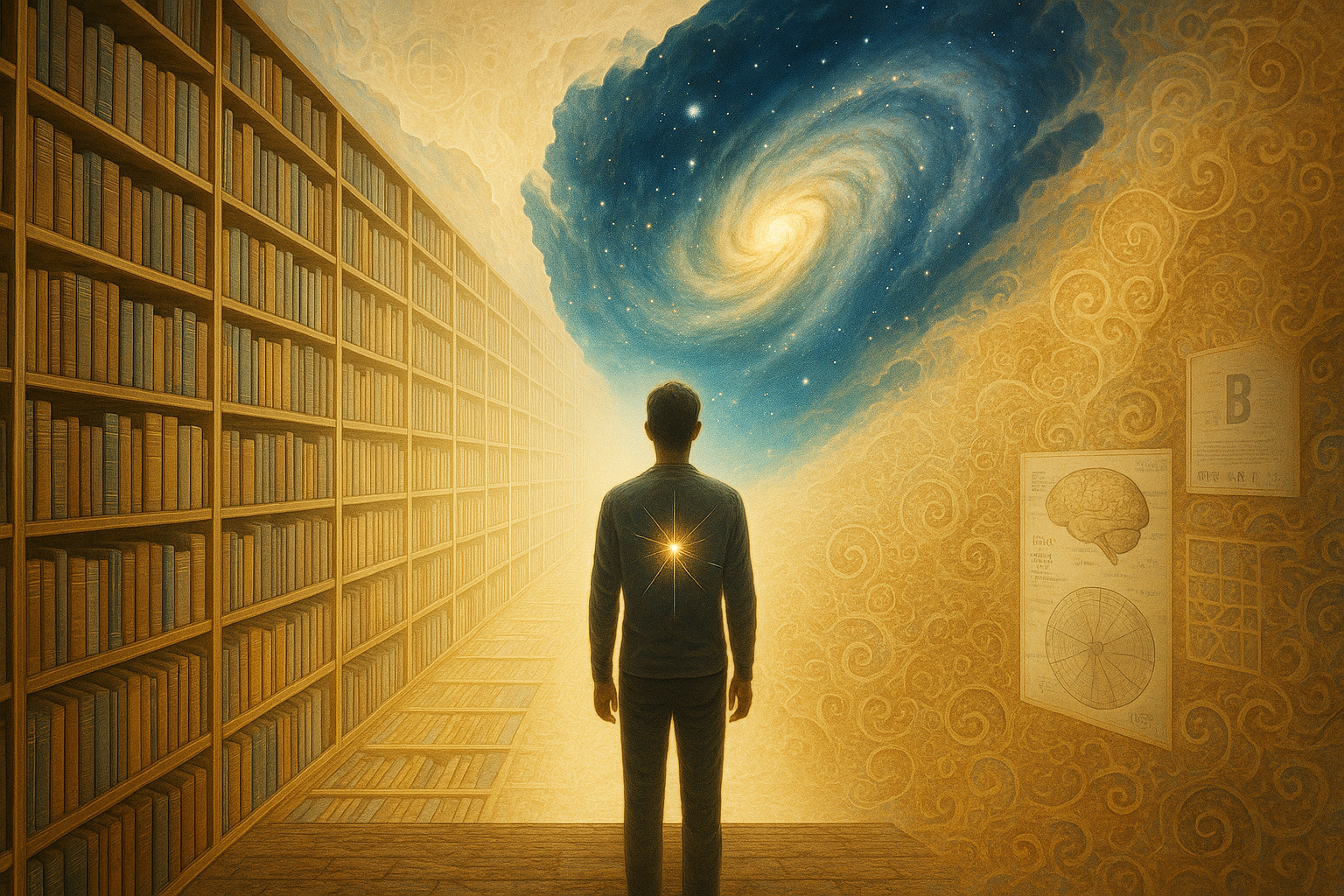
Welcome to the deep dive. We take incredible sources and well, we distill them down into the most important nuggets for you. Today, we're diving into something really fascinating--identity. Something we all think we understand, but uh as we'll find out, it has these cosmic dimensions you probably haven't imagined. Our guide today is an essay called Identity by Bob Debold. Now, he spent decades looking into these really deep questions about humanity, the universe, often through the lens of The Urantia Book. And his background is well, It's really diverse. High school math teacher, corporate leader, athlete, grandparent. It all shapes his unique perspective, bringing these big ideas down to earth.
Exactly. And this essay really asks us to, you know, stretch our thinking a bit to maybe suspend disbelief and engage with ideas that push against the usual materialist viewpoint. It offers a well, a pretty profound glimpse into reality and maybe even human destiny. Sounds perfect for us. So for you listening, what's the core question we're really trying to tackle here? What's our mission for this deep dive? Okay, our mission today is to sort of untangle this really deep relationship between personality, identity, and the self, but we're looking at it through this cosmic lens provided by the source material. It's not just about what we are right now, but um fundamentally who we're becoming on potentially an eternal scale.
Okay, becoming. I like that. Yeah, let's unpack this. So, before we jump right into the deep end with concepts, maybe just a quick word on the source itself, the Urantia Book, what is it in this context? Why is it so central? for Debold, right? So, the essay frames the Urantia Book as the source of, uh, sweeping truths. It even calls it a cosmic upstep. Basically, it claims to offer a profound glimpse into the nature of reality and human destiny. It's presented as a revelation, meaning you know that maybe human intellect alone can't reach. And it expands or even redefines things like personality, identity, selfhood in ways that science, philosophy, religion haven't quite grasped yet. One important thing the authors mention is they use regular English words but sometimes they recontextualize them give them new cosmic meanings so we need to keep that in mind
Got it familiar words new framework. Okay, let's tackle these key terms then personality, identity, self. The essay says Debold had to unpack identity to get to personality and then self came into play so how does the Urantia Book define these? Let's start with personality. okay personality yeah most of us we think of it as you know how we act our quirks our traits how people see us but this source the Urantia Book, it presents something pretty revolutionary. It says personality is not just biology, not just society shaping us, not even just something that pops out of a complex mind. No, it's described as a direct um unchanging and totally unique gift--bestowed by what it calls the universal father. The text is super specific. Personality is a unique gift of the universal father. It is not bestowed by the eternal son nor by the infinite spirit. Neither is it a function of the physical life vehicle or of the mind endowment.
Wow. Okay. That is a game changer. So it's not something we build or earn. It's like the fundamental us divinely given and unique from the start that really shifts things. It absolutely does. So if that's personality, this unchanging core, what on earth is identity then? Ah good question. That's the key distinction, right? The essay clarifies identity is the evolving record of the self shaped by experience. So unlike personality, identity is not static. It's not even guaranteed to be eternal. It's more like the unique personal pattern that get formed as our unchanging personality interacts with everything else. Our mind, our spirit, our physical body, our experiences.
Okay. So, personality, constant divine spark, identity, the dynamic changing story or pattern built on that spark through living. Makes sense. Exactly. What about selfhood or personhood? Are those just synonyms for identity or? Well, the essay uses personhood sort of as an easier entry point for us today, even though the Urantia Book uses selfhood, but essentially, yeah, they both point to the evolving expression of a personality unified energy system. They kind gathered together this whole cluster of qualities that define a spiritually significant individual. That's personality, identity, self-awareness, our free will, something called the thought adjuster, which we definitely need to talk more about. And crucially, the potential for eternal survival.
So personhood isn't just what I AM, but who I'm becoming in relation to everything? precisely. Who you're becoming in relation to God, yourself, the universe. It's a dynamic process. This is incredibly profound--and complex. So where does this personality this gift actually come from? You mentioned the universal father but the essay starts even before that right with the I AM? exactly to really grasp this architecture you have to go back to the absolute beginning the pre Deity source of all reality the I AM. It's described as the state of undivided infinity, static potential, totally self-contained pure potentiality. And from that origin everything else arises including the universal father who's called the first existential identity the personal will of the I AM made manifest.
Okay. So, the I AM is the ultimate source, pure potential. Yeah. But personality doesn't just pop out of that in isolation. You said it's a gift from the father, right? And this is where it gets really interesting. The essay makes a huge point. Self-will alone does not constitute personality. Just having will isn't enough. Personality in this cosmic view only becomes real when the I AM differentiates into relational deity. This happens specifically when the I AM becomes the eternal father of the original son and also the eternal source of the aisle of paradise. So, personality emerges fundamentally not in isolation but in relation.
Whoa. Okay, hold on. So even at the absolute highest level, personality needs another distinct being to relate to just to exist. It requires relationship. That's huge. It is huge. It suggests a relationship is fundamental to the very fabric of reality. Right from the top. Is there an analogy they use to help picture this? It's pretty abstract. Yeah, there's a great one using light. Think of the I AM before differentiation as like an infinite ball of light shining everywhere into an infinite vacuum of everythingness. No walls, no surfaces, just pure potential light. But then when the sphere opens, when the Son and paradise emerge, that light is refracted into reality, made manifest in glory and presence.
Uh so just like light needs something to hit or interact with for us to see it. Exactly. Personality, even divine personality, only actualizes, only becomes manifest when it enters into relationship. It needs that other. OK, That really does help visualize it. Okay. So, if that's the cosmic picture, our usual human understanding of I or self, it feels kind of small now, doesn't it? Yeah. How does the essay bridge this gap? How does it connect to how philosophers and thinkers have tried to understand identity?
Well, it acknowledges that human thinkers have always sort of sensed something there, right? This essential core behind all the changing experiences. People called it the soul, the self, the witness, the subject. You think of Descartes in his I think, therefore I AM. That thinking thing or Kant talking about the transcendental unity of apperception the thing that holds experience together or even William James making that distinction between the me the self we know about and the I the self that does the knowing and Husserl's phenomenology got really close too pointing to a knower behind the knowing.
So, lots of brilliant lines circling it sensing it but maybe not quite nailing it down. precisely the essay says a breakthrough eludes them because science it argues is kind of stuck with its materialist assumptions and religion often gets tangled in dogma or metaphor. What was needed, the essay suggests, was a completely new frame of reference. This cosmic integration placing the self within a spiritual universal architecture. And that's what the Urantia Book claims to offer. Personality revealed not as a guess or a theory, but as a reality.
Okay. Was there anyone in more recent thought who maybe got particularly close to this even without having this specific framework? The essay does highlight one person, Professor Arthur Dykeman. He was a psychiatrist, also studied mysticism. And Dykeman proposed that the fundamental self is actually pure awareness, that silent observer behind all our thoughts and feelings. He argued that unless we recognize this elusive central self, science and philosophy would just keep asking, "Who am I?" and never get the real answer. Now, he didn't use the same cosmic language, obviously, but the essay suggests he intuited a reality that exists prior to thought beyond content, something capable of spiritual recognition. He came closer than most to realizing this observer is personality.
Interesting. So, okay, we have personality, the unchanging divine gift. We have identity, the evolving pattern shaped by life. How does this process of becoming this growth actually work for us mortals? The essay talks about psychic circles. What are those? Right. The seven psychic circles. These aren't just like metaphors for growth. They're described as a divine architecture that actually indicates our status regarding personality, mind development, soul growth, and how attuned we are to that indwelling adjuster. They basically track how coherent our self becomes, how unified it gets in relation to God, spirit, and universal values. It's about moving from an identity that might be dominated by, say, self-assertion and fear towards one that's more stable in trust, loyalty, and recognizing truth. It's a path of inner unification.
So, it's deeper than just learning stuff or being good. It's about a more fundamental integration of our whole being. Exactly. The essay really stresses that the progression is inward, experiential, and cumulative. It's not just ticking boxes. And the text even says persons become more real as they ascend from the seventh to the first level, which is a fascinating idea. Becoming more real. More real. Wow. Yeah. It's meant ontologically like a change in your actual being, not just symbolically. Linda Bucelli, who wrote about these circles, contrasts them with psychological models like Ericson's stages. She points out the circles are specifically about unifying mind, personality, and soul. And crucially, she says relationships are key to mastering circles. Our connections matter deeply for this growth.
Okay. Relationships can and this whole journey through the circles is preparing us for something even bigger. The ultimate transformation. Yes. Exactly. It's all leading towards being ready for a conscious partnership with that indwelling divine spark, the thought adjuster. It brings our evolving identity closer to making this uh irrevocable consecration. Which leads us to fusion. That sounds like the climax of the whole spiritual journey described here. What exactly is fusion in this context? Yeah. Fusion. Okay. So, basic meaning joining two things so completely they become one. Right. In the Urantia Book's teachings fusion is the permanent and eternal unification of the human soul with the divine presence of the indwelling thought adjuster. Yeah. Remember the thought adjuster is described as this pre-personal fragment of God within us. So fusion is presented as a literal actual cosmic event. Your evolving identity, your soul built through choices spiritually joins with that divine fragment. The result--a totally new unity.
Okay. So, not just a nice spiritual idea, but a literal merging, a fundamental change in what you are. The soul built from experience literally fuses with the piece of God. That's the concept. And the personality, that unique unchanging gift we started with, it provides the continuity. It ensures the you is still you. But the adjuster brings the divinity, the eternal nature. And the result is this eternal individual, unchanging in loyalty, unceasing in purpose, utterly unique. Now, it's not like two equal things merging. The adjuster's pure spirit; we're creatures of time. But through, you know, thousands and thousands of moral choices, moments of seeing truth, acts of faith, the human side grows to reflect the adjuster's values, making fusion possible.
Okay. And once fusion happens, Mmmm. what's the result? What changes? It's described as the universe basically giving a solemn nod, recognizing that this mortal has made an eternal decision. The soul has freely, knowingly, finally chosen to align with the will of the universal father forever. At that point, personality becomes fixed but not rigid, more like divinely secured in its U weakness. The fused person becomes deathless, guaranteed to continue the journey through the spiritual realms, eventually to stand directly before the father on paradise. Your soul gets its final identity and your personality is now sealed in divinity. It's presented as the ultimate achievement, the ultimate self-realization.
That is well, it's almost overwhelming to think about. Such an incredible transformation. Did the essay offer an analogy to help grasp this, too? Fusion sounds pretty hard to imagine. It did. Yeah. A really good one actually. Making steel from iron. So steel is an alloy, right? Iron atoms and carbon atoms locked together at the molecular level. They form a totally new structure with completely different properties, much stronger, less brittle than iron. In the analogy, the iron is like our human identity. Shaped by life, by experience, by choice. The carbon represents the thought adjuster working within us, quietly trying to uplift and spiritualize us.
I'm the heat and pressure. That's life. the challenges, the big decisions, the struggles, the crucible where our soul and the spirit within are tested and ultimately forged together. So like steel, the fused being is something new, stronger, indivisible, a permanent spiritual entity. Wow. And you mentioned the supreme being earlier. Does that play a role in fusion too? Yes, absolutely. The supreme being is described as sort of the context, the field in which it all takes place like the furnace itself in the steel analogy. It's the living matrix of energy, mind, and spirit potential where soul substance is actually drawn from and where destiny gets shaped. So fusion isn't just between the human and the adjuster. It's a co-creative triumph happening within this larger evolving divine reality of the supreme. The adjuster provides the divinity. The supreme provides the evolving arena and potential and our personality. That's the indispensable catalyst, the one unique ingredient required for an immortal soul to even be realized.
Our unique personality is the catalyst. I like that. So wrapping this up, this whole deep dive into personality, identity, self through this unique Urantia Book lens, it really paints a picture of a grand dynamic cosmic story, not just about what we are, but as you said at the start, who we are becoming. Exactly. And it leads to this really profound idea in the essay. The supreme is not complete without our contribution. It's like a call to action almost a call to co-author reality with God. A reality that's still unfinished, still alive, still open to the creativity of personality, our creativity.
So, thinking about you listening right now, Yeah. What does all this incredibly cosmic stuff mean for everyday life? Well, it implies that every act of will, every decision you make, especially those favoring truth, beauty, goodness, it actually imprints something eternal into the evolving face of reality. It points towards this amazing idea that God isn't just out there or up there, but also right here within us, experiencing the universe through us, growing with us, and finding fulfillment through our willing choices to grow and ascend
Our choices to actually contribute to God's experience. That's a powerful thought to sit with. It really is. The essay ends with this really poignant quote about the universal father. “In all your afflictions, I AM afflicted,” which just deepens that sense of connection, doesn't it? It suggests that right here in the middle of our lives, our struggles, our choices. Our soul is being forged, not just for survival, but for potentially eternal meaning and purpose within this vast infinite cosmos. Thank you for joining us on this deep dive. We really hope this exploration has maybe given you a fresh perspective. perspective on this sacred co-creative journey of becoming that. Well, maybe we're all on. What stands out to you from today's deep dive? Definitely something to mull over. Until next time.