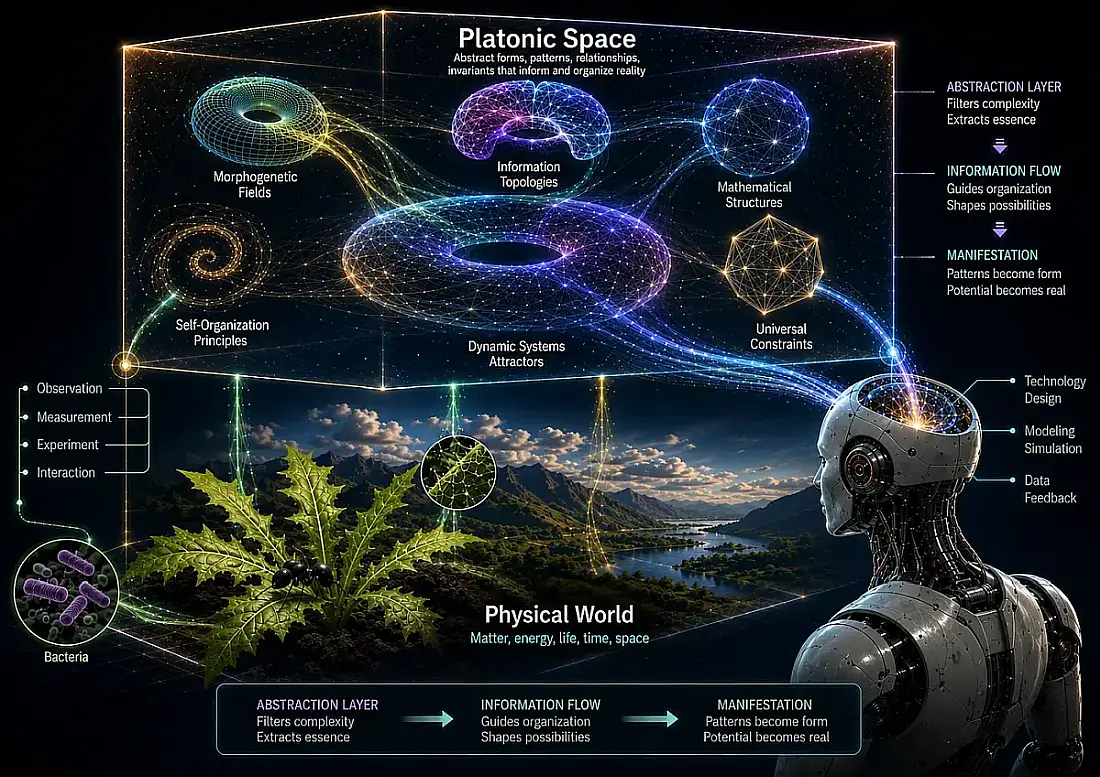
—Alfred North Whitehead (1934)- Copied from thoughtforms.life
The Organization of Possibility
The Ministry of Mind, The Pursuit of Life
Abstract
For more than three centuries, modern biology has achieved extraordinary success by reducing living systems to their constituent parts. That strategy has revealed the molecular mechanisms of heredity, metabolism, and cellular function with remarkable precision. Yet one question remains surprisingly elusive: How do collections of relatively simple components organize themselves into living systems capable of adaptation, problem solving, and increasingly intelligent behavior?
This essay explores that question through the emerging science of developmental biology, systems theory, and Michael Levin's research on basal cognition. Rather than treating intelligence as something that suddenly appears with nervous systems, Levin's work suggests that competency is deeply rooted in the organizational properties of living systems themselves. Cells, tissues, and organisms continually discover, navigate, and expand the landscape of possibilities available to them through local interactions that give rise to coherent global behavior.
The discussion then places these scientific developments into conversation with the cosmology of The Urantia Book. Without conflating scientific discovery with religious revelation, the essay asks whether both are independently describing a universe organized through nested layers of competency, each preserving the achievements of the levels beneath while opening entirely new domains of possibility. From this perspective, organization is not merely the arrangement of matter but the progressive enlargement of what living systems are capable of perceiving, coordinating, and becoming.
Ultimately, this essay proposes that one of the most profound questions facing both science and philosophy is not simply what life is, but how life continually expands the range of possibilities available to itself. It concludes by suggesting that organization may point beyond reductionism toward a richer understanding of reality—one in which progressively expanding forms of competency, mind, and participation become central to understanding both evolution and the human capacity to know God.
Four Ways to Engage With the Ideas in This Essay
An Invitation to the Reader
This essay is intentionally ambitious. It brings together insights from developmental biology, systems science, evolutionary theory, Michael Levin's work on basal cognition, and The Urantia Book to investigate a single organizing question: What determines the landscape of possibilities available to a living system? The answer proposed here is that organization does more than arrange matter. It expands competency, enlarges possibility, and may point toward deeper organizing principles that science is only beginning to recognize.
At just under 9,700 words, this is a substantial essay intended for reflective rather than hurried reading. Readers may also approach its central ideas through several companion formats. A 24-minute podcast provides an accessible overview of the arguments. A 15-slide visual presentation distills its major concepts into evocative images with concise explanations, allowing the structure of the essay to be grasped more holistically. A companion song carries the same themes into a more metaphorical and experiential form. Each medium offers a different point of entry: read for depth, listen for orientation, view for synthesis, or begin with the song and encounter the ideas through imagery and feeling. The additional media are not merely shortened versions of the essay; each reveals the material from a different perspective.
You may find it best to approach the essay as a journey rather than a destination.
- Read slowly. There is no prize for finishing quickly.
- Pause occasionally to consider how each section connects to the central thesis.
- If an idea doesn't immediately resonate, continue reading before deciding. Later sections often illuminate earlier ones.
- I expect you won't concur with many of its conclusions. But I do trust you can profit from the exploration. The goal is not merely to persuade but to invite fresh consideration of some familiar ideas and a few new ones to consider.
- If listening to the podcast, consider following along with the transcript or listening in shorter segments.
Above all, ask yourself one question as you read: How did (and how does) life on this planet progress from its simplest beginnings to the will dignity of personalities capable of knowing God? Of beings capable of pursuing truth, beauty, goodness.
Whether or not you agree with the conclusions, that question lies at the heart of everything that follows.
Explore the essay through audio via a podcast (24 mins.)
Engage with a musical rendition (7:58 mins:secs.)
See the ideas take shape (15 slides)
Introduction: The Organization of Possibility
Physics uncovered the laws governing energy, motion, and the fundamental forces; chemistry explained the organization of matter in terms of elements and their physical interactions; biology increasingly sought life's explanation in cells, molecules, proteins, and ultimately genes essentially reducing to complex chemistry; and psychology reduced behavior, thought, and emotion to the biology of neurotransmitters. This reductionist strategy transformed science and medicine, yielding discoveries of immense practical value. Yet one persistent question has remained only partially answered: How do living systems reliably organize themselves into coherent, functional wholes? Increasingly, this question has shifted scientific attention away from the components of life alone and toward the principles that organize those components into adaptive, integrated systems.
During the past several decades, biology has increasingly shifted toward systems-oriented approaches that emphasize organization, communication, and the dynamics of whole living systems in addition to their molecular components. While molecular biology continues to illuminate life's constituent parts, developmental biology,[ref] systems biology,[ref] and complexity science have redirected attention toward how those parts organize themselves into coherent, adaptive wholes. This takes the slogan "the whole is greater than the sum of its parts" into new territory.
Consider meaning in language. Let's assess DOG versus GOD. Exactly the same letters. Entirely different meaning. Meaning is relational. No individual letter contains the meaning; the organization produces it. Or think about a symphony. Imagine dumping violins, trumpets, drums, and clarinets into a pile. Every fundamental component needed for Beethoven's Fifth is present. Yet there is no symphony. Now arrange musicians according to a score. Nothing material has changed. Only relationships. Suddenly there is music. The score is not another physical instrument. It is an organizational principle.
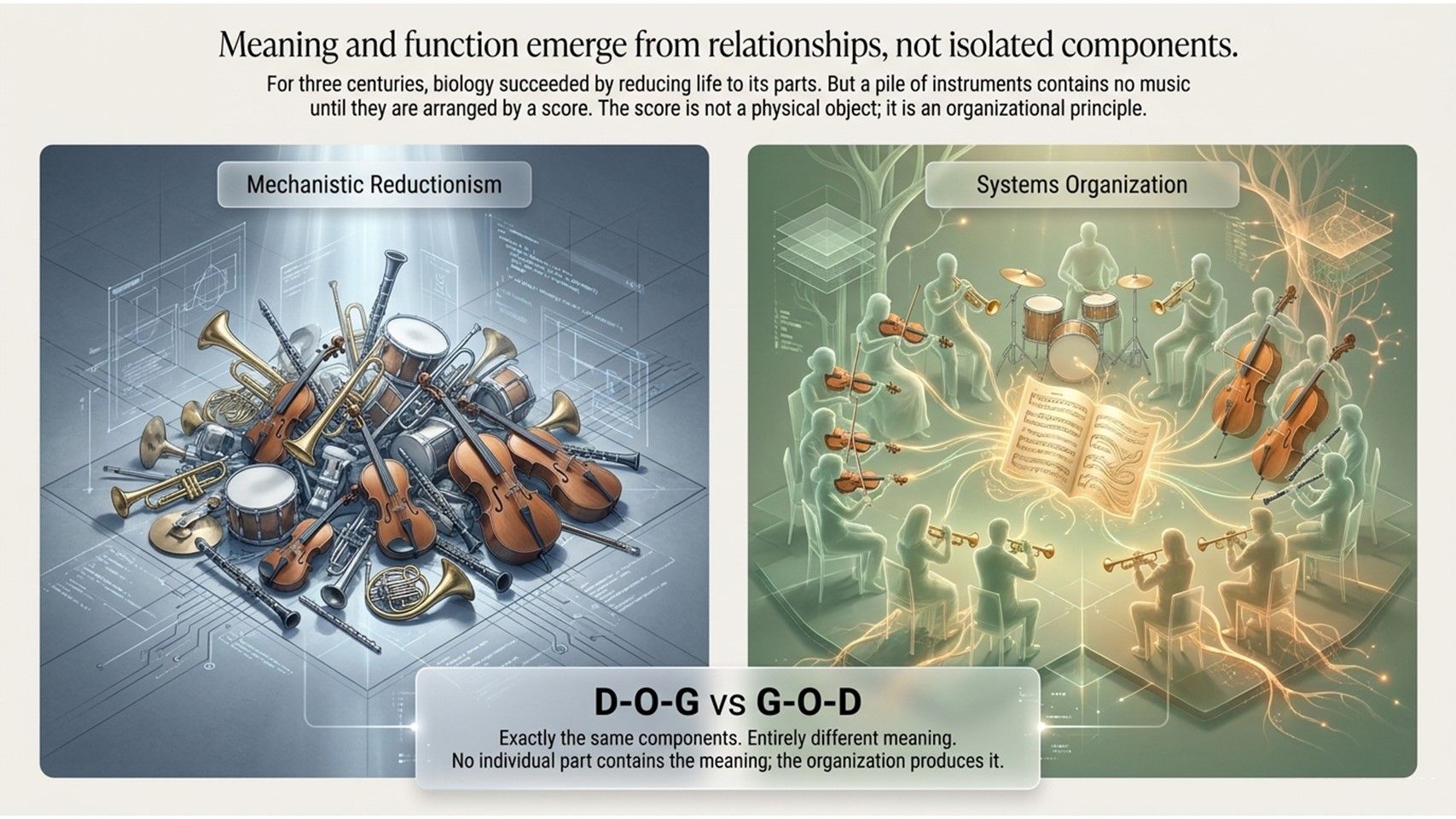
The organizing relationships among parts possess explanatory and causal significance that cannot be found by analyzing the parts in isolation. Reductionism excels at identifying components. Systems thinking asks (and attempts to identify) how components are organized into coherent systems whose relational structure both constrains behavior and opens new possibilities. Relationships between and among components are not secondary consequences; they are the architecture through which new levels of reality emerge.
Before life appeared, the universe exhibited an extraordinary range of physical possibilities: atoms combined into stars, galaxies, planets, and increasingly complex chemistry. And prior to two atoms of hydrogen and one of oxygen amalgamating, "wetness" didn't exist. Hydrogen burns; oxygen supports combustion. Yet together they produce water, which extinguishes fire. Neither atom possesses "wetness." Wetness emerges only when enormous numbers of molecules are organized together.
And with the emergence of life, an entirely new class of possibilities entered the cosmos. Living systems began synthesizing proteins, constructing cells, building ecosystems, and eventually generating cognition, culture, and networked intelligence. Life continually expands the space of organized capabilities available to the universe.
This essay posits that the key to the possibility of expansion is relationship. New possibilities do not arise simply because additional matter or energy appears, but because matter enters into new and increasingly organized relationships. A protein is not merely a collection of amino acids; it is a specific relational arrangement among them. A cell is not merely a collection of molecules; it is a stable network of relationships that sustains itself through time. Likewise, an organism is not merely an aggregate of cells but an enduring pattern of coordinated relationships pursuing shared goals. As organization increases, the landscape of possible relationships expands geometrically, opening entirely new domains of action, adaptation, and meaning. This principle is not confined to biology. Wherever relationships become more deeply integrated, new possibilities emerge that were unavailable to the isolated components alone. In this sense, possibility is fundamentally rooted in organized relationships before it becomes expressed in any particular form of reality.
This essay argues that relationships are not merely connections among existing things; they are the organizing principle through which new possibilities become actual at every level of reality.
Throughout this essay, possibility does not refer merely to future events or hypothetical outcomes. It refers to the structured landscape of relationships that are available to a living system before they are physically realized. An embryo, for example, contains countless possible anatomical configurations, yet only a small subset are biologically coherent. Development consists in navigating this landscape, continually correcting errors while converging upon an integrated form. These possibilities are abstract, not because they are imaginary, but because they cannot be identified with any single molecule, gene, or cell. They exist as patterned relationships among components that constrain physical processes without violating physical law.
Increasingly, developmental biology is revealing that genes alone do not explain the remarkable ovrall competency of living systems. For example, embryos routinely correct developmental errors; tissues regenerate after injury; cells communicate continuously, negotiate their activities, and discover alternative pathways when normal processes are disrupted. Rather than behaving as passive molecular machines executing rigid genetic instructions, living organisms appear to function as adaptive, problem-solving systems capable of pursuing developmental goals under changing conditions.
This emerging perspective represents more than just a continuing refinement of genetics; it signals a broader shift in the kinds of questions biology is beginning to ask. The central issue is no longer simply, What are organisms made of? Increasingly, researchers are asking, How do living systems organize possibility into functional form? How do billions of individual cells, each possessing only local information, cooperate to produce and maintain coherent physical (anatomical) structures? How does biological organization remain robust in the face of continual disturbances? And how do increasingly sophisticated forms of competency arise throughout evolutionary history?
At the center of this contemporary conversation stands developmental biologist Dr. Michael Levin,[ref] whose research on bioelectric communication, regeneration, and collective cellular intelligence has challenged several long-standing assumptions about biological organization. Levin argues that cells should not be viewed merely as biochemical machines but as members of problem-solving collectives that pursue anatomical goals through communication, adaptation, and continual error correction. His work joins a growing body of research suggesting that life is fundamentally an information-processing phenomenon in which communication, memory, and goal-directed behavior are as essential as chemistry itself.
These developments also reopen one of biology's oldest and most controversial questions: teleology, or goal-directedness. For much of the twentieth century, scientists deliberately avoided the language of purpose, preferring explanations based solely on chemistry, physics, and natural selection. And since teleology historically carried theological implications, many biologists deliberately avoided such language. Today, however, many leading researchers routinely describe living systems using terms such as goals, memory, decision-making, problem solving, competency, and agency. Whether these concepts represent merely convenient descriptions or point toward something more fundamental remains one of the most intriguing questions in contemporary science.
It appears an even deeper question, however, may be emerging as a result of these scientific discussions. Perhaps the most profound issue is not simply how organisms develop, but what organizes possibility itself. This question is occurring across multiple disciplines that includes not only developmental biology and systems theory, but artificial intelligence, cognitive science, and the philosophy of mind. The focus is gradually shifting from asking what reality is made of to that of how reality organizes itself into increasingly integrated, adaptive, and competent forms. The question is no longer only about matter alone. It is increasingly about organization.
Yet even deeper mysteries remain. How does every acorn reliably develop into an oak and never a maple? How does a single fertilized egg consistently generate a functioning organism composed of trillions of coordinated cells? How do embryos correct developmental errors, regenerate damaged tissues, and restore anatomical order after disruption? And perhaps most astonishing of all, how does the caterpillar dissolve much of its own body before reorganizing itself into the radically different form of a butterfly? These are not merely questions about molecules or genes. They are questions about the principles by which living systems generate, preserve, and restore organized possibility.[ref]
This essay explores that emerging paradigm. It follows the scientific trail through the work of Dr. Levin and others who are redefining how we understand development, intelligence, and biological organization. It also considers earlier voices, such as Rupert Sheldrake, who challenged strictly gene-centered explanations decades before today's renewed interest in cellular communication and morphogenesis. Finally, it asks whether these scientific developments invite a broader conversation that extends beyond biology itself.
For students of science, philosophy, and religion alike, these questions occupy an extraordinary frontier. Science seeks to understand the mechanisms by which organized systems arise. Philosophy asks what concepts best explain those mechanisms. Religion asks whether the remarkable order, purpose, and intelligibility of the universe point toward a deeper albeit spiritual reality. The thesis of this essay asserts that biology itself is increasingly uncovering phenomena that naturally invite these larger conversations. In that sense, the growing study of biological organization may represent one of the most significant opportunities of our time for coordinating the dialogue among science, philosophy, and religion.
What I am endeavoring to portray in the sections that follow is what might be called the organization of possibility—the idea that while nature becomes increasingly intelligible through analysis of its components, its deeper coherence emerges through the organizing principles that self-organizes those components across multiple levels of reality. This essay argues that the insights of Whitehead, Sheldrake, Levin, and others converge upon a common question that naturally invites comparison with the Urantia Book's revelation of the adjutant mind-spirits: How is possibility organized into actuality? If relationships are the organizing principle through which new possibilities become realizable, they may also illuminate one of humanity's oldest puzzles: the relationship between the part and the whole.
Beyond the Genetic Blueprint
Yet anyone who has participated in even a modest project knows that a blueprint alone does not explain how the finished structure comes into being. Likewise, every parent who has planned a family vacation knows that even the best itinerary quickly gives way to a continual process of communication, adaptation, and problem solving.
The blueprints are indispensable. They define the structural requirements of buildings, the dimensions of roads, the locations of water lines, electrical conduits, storm drains, and communication networks. The same applies to the itinerary; it too is indispensable. It defines the intended destinations, routes, accommodations, schedules, and activities that give the journey its overall direction. Yet neither the blueprint nor the itinerary explains how the work or the journey actually unfolds. Both require continual communication, adaptation, coordination, and problem solving as unforeseen circumstances arise.
With respect to the city construction, the actual work inevitably unfolds as an ongoing process of adaptations. Unexpected rock formations require foundations to be redesigned. Weather delays alter construction schedules. Material shortages force substitutions. Utility conflicts require rerouting. New regulations appear. Equipment fails. Contractors coordinate continuously, solving thousands of problems that no blueprint could possibly anticipate. Every day the project adjusts to changing conditions while never losing sight of its overall objective.
In reality, the city is not built by blueprints alone. It is built through the continual interaction between planning and problem-solving. The project plan provides the goals, constraints, and governing principles. The countless workers, engineers, supervisors, and specialists transform those plans into reality through communication, coordination, and intelligent adaptation to feedback. Success depends not simply upon having good instructions but upon possessing the capacity to respond creatively to an ever-changing environment.
The same distinction applies to living organisms. If the plans required to build a city are not sufficient to explain its construction, should we expect the genetic "plans" of an embryo to explain the construction of a living body? But this question wasn't ready to be asked for quite some time after the monumental discovery of the double helix of DNA[ref] as it catalyzed many amazing successes that spun off of molecular biology. In effect, it seems to have created a blindspot. During the latter half of the twentieth century, a powerful metaphor ensued: DNA came to be viewed as the organism's blueprint.
This metaphor was well deserved. Discoveries in genetics transformed our understanding of heredity, revealing how DNA influences inherited traits, many genetic diseases, cancer mutations, and infectious diseases. They fueled revolutionary advances in medicine, forensic science, and ancestry research, while opening entirely new frontiers in biotechnology. Such achievements naturally led both scientists and the public to think of genes as containing the instructions required to build a living organism. While this metaphor captured essential truths about heredity and protein synthesis, it also encouraged the impression that development itself was largely the execution of a genetic program.
There is considerable truth in that supposition. Genes do specify many remarkably stable features of an organism. They influence the proteins cells produce, the chemical pathways they employ, and many inherited characteristics, from eye and hair color to muscle fiber composition and aspects of metabolism. Without DNA, development simply cannot occur. Yet these remarkable successes exposed a deeper mystery: that knowing these molecular components has not explained how a developing form organizes itself into a coherent, adaptive, and goal-directed living organism.
Yet as biologists have come to study development itself, they have increasingly recognized that genes alone cannot explain how a fertilized egg becomes a functioning organism. DNA specifies the molecular components, but it does not appear to dictate every movement of every cell, every adjustment to unforeseen circumstances, or every correction required along the way. Embryo development (embryogeny) is clearly not the execution of a rigid script. It is a dynamic process unfolding within a constantly changing biological environment.
As a result, the remarkable successes of the blueprint metaphor transformed modern biology. They illuminated many essential aspects of heredity and development while simultaneously revealing the limits of a purely genetic explanation. The more scientists learned about the molecular components of life, the more pressing became a deeper question that remained largely unexplored: Who—or perhaps more accurately, what—manages the project?
An audience of 5000 found itself "piloting" a commercial airliner. There was no designated pilot, no central coordinator, and no one issuing instructions but together they generated coherent global behavior. It landed safely despite the fact that virtually no one present knew how to fly an airplane.
This realization has encouraged a growing number of researchers to ask a different question. Rather than asking only how genes specify biological parts, they ask how billions of communicating cells coordinate their activities to achieve coherent developmental goals. In other words, they are shifting attention from the components of life to the organization of those components—from instructions to intelligent coordination, from static plans to adaptive processes, and from predetermined outcomes to the continual organization of possibility.
Few scientists have articulated this transition more clearly than developmental biologist Michael Levin. His research suggests that living organisms develop much less like machines executing a fixed program and much more like large-scale construction projects whose countless participants continually communicate, adapt, solve problems, and discover new pathways toward a common objective. In his view, the remarkable achievement of development lies not simply in the genetic instructions but in the living system's extraordinary capacity to organize itself.
Levin argues that development is not the singular execution of a genetic blueprint but the continual navigation of a living system toward a target morphology through the collective intelligence of communicating cells. DNA establishes many of the biological constraints and resources, but the developmental process itself unfolds through the collective intelligence of communicating cells. Rather than executing a predetermined sequence of instructions, these cellular communities continually assess their current anatomical state, exchange information, compensate for disturbances, and navigate toward a target morphology. No single cell serves as the project manager. The "intelligence" resides in the relationships among them. This leads us to the notion of distributed intelligence. No single cell is "the project manager." Rather, the management emerges from the network of communicating cells. That distinction is central to the thesis of this essay—the organization of possibilities.[ref]
A memorable illustration of distributed intelligence comes not from biology but from computer science. In Out of Control (1994), Kevin Kelly recounts an experiment conducted during the 1991 SIGGRAPH conference in Las Vegas. An audience of nearly 5,000 attendees was handed a simple cardboard paddle colored red on one side and green on the other. A camera scanned the audience and translated the collective display of red and green paddles into steering commands for a flight simulator projected onto a giant screen. Suddenly, the audience found itself "piloting" a commercial airliner.
There was no designated pilot, no central coordinator, and no one issuing instructions. Yet as the simulated aircraft drifted off course, thousands of individuals instinctively adjusted their paddles in response to what they observed on the screen. Local perceptions produced local actions, but together they generated coherent global behavior. The audience successfully stabilized the aircraft and landed it safely despite the fact that virtually no one present knew how to fly an airplane.
Kelly used this episode to demonstrate how complex systems can exhibit remarkable competence through decentralized cooperation rather than centralized control. Levin's work suggests that developing organisms function in a strikingly similar way. No single cell serves as the embryo's project manager. Instead, countless cells continually exchange information, detect deviations from an anatomical goal, and adjust their behavior in response to one another. Intelligence resides not in any individual cell but in the network of relationships among them.
This analogy also helps illuminate Levin's idea of an abstraction layer. The conference participants never manipulated rudders, elevators, ailerons, or engine thrust directly. They interacted through a simple interface that concealed the enormous mechanical complexity beneath it. Likewise, cells need not possess complete knowledge of an organism's biochemical machinery. They communicate through higher-level signals that allow the collective to navigate toward a target anatomical form while leaving much of the underlying molecular complexity hidden.
Levin often summarizes this by saying that cells possess a very primitive form of intelligence or agency. He does not mean that cells think like humans. Rather, he means they demonstrate behaviors that resemble the simplest forms of problem solving. Cells can pursue objectives, adapt to unexpected circumstances, compensate for damage, and discover alternative routes toward successful outcomes.
This brings us to one of Levin's more difficult phrases to get one's mind around: the developmental abstraction layer. Engineers use this term to describe a level of organization that hides enormous complexity beneath it.[ref] Computer scientists, for example, design operating systems that allow users to perform sophisticated tasks without controlling millions of individual electronic operations. Michael Levin suggests that developmental biology possesses similar abstraction layers. It is simply a level of organization that hides enormous complexity underneath it.
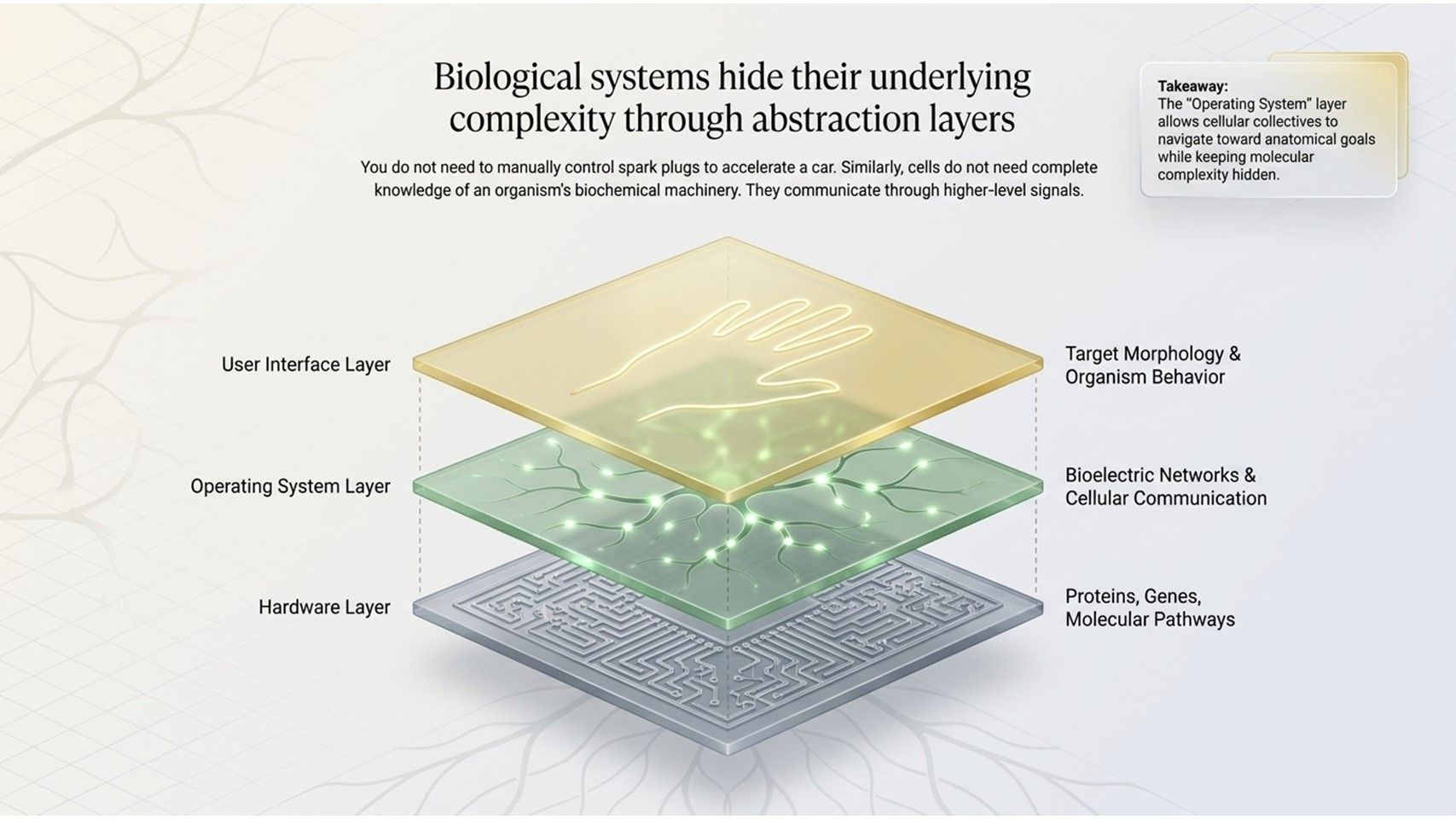
Consider driving a modern automobile. When you press the accelerator, you are not controlling fuel injectors, spark plugs, pistons, crankshafts, sensors, or engine timing. You simply ask the car to "go faster." The accelerator pedal translates your simple command into thousands of coordinated mechanical actions. It acts as an abstraction layer between your intention and the machinery.
The operating system on your computer performs the same function. When you click "Save," you are effectively instructing millions of transistors how to rearrange electrical charges. The operating system translates your simple request into countless low-level operations.[ref]
Bubble sort is deterministic, has been exhaustively studied, and has no hidden intricacies left to discover after seventy years of computer programming. Levin’s researchers chose it for exactly that reason: a system this simple, this old, and this thoroughly understood leaves nowhere for an undiscovered mechanism to hide.
Levin argues that embryonic development employs a biological abstraction layer analogous to those found in engineered systems like the car and the computer described above.[ref] Rather than prescribing every developmental event directly, the genome provides many of the communication pathways, bioelectric properties, chemical signaling mechanisms, and behavioral rules that enable cellular communities to work together. Development therefore moves beyond the constraints of the execution of a rigid genetic script toward an ongoing process in which cells continually exchange information, adapt to local conditions, and coordinate their activities as the organism takes shape.[ref]
Within this developmental layer, genotypic information is translated into anatomical and behavioral phenotypes through the continual interactions of communicating cells.[ref] Rather than transmitting genetic instructions unchanged, the developmental process continually interprets signals, coordinates cellular activity, corrects errors, and navigates toward target anatomical outcomes. In this sense, the developmental abstraction layer is itself an organizer of possibility. This, in turn, raises a constellation of deeper questions. For example, how does such an abstraction layer arise? And how do billions of individual cells, each possessing only local information, collectively generate the competencies required to build, maintain, and restore a coherent living form?
The Ratchet of Competency
If development depends upon communication among cells rather than the rigid execution of genetic instructions, a deeper question naturally follows. How do billions of individual cells, each possessing only local information, coordinate their behavior well enough to build, maintain, and repair a coherent organism? Michael Levin argues that the answer to development depending upon communication among cells lies not in increasingly elaborate genetic instructions, but in increasingly competent developmental systems. Evolution, he suggests, has progressively shifted its emphasis from perfecting biological hardware (the genome) toward improving the collective problem-solving abilities of living tissues. He call this the software of the developmental system.
Engineers generally dislike noise. Random disturbances usually make machines perform worse. Living systems, by contrast, have evolved to tolerate noise and often exploit it. Small variations, unexpected events, and imperfect conditions can promote robustness, adaptability, and even innovation, not despite the noise, but in some circumstances because of it.[ref] Levin actually writes: "In biology, the noisiness of the local environment is a feature, not a bug."[ref]
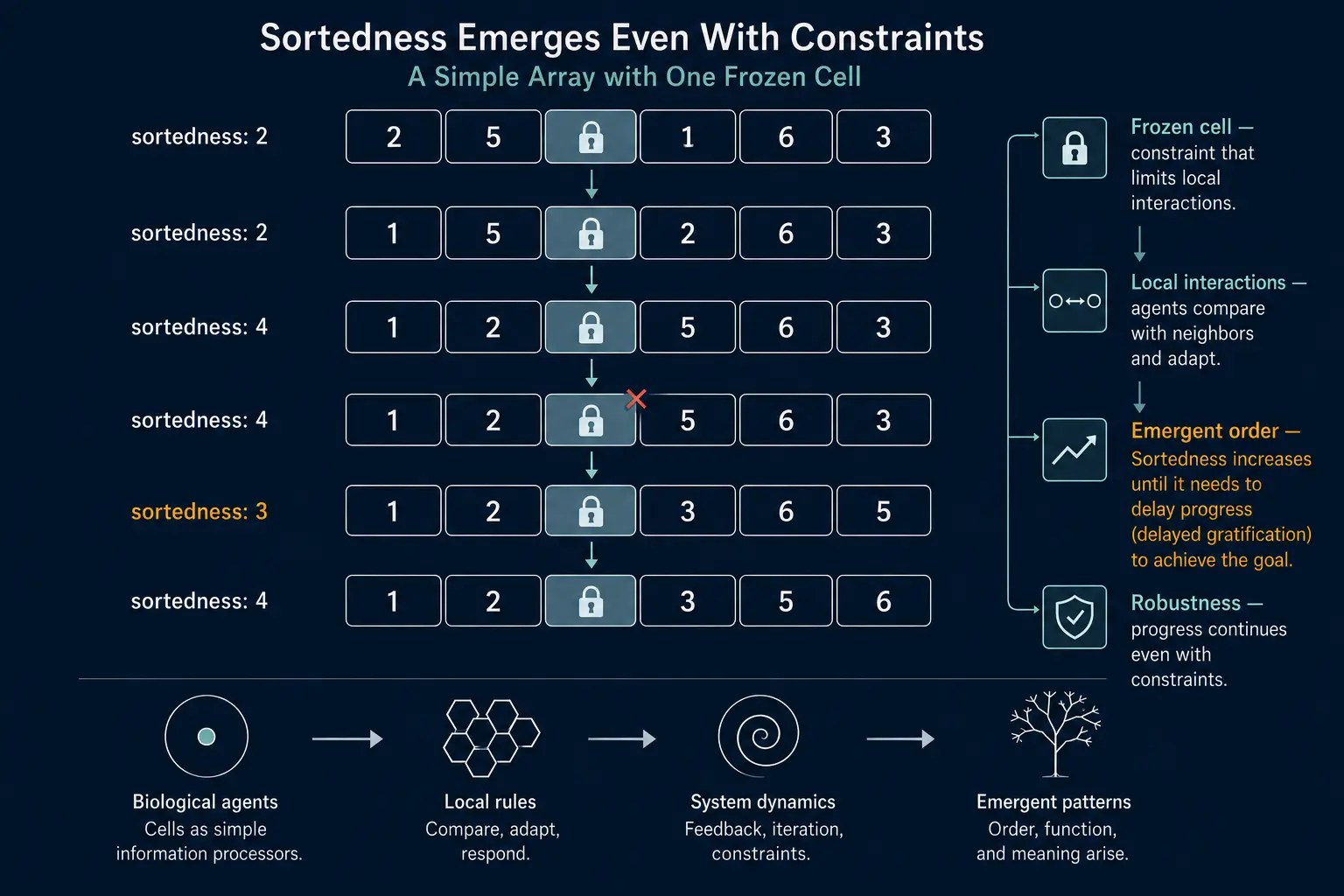
That claim sounds almost paradoxical until you see it demonstrated in an example simple enough to fully appreciate the counter intuitiveness of the phenomenon. In 2024, Levin and colleagues published a study that does exactly that, using perhaps the least example imaginable: a “bubble sort.”[ref] Nearly every introductory computer science student is assigned a task to develop this algorithm. The students must demonstrate they can code this to happen: given a list of scrambled numbers in a linear array, compare each pair of neighbors; swap them if they're out of counting sequence; repeat until nothing more needs to move. When there can be no more swapping, the array should end up listed in order from numerically low to high. It is about as far from biology as a learning event can get.
Bubble sort is deterministic, has been exhaustively studied, and has no hidden intricacies left to discover after seventy years of computer programming. Levin’s researchers chose it for exactly that reason: a system this simple, this old, and this thoroughly understood leaves nowhere for an undiscovered mechanism to hide. Or is that an assumption that is too good to be true?
The experiment made one change to the algorithm's design: rather than a single external controller reaching in and swapping numbers at will, each number was coded to function as an autonomous "cell," able to see only its immediate neighbors and decide, on its own, whether to move. There is no top-down “manager” as the typical code maintains. The sort has to emerge from many independent, purely local decisions running in parallel. This is precisely the shift from blueprint to distributed coordination that has occupied us throughout this essay, reduced to its barest possible form.
One note of definition. Throughout this discussion, agent does not imply consciousness or deliberation. It refers to any semi-autonomous system capable of sensing relevant local conditions, responding according to its governing rules, and thereby contributing to the behavior of a larger system. Computer programs are specifically designed to do this. Whether agency is centralized in a single controller or distributed among many interacting units depends upon the architecture of the system. In conventional sort, and typically how nascent students code, the algorithm instantiates a single centralized agent.
In Levin's Bubble Sort model, each computational element (that is, each number and its location in the array) functions as an autonomous agent, interacting only with its immediate neighbors through individually assigned and coded “local” rules. The algorithm has no code that allows an individual agent to have direct access to the global ordering of the array; the overall solution is a result of the collective interactions of the agents. In other words, an agent “sees” only its neighbor and executes its own local procedures according to the specific rule Levin calls an “algotype.”[ref]
There are three possible agent types: Bubble, Selection, and Insertion. Each is defined by its assigned behavioral rule, or algotype. In a homogeneous array, all agents share the same algotype. In a chimeric array (heterogenous), agents of two (or more) different algotypes are intermixed, although each individual agent retains its own fixed type throughout the sorting process. This distinction becomes important when we discuss how agents governed by different local strategies interacted within the same collective.
The agent then is defined by its individual participation in the network of local interaction rules. The number "7" is not an agent. Location 15 is not an agent. The local rule is not an agent. The computational element (number + location + local rule) functions as an agent because of its participation in the network of interactions. Agency, therefore, is not an intrinsic property of the component but a functional role constituted by its relationships. I press on the point that the agent is not defined by the rule alone. It is defined by 1) its state (number occupying a location), 2) the local rule (algotype), 3) and the interaction network. The rule by itself is just a rule. Only when instantiated within a network of interacting components does it become a governing relationship. This implies agency is relational rather than intrinsic. Said another way, agency is the capacity of a component to participate meaningfully within an organized network of relationships.
What I am saying here is that agency is not something possessed; it is something enacted through participation in organized relationships. It means agency is less like a substance and more like a functional status within a system. This idea aligns remarkably well with the Urantia Book passage we’ve reflected on before regarding the mortal mind and the Thought Adjuster: "The relationship between material mind and divine spirit, which connotes a value and carries a meaning not found in either of the contributing factors to such an association. The reality of this unique relationship is neither material nor spiritual but morontial. It is the soul." (111:2.7) The structural parallel is striking: in both cases, a relationship is not merely a connection between entities; it is itself a locus of causal organization that carries new capabilities not present in the isolated components. Said another way: agency is the capacity of a component to participate coherently within an organized network of relationships.
Before moving on to the actual outcomes of the experiment, we’ll cover two areas that are important to set the context by asking questions: 1) Is this experiment novel, and 2) What did Levin find running the local sort before introducing exceptions?
With respect to novelty (1), readers with a background in computer science may object at this point that none of this is new. They would be right, in a narrow sense. Sorting through networks of simple, locally acting comparators is a well-established idea. Kenneth Batcher’s 1968 bitonic and odd-even merging networks demonstrated how a predetermined arrangement of comparators—each responsive only to its own two inputs—could collectively sort an entire sequence without a central controller inspecting the whole array or deciding dynamically which comparisons to make. An even closer precedent for Levin’s strictly neighbor-to-neighbor arrangement is A. Nico Habermann’s 1972 “parallel neighbor-sort,” now generally known as odd-even transposition sort, in which alternating sets of adjacent pairs repeatedly compare and exchange their values.[ref]
But this objection, while technically correct, mistakes the architecture for the experiment. Nobody building sorting networks in 1968 was asking whether such a system might exhibit anything resembling delayed gratification, or whether damaged components would reveal something about the difference between centralized and distributed fault tolerance, or whether elements following different rules would cluster with their own kind for reasons the rules themselves cannot explain. Those questions belong to a different discipline altogether — not computer engineering optimizing for speed, but developmental biology asking what minimal ingredients are required before something resembling goal-directed problem solving appears. What is new is not the sort. What is new is the question being asked of it — and, more importantly, that the sort answers a question nobody had thought to put to it before
With respect to the local sort before introducing exceptions (2) for which the sort would need work-arounds to complete, the researchers first had to answer a more basic question: does a cell-only sort with no central authority actually work at all? It did. Every array, run under every one of the three cell-view algorithms, reached a fully sorted state. No cell needed to know anything beyond its own immediate neighbors, and no one was watching over the whole array to confirm progress, yet the array always found its way to complete low-to-high order. That alone was not remarkable; it simply confirmed that dismantling the central controller hadn't broken the underlying logic.
What Levin found next was truly interesting: how did this leaderless version stack up against the traditional, top-down algorithm on efficiency? If only the actual swaps were tallied, two of the three cell-view algorithms performed almost identically to their traditional counterparts. The third algotype, the cell-view Selection sort, fared considerably worse, taking roughly eleven times as many swaps to finish, since each cell was chasing its own private notion of where it belonged rather than following one coordinated pass through the array. But when the researchers also counted every comparison a cell made — every glance at a neighbor's value, whether or not it led to a move — the picture shifted. They performed this experiment because sensing is not free in biology. A cell that continually monitors its neighbors expends time and energy doing so. Likewise, your own body continuously monitors temperature, blood chemistry, balance, and countless other variables—even while you sleep—paying an ongoing metabolic cost simply to maintain awareness of its internal state. Once that cost was included, Levin found the decentralized Bubble and Insertion sorts turned out to be more efficient overall than their centrally controlled counterparts, needing meaningfully fewer total actions to reach the same fully ordered result. Selection sort remained the exception, still less efficient in its cell-view form even by this fuller accounting.
There was no obvious reason to expect this outcome. A single controller, surveying the whole array and choosing exactly which comparison to make next, should in principle be able to sort with less wasted effort than a crowd of cells each guessing independently, blind to everything but their nearest neighbor. That two of the three algorithms defied this expectation — that ignorance and independence sometimes outperformed omniscience and central planning — was itself a small, genuine surprise, and it appeared before any cell had been damaged, before any obstacle had been introduced, and before anything resembling delayed gratification had entered the picture at all.
Then the researchers introduced damage. Some cells were made "frozen" — locked in place, unable to move no matter what the rule told them to do. A cell sitting beside a frozen neighbor might try, every cycle, to swap into a spot it can never reach. What happens next is the part worth taking notice. Watching one such array in the paper's own worked example, the sortedness of the array — a simple percentage measuring how close to fully ordered it is — climbs steadily upward, stalls, and then, at one specific step, drops. A cell that cannot get past the frozen blockage takes the only move actually available to it, temporarily scattering numbers that had just fallen into place. One step later, that detour opens a path for other cells to complete the job, and sortedness climbs higher than it would have otherwise. The system got measurably worse before it got better — not by accident, but because getting worse was the only way through.
Levin borrows a phrase from William James for this pattern: delayed gratification which he defined as the capacity to move temporarily away from a goal in order to reach it more fully later.[ref] James used it to distinguish genuine goal-seeking from simple mechanical attraction: a magnet, blocked by a wall, never routes around the obstacle — it just sits there, straining uselessly in a straight line forever. The sorting array does something categorically different. It reroutes. And nothing in its code ever told it to.
A second finding is, if anything, stranger. When the researchers built arrays in which different cells followed different sorting algorithms entirely, some coded as bubble-sort cells, others as insertion-sort or selection-sort cells, the array still sorted itself completely. But partway through the process, cells running the same algorithm began drifting toward one another, forming loose neighborhoods of like-minded cells, before eventually being pulled apart again as the numbers settled into final order. No cell can perceive which algorithm its neighbor is running. There is no line of code anywhere that references this property at all. And yet, for a short time during the sort, likeness clusters with likeness — a shape in the data with no counterpart anywhere in the instructions that produced it.
It would be an overstatement to call any of this an unambiguous demonstration of intelligence, and it is worth saying plainly that the paper's own numbers are more uneven than its headline language suggests. Namely, the "delayed gratification" effect is stronger in some algorithms than others, and even appears, to a lesser degree, in the old-fashioned centralized version the researchers used for comparison. The authors themselves offer an important caveat, conceding that "there is no magic here." Everything the array does remains, in the most literal sense, a consequence of the simple rule each cell follows.[ref] The clustering, too, dissolves under analysis into something almost mundane: cells that move at a similar pace tend, for a while, to stay near one another. This is not so different from noticing that vehicles traveling at a similar speed end up bunched together in the same lane of traffic. No mysterious new force needs to be invoked.
But this, I think, is exactly where the discussion becomes interesting. That a detour-and-recovery pattern, or a pace-driven clustering pattern, can be fully explained once you know the mechanism does not make the underlying observation trivial. It sharpens it. What the experiment actually demonstrates is that a handful of simple, local, rule-following relationships i.e., with no central authority, no memory, no lookahead, and no explicit instruction for what to do when blocked, can produce coherent, goal-adjacent, system-level behavior that is not visible anywhere in the rules themselves. The competency exists at the level of organization, not at the level of any component's design. This is the ratchet metaphor Levin points toward: that evolution discovers better ways of arranging relatively simple parts. And arrangements unlock capacities and possibilities the parts, considered alone, never possessed.
This brings a very interesting statement the Urantia Book makes while discussing Personality and Reality: “In aggregations parts are added; in systems parts are arranged. Systems are significant because of organization—positional values. In a good system all factors are in cosmic position. In a bad system something is either missing or displaced—deranged. In the human system it is the personality which unifies all activities and in turn imparts the qualities of identity and creativity.” 112:1.19 (1227.9)
Levin's Bubble Sort experiments provide a concrete illustration of this principle. Nothing new is added to the system beyond simple agents following local rules. What changes is the organization of their relationships, especially when different algotypes are introduced. From that organization emerge competencies that cannot be attributed to any individual component in isolation. The experiment suggests that possibility itself expands as organization becomes more coherent. And this is not because the parts become more sophisticated, but because their relationships enable capacities that did not previously exist.
The Urantia Book's distinction between aggregation and organization parallels the principle illustrated by Levin's experiments. The issue is not that organized systems merely contain more possibilities than unorganized ones. Rather, organization itself changes what becomes possible. By arranging components into coherent relationships, new competencies arise that cannot be attributed to the parts alone. The revelation then extends this principle one step further. In living persons, organization is not left to chance or mere mechanical interaction; personality functions as the unifying center that coordinates the system, imparting identity and creativity. Organization is therefore not simply a description of the human system. It becomes the basis by which new possibilities can be recognized, integrated, and creatively expressed.
This raises a question this essay has been circling from its first few paragraphs. If a capacity like this doesn't have to be built from scratch. If it is simply available to any system organized the right way, biological or digital, cellular or numerical, then where does that possibility come from? Levin has begun gesturing, in his more speculative writing, toward the idea that certain competencies may be less like inventions and more like discoveries: mathematical or logical structures that are, in some sense, already there, waiting in the space of all possible organizations, for any sufficiently arranged system to draw upon as something closer to a free inheritance than an achievement. He calls these structures "free lunches."[ref] It is a strikingly Platonic suggestion for a laboratory scientist to make — that the organization of possibility itself might have a kind of pre-existing structure, discovered rather than manufactured, whenever the parts are finally arranged well enough to find it.
That suggestion is not new to human thought, even if it is new to sorting algorithms. Decades before Levin's bioelectric networks, biologist Rupert Sheldrake proposed that developing organisms draw form and coordination not solely from their own molecular machinery, but from a wider, patterned field of influence — a morphogenetic field — inherited across the history of a species through what he called morphic resonance.[ref] Sheldrake was largely dismissed by his contemporaries, and his proposal remains outside the scientific mainstream. But the question he was asking: 'where does the pattern that organizes a developing body actually come from, if not solely from the genome?' This is, in substance, the very question Levin's cells and bioelectric fields are now being used to answer experimentally. It is to that lineage and to the bioelectric networks that Levin and his colleagues have shown to play a central coordinating role in development, performing experimentally much of the organizational work that Sheldrake could only hypothesize that we now turn.
Sheldrake's broader hypothesis of morphic resonance remains controversial and has not gained acceptance yet (that I can tell of) within mainstream biology. Nevertheless, his willingness to challenge a strictly gene-centered, mechanistic view of development helped keep alive an important scientific question: Where does biological organization come from?
From Morphogenetic Fields to Bioelectric Networks
Long before Michael Levin began describing cells as problem-solving collectives, biologist Rupert Sheldrake challenged the prevailing assumption that genes alone could explain the development of living organisms. In the early 1980s, Sheldrake proposed that organisms develop within what he called morphogenetic fields.[ref] He describes these as organizing fields that guide the emergence of biological form. Sheldrake argues that DNA provides the molecular building blocks of life but does not contain sufficient information to specify the final architecture of an organism in all its complexity. In his view, development depends not only on chemistry but also on higher-level patterns of organization that help coordinate the behavior of countless individual cells.
Sheldrake's broader hypothesis of morphic resonance remains controversial and has not gained acceptance within mainstream biology. Nevertheless, his willingness to challenge a strictly gene-centered, mechanistic view of development helped keep alive an important scientific question: Where does biological organization come from?
While Levin does not appeal to morphogenetic fields or morphic resonance to explain development, his work similarly shifts attention away from genes as the sole directors of biological form and toward distributed communication, bioelectric signaling, and collective cellular problem-solving. In that sense, Levin and Sheldrake share a common dissatisfaction with reductionist explanations, even though they propose very different mechanisms.
For students encountering these ideas for the first time, it is useful to recognize that science often progresses by expanding the kinds of questions it is willing to ask. Sheldrake asks whether there might be organizing principles beyond molecules and genes. Levin asks how collections of communicating cells generate goal-directed behavior and solve developmental problems. Whether future biology ultimately vindicates, modifies, or rejects either framework remains to be seen. Yet together they illustrate an important transition in scientific thinking—from viewing organisms as passive molecular machines to viewing them as dynamic, information-rich systems whose remarkable capacities cannot be fully understood by studying genes in isolation.
A Cosmology of Organized Possibility: The Urantia Book Perspective
Sheldrake's morphogenetic fields and Levin's Platonic space of possibility are, in the end, two scientists reaching for the same unnamed thing from opposite directions — one from the outside, positing an inherited field that shapes form; the other from the inside, positing a mathematical space of competencies that developed systems can discover rather than invent. Neither uses the other's vocabulary. Neither, with certainty, uses the vocabulary of revelation. But strip away their disciplinary dialects and both are asking a single question: what organizes the possibilities available to a living system, before any part of that system can be said to choose among them? For readers of The Urantia Book, this question is not new. It is one of the revelation's recurring themes: that reality is progressively organized through ministries, relationships, and coordinating intelligences operating across successive levels of creation.
The Urantia Book describes the emergence of life and mind as successive levels of celestial "ministry," each responsible for organizing one further layer of possibility before the next can operate.[ref] Before life exists at all, the Master Physical Controllers establish the physical conditions under which matter and energy can be organized on a given world (29:4.3-12). What they govern is real, patterned, and law-abiding, but it is not yet capable of learning; the revelation applies the term "living mind" here only in the most minimal sense. It is essentially mechanical, nonteachable, responsive to physical law but incapable of drawing on its own experience (36:5.15). This is, in the vocabulary of this essay, pure arrangement without adaptation: order imposed by fixed law, not order discovered through trial and error.
The Life Carriers arrive next, and their role is precisely what one might expect: not manufacturing life from nothing, but establishing it. By this is meant a carefully arranged matrix of energy and material components designed to embody life potential.[ref] The revelation informs the reader that they catalyze inert patterns of matter into living matter imparting what the revelation describes as the "vital spirit spark" capable, for the first time, of growth, reproduction, and response 36:3.3 (399.5). They bring and install what the revelation calls "germ plasm" as the initial living patterns of matter from which a planet's biological history unfolds (36:2.14 (398.1); 65:1.7 (731.2); 62:6.1 (709.2)). Still, at this stage, mind remains "preadjutant." The revelation describes it as little more than "the consciousness of physical sensations," a biological foundation not yet capable of learning from what happens to it (36:5.14 (403.2); 133:7.10 (1480.2)). An organism at this stage can be injured, can react, can even repair, but it cannot yet be said to adapt its behavior on the basis of experience.
The threshold that matters most for this essay arrives with the seven adjutant mind-spirits. And here the revelation is startlingly precise about exactly which capacity marks their arrival: it is "the acquisition of the potential of the ability to learn from experience" that marks the beginning of the adjutant spirits' functioning (65:7.6). Not sensation. Not mere responsiveness, but learning. The capacity to be shaped by what has happened before, and to behave differently because of it. This is, without exaggeration, the exact functional line Levin's paper spends its entire length probing in the most minimal substrate its authors could find. A sorted array of integers cannot learn in any meaningful sense — it has no memory, no representation of its own history. And yet, faced with a frozen, unmovable obstacle, the array's cells found their way around it anyway, temporarily sacrificing progress toward a goal in order to achieve more of that goal later. This is the very definition of "delayed gratification" this essay traced in fine-grained detail. It would overstate the case enormously to claim that Levin's integers were "learning" in any adjutant-spirit sense. But it would understate the case just as badly to call the resemblance a coincidence. Both are describing, in their own registers, the same threshold: the passage from a system that merely executes to one that, however faintly, adapts.
What figure x makes visible, and what a purely linear reading of the revelation can sometimes obscure, is that these ministries are not successive stages that replace one another. They are nested layers of organization, each remaining active while enabling new competencies at the next level (42:10.2-7). The ministry of the Master Physical Controllers does not cease when the Life Carriers begin their work, nor does Life Carrier ministry end with the arrival of Adjutant mind. Each continues to provide the organizational foundation upon which higher forms of competency emerge. This corresponds closely to the abstraction layers discussed earlier in this essay, where higher levels organize, enable, and expand possibilities for lower processes without abolishing them. In other words, higher levels relate to the processes beneath them, enabling competencies that could not arise from the lower layer alone. Levin's image of a "cognitive light cone" expanding with increasing organizational complexity expresses the same principle from a contemporary biological perspective: new competencies accumulate through organization while preserving the competencies that came before.
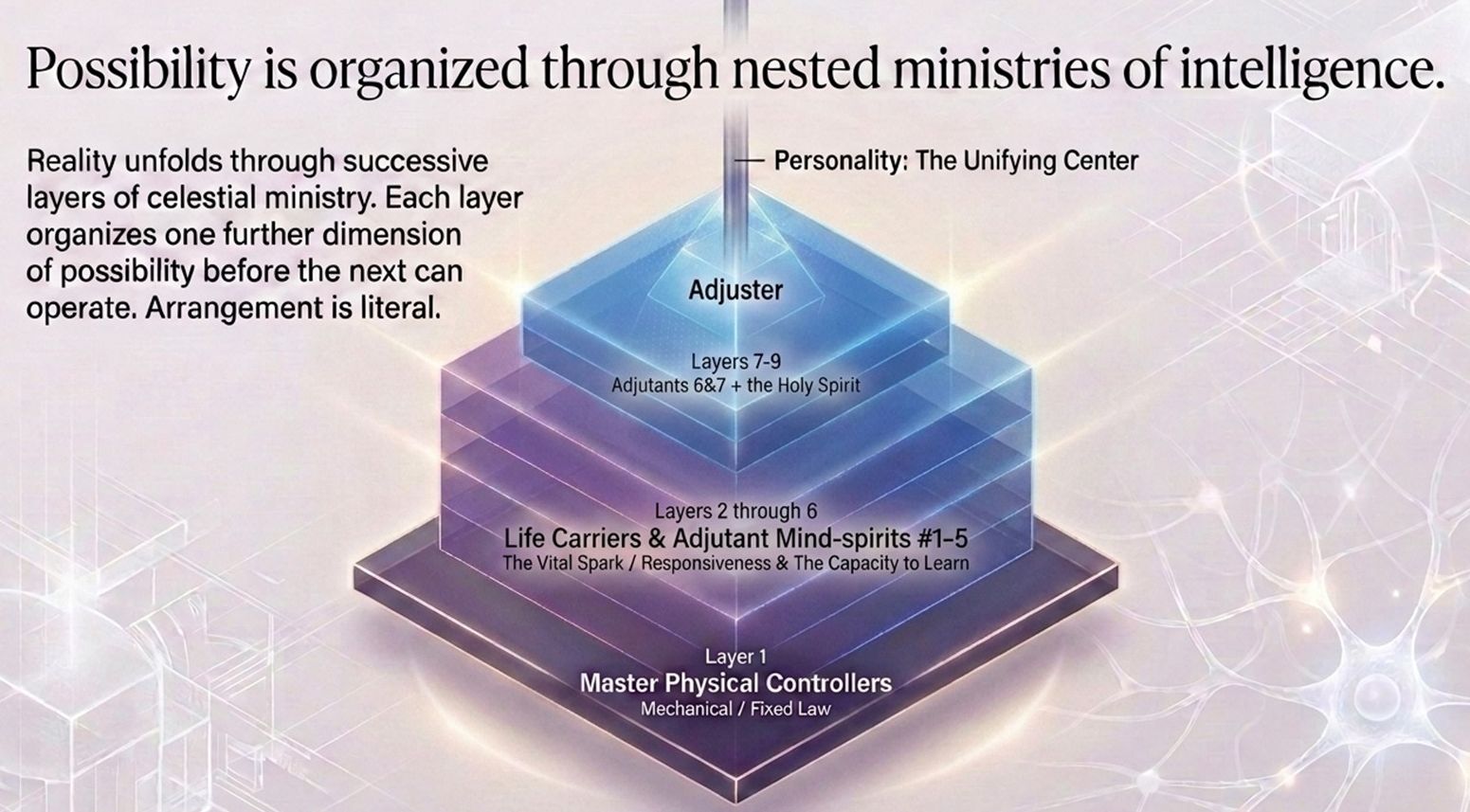
It is worth returning, once more, to the specific image this essay opened its discussion of Levin's paper with: cells, or numbers standing in for cells, finding their way into correct arrangement along a single axis — Levin's own illustration explicitly likens this to the anterior-posterior ordering of organs in a developing tadpole. Arrangement is not a metaphor here; it is the literal biological event under discussion in both registers — the revelation's account of organisms progressively enlarging their competency to arrange themselves correctly (instinct, understanding, courage, knowledge, counsel, worship, wisdom, each adding a further degree of adaptive flexibility to that arranging), and Levin's demonstration that even a deterministic array of integers, given nothing but local relationships to its neighbors, can arrange itself around an obstacle no individual element was built to anticipate. Both, in their own idiom, are studies in what this essay has called organization without blueprint — the discovery that correct arrangement can emerge from relationship itself, without any component needing to hold the whole plan in view.
None of this is offered as proof, and it should not be mistaken for one. Levin does not invoke adjutant spirits; Sheldrake does not either; and nothing in this essay should be read as claiming that either scientist would recognize, much less endorse, the cosmology being laid alongside their work here. What is being offered is a conjecture, and and one this essay pursues: that when today's most careful biologists find themselves needing new vocabulary (Platonic space, morphogenetic fields, distributed competency, basal cognition) to describe what they are observing in cells and sorting arrays, they may be circling, from the outside and in small increments, a ministry the revelation describes as already fully organized: an ascending series of mind-endowments, each making possible a form of adaptive arrangement that the layer beneath it could not achieve alone.
If such is the case, the frontier of biology and the oldest claims of the revelation are not in competition. They are, at best, two very different vantage points on the same unfolding ladder. Both measured respectively: one in swap-steps and sortedness values, the other in the ministry of mind, and as the revelation puts it, progressing from the mechanical to the living to the truly experiencing. And all of this in the fullness of time, with an eye to the teleology of the spiritual and oneness with Deity.
Epilogue: Beyond Organization
Every worthwhile inquiry eventually reaches a point where the answers it uncovers give rise to better questions. This essay began by asking whether life is better understood as a collection of parts or as an organization of relationships. Along the way it considered morphogenetic fields, developmental biology, basal cognition, and the surprising competencies that emerge when simple agents cooperate toward shared ends. Yet beneath each of these discussions lay a quieter pattern that deserves a final glance before we close.
Perhaps the deepest story is not simply that organization gives rise to new possibilities. It is that, throughout the history of life, new kinds of competencies continually appear. Matter possesses capacities unavailable to energy alone. Living cells accomplish what chemistry by itself cannot. Multicellular organisms navigate worlds inaccessible to single cells. Human beings, in turn, inhabit landscapes of meaning, truth, beauty, and moral choice beyond anything available to biological metabolism. At every step, the horizon of what can be perceived, coordinated, and achieved expands.
How does such an expansion occur?
It occurs well beyond just accumulating more matter. And not simply by increasing complexity. Something changes fundamentally in the way a system engages its world. Each new level seems capable of recognizing relationships, solving problems, and pursuing possibilities that literally did not exist with the level below. Michael Levin describes this progression as an expansion of a system's "cognitive light cone." This is its capacity to sense, predict, and influence an increasingly larger domain of reality. Whether one accepts Levin's broader framework or not, the pattern itself is difficult to ignore. Evolution does not merely produce more complicated structures; it produces broader competencies.
Readers of The Urantia Book may recognize a strikingly similar pattern. The revelation consistently portrays reality as unfolding through successive layers of mind, each enlarging the range of possible action without abolishing what came before. The lower levels are not discarded when higher ones appear. They remain active, continuing their own ministries while providing the foundation upon which new competencies are built. The universe described by the revelation is not one in which yesterday's achievements are replaced, but one in which they are retained, coordinated, and carried forward into richer forms of participation.
If that is so, then perhaps the next frontier is not simply the biology of life but the architecture of mind itself.
For much of modern science, mind has largely been treated as something that appears once nervous systems become sufficiently complex. Levin's work has already begun to soften that boundary, revealing forms of problem-solving and goal-directed behavior in places biology once assumed to be merely mechanical. If competencies continue to appear wherever organization reaches new levels, then perhaps the question is no longer whether mind exists, but how many different forms of mind participate in the long unfolding of life.
That is where this inquiry now leads.
The next essay will explore the revelation's remarkable picture of progressively expanding mind—from the "living mind" associated with life's earliest organization, through creature mind enriched by experience, to the higher ministries that culminate in the emerging morontia soul. These are presented not as competing explanations, nor as replacements for one another, but as nested forms of participation, each enlarging the possibilities available to those that follow.
If this essay has argued that organization enlarges possibility, the next will ask a more fundamental question:
What is it that enlarges organization itself?
For that question leads beyond biology alone, toward a universe in which the expansion of life is inseparable from the expansion of mind.
// Bob Debold July 2026.