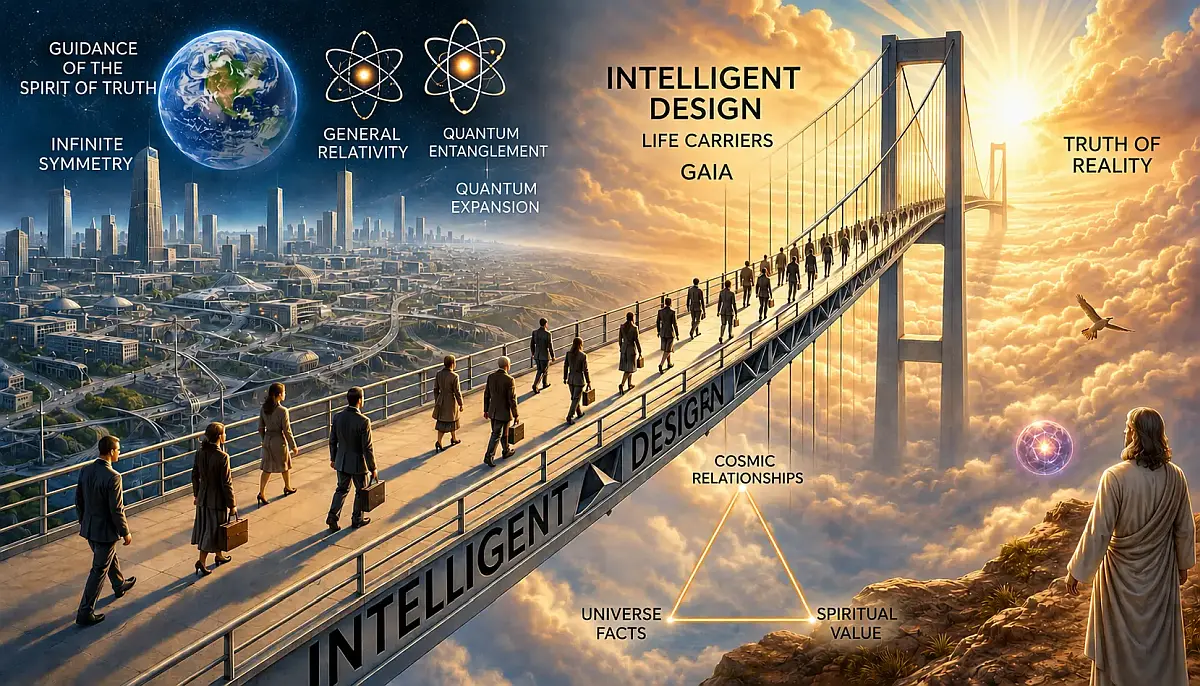
The COSAR Concept as The Truth of Reality
JJ Johnson’s concept of COSAR—the coordination of science and religion—captures a central function of revelation described in The Urantia Book: not to replace science or religion, but to coordinate both with the truth of reality. This essay explores that principle through two enduring philosophical tensions: dualism versus monism and materialism versus idealism.

The Architecture of Illusion; The Psychology of Delusion
This essay explores the distinction between illusion and delusion not merely as psychological conditions, but as civilizational dynamics that shape cultures, institutions, ideologies, and religious movements. While illusions may arise naturally from the limitations of human perception, delusions emerge when those distortions become collectively reinforced, emotionally defended, and socially institutionalized.

How Jesus Meditated
The late Peter Holley has left us with an essay that provides some profound analysis for thinking through these deep spiritual and cosmic concepts. It is entitled Meditation in The Urantia Book - Jesus Style and was published in the Herald magazine in the Fall 2004 edition. I will point out three themes Peter analyzes. First, the term meditation used in the Urantia Book is very different from the conventional late 20th century usage as an altered state of consciousness; it is rather meant as close or continued thought - specifically, thought devoted to religious (or cosmic) subjects. Secondly, the Thought Adjuster dwells and interacts within "the thinking centers of the individual's mind” 34:5.6 (379.6). And third, Peter makes the important distinction that meditation Jesus-style is active not passive. He explains with authoritative references why emptying the mind for passive meditation can even be dangerous to one’s material and mindal health if not one’s spiritual development.

Review of Dr. Sioux Oliva's Book Regarding Dr. William Sadler
This review examines Sioux Oliva’s book Dr. Sadler and The Urantia Book: The Historic Origins of a Spiritual Revelation in the 20th Century, assessing both its contribution to the historical record and its controversial interpretation of William S. Sadler’s role in the emergence of The Urantia Book. Dr. Oliva’s research illuminates the remarkable human story of William and Lena Sadler and their decades of involvement with the Urantia Papers.

Holonic Systems Management: Organizations as Living Systems
How can organizations preserve coordination without sacrificing the autonomy and intelligence of the people within them? This essay develops a holonic model of management in which individuals and organizational units function simultaneously as self-directed wholes and cooperative parts of larger systems. Drawing on cybernetics, complex adaptive systems, and living-system principles, it proposes an alternative to rigid command-and-control management built around feedback, learning, cooperation, and adaptability.

MMT—Not Just a Theory, But the Reality Few Recognize
Modern Monetary Theory turns familiar ideas about taxes, deficits, government debt, and federal spending upside down by asking how a sovereign fiat currency actually operates. This essay explains MMT in practical terms, showing why federal deficits create private-sector financial assets, why bank credit differs from government-created money, and why the real constraint on federal spending is resources and inflation rather than the government's ability to obtain dollars.